What does the Human Skeletal System NEET 2026 question ask?
A correct combination must include every true statement and no false one. This Human Skeletal System NEET 2026 question is a medium-difficulty, single-correct MCQ. The question bank sets a target time of 60 seconds, not a compulsory time limit.
Assess these five claims about the human endoskeleton, then choose the complete correct set:
- A: The human skull has only one condyle for articulation with the vertebral column.
- B: The connection between each neighbouring pair of vertebrae is classified as cartilaginous.
- C: Humans possess seven cervical vertebrae.
- D: Human ribs are bicephalic except for the final two pairs.
- E: The skull’s occipital bone articulates with the atlas vertebra.
Choose from:
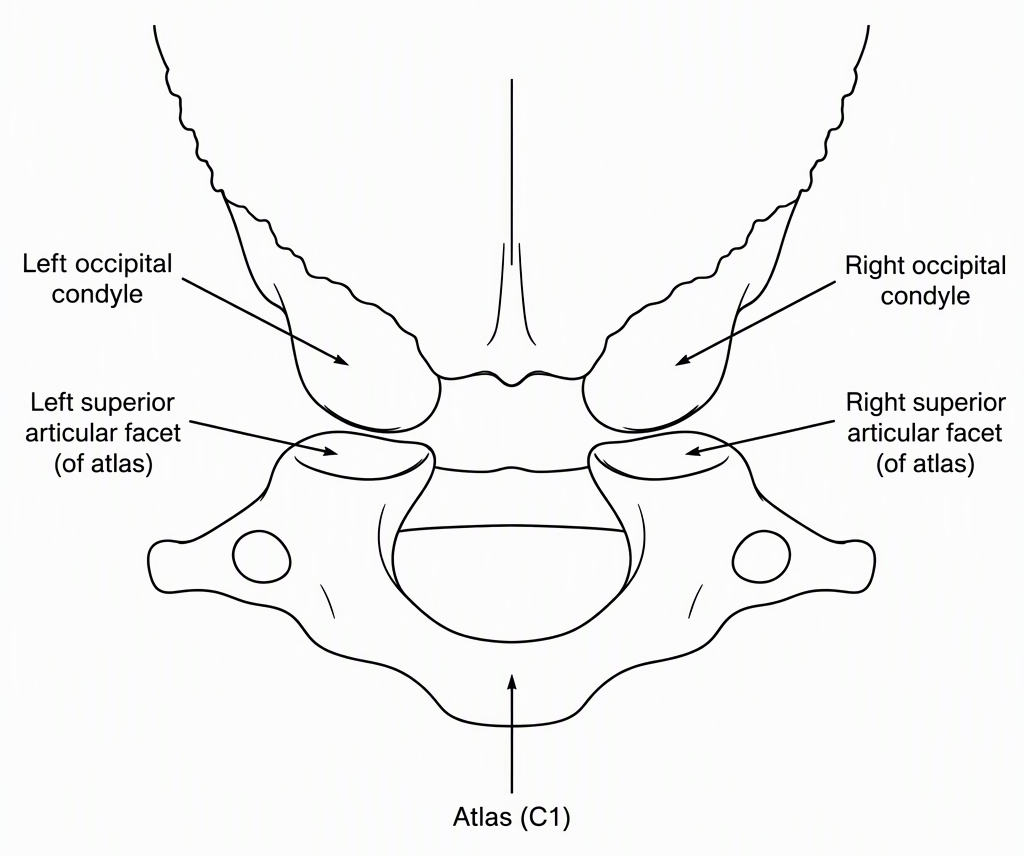
The skull rests on the atlas through its occipital region. Assess the claims before reading the solution.
Are statements A and B correct about the skull and vertebral joints?
A is false; B is accepted as true in the supplied solution. A tests the number of skull condyles; B tests the cartilaginous connection between neighbouring vertebral bodies. Assess each statement before looking for a matching option.
Step 1, statement A: The human skull is dicondylic, not monocondylic. Two occipital condyles articulate with the atlas at the top of the vertebral column.
Counting condyles is not the same as counting bones. One occipital bone bears two occipital condyles, so a single occipital bone does not make the skull monocondylic.
Step 2, statement B: The supplied solution accepts the connection between adjacent vertebrae as cartilaginous. This connection lies between adjacent vertebral bodies, through the intervertebral discs. The verdict does not mean that every articulation involving vertebrae is cartilaginous.
Running verdict: A false; B true.
Are statements C, D and E correct about cervical vertebrae, ribs and the atlas?
C and E are true; D is false under the supplied solution’s framing. Humans have seven cervical vertebrae, and the occipital bone articulates with the atlas. For D, keep the supplied meaning of bicephalic separate from rib classification by attachment to the sternum.
Step 3, statement C: Humans have seven cervical vertebrae. The atlas is the first cervical vertebra and is included in that total, not counted separately.
Step 4, statement D: The supplied solution describes all human ribs as bicephalic, meaning that they have two articulation surfaces at the dorsal end. Within that explanation, excluding the last two pairs makes D incorrect.
This is the supplied solution’s exam terminology, not an exhaustive clinical-anatomy description of every rib. Dorsal articulation and anterior attachment are separate features: the last two rib pairs lack attachment to the sternum, but that fact does not establish D under this key.
Step 5, statement E: The occipital bone articulates with the atlas through the occipital condyles, forming the atlanto-occipital joint. E is therefore correct.
A can be false while E is true. The skull does articulate with the atlas, but the claim that it does so through only one condyle is false.
Which option matches B, C and E only?
B, C and E only matches option (2), labelled B in the question-bank option list. The completed verdict sequence is: A false; B true; C true; D false; E true.
Statement B is the vertebral-joint claim. Answer-option B labels numbered option (2). Do not confuse a statement’s letter with the selected option’s label.
Why could stopping early produce the wrong option (1)?
Confirming B and E is insufficient because C is also true. One possible wrong-answer pathway is to recognise the vertebral connection and skull–atlas articulation, notice option (1), and stop checking. That is premature option matching, not evidence of weak memory.
Humans have seven cervical vertebrae, so B and E form an incomplete set. A valid combination must contain every true statement and no false statement.
If the marking scheme awards four marks for a correct answer and deducts one mark for an incorrect answer, selecting option (2) earns four marks; selecting option (1) loses one mark. Under that scheme, the score difference is:
Mark all five statements true or false before comparing any answer combination. Finish the anatomy check first; match the option second.
Can you solve three related skeletal-system questions?
Check whether you can distinguish bone count, condyle count and vertebral identity. These are original related practice questions, not additional verified PYQs. Cover each answer until you have assigned your own verdict.
Does one occipital bone make the human skull monocondylic?
Answer: No. Dicondylic refers to the skull’s two occipital condyles, not the number of occipital bones. Both condyles belong to the same occipital bone, so “one bone” and “two condyles” are compatible facts.
Which vertebra meets the occipital condyles, and how many cervical vertebrae are there?
Answer: The atlas, the first cervical vertebra; seven cervical vertebrae in total. The occipital condyles articulate with the atlas to form the atlanto-occipital joint. The atlas is part of the cervical count, not an extra vertebra outside it.
Which assertion is correct: seven cervical vertebrae or a monocondylic skull?
Answer: Only the cervical-count assertion is correct. Humans have seven cervical vertebrae, making the first assertion true. The skull is dicondylic because it has two occipital condyles, making the second assertion false.
For your next combination MCQ, use this order: identify the anatomical structure, define the tested term, assign a verdict, then match the complete set.
Next step: photograph a doubt on NEET JEEnius AI and photograph any question you are stuck on and get a step-by-step solution across Physics, Chemistry and Biology (20 free a month).
Keep going with Redox Reactions and Electrochemistry NEET 2002: NaCl Cathodes.
Frequently asked questions
What is the correct answer to this human skeletal system MCQ?
Option (2), B, C and E only, is correct under the supplied solution. The verdicts are A false, B true, C true, D false and E true. Option (1) is incomplete because it omits the true statement C.
Is the human skull monocondylic or dicondylic?
The human skull is dicondylic because it has two occipital condyles. Both belong to one occipital bone and articulate with the atlas, forming the atlanto-occipital joint.
How many cervical vertebrae do humans have, including the atlas?
Humans have seven cervical vertebrae in total. The atlas is the first cervical vertebra and is included in that count, not added separately.
Are the joints between adjacent vertebrae cartilaginous?
The supplied solution accepts this statement as true for the connections between adjacent vertebral bodies through intervertebral discs. It does not mean that every articulation involving vertebrae is cartilaginous.
Why is the statement about the last two rib pairs marked false?
The supplied solution describes all human ribs as bicephalic, meaning they have two articulation surfaces at the dorsal end, so it rejects the stated exception. This is the solution’s exam terminology, not an exhaustive clinical-anatomy description of every rib. The last two pairs lack attachment to the sternum, but anterior attachment and dorsal articulation are separate features.