What is the answer to the NEET 2002 aqueous NaCl cathode question?
Correct answer: B, hydrogen evolution requires a greater overvoltage on Hg than on Pt. This supplied redox reactions and electrochemistry NEET 2002 Chemistry PYQ tests why changing the cathode changes the product. The question bank classifies it as hard, a difficulty tag, not a measured student error rate.
The electrolyte is aqueous NaCl. A platinum cathode releases hydrogen, while a mercury cathode gives sodium amalgam. Which explanation accounts for this difference?
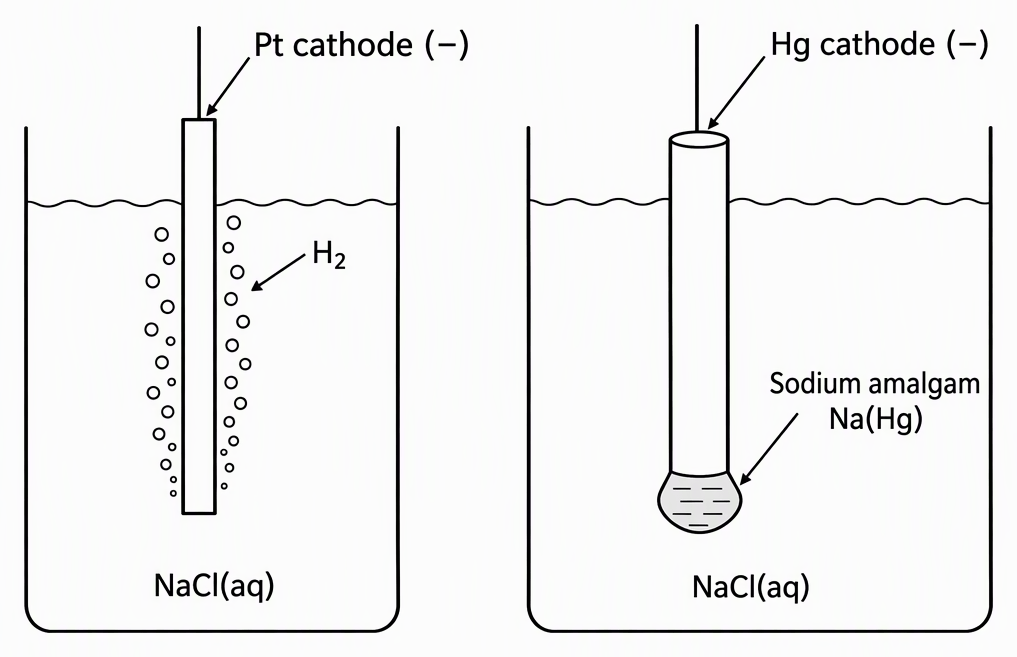
Choose the explanation for the changed cathode process, not merely a statement about the final product.
Why does the platinum cathode release hydrogen?
Hydrogen ions or water are reduced readily at platinum in the stated comparison, so hydrogen forms rather than sodium metal. This is a conceptual worked solution: no numerical electrode potentials or voltage calculation are needed.
Step 1: Identify where reduction occurs. The cathode is the electrode where species gain electrons. Aqueous sodium chloride supplies sodium ions and water as relevant participants in the cathodic processes.
Step 2: Write hydrogen evolution at platinum. For the aqueous solution, the balanced half-equation is:
Check it explicitly: there are four hydrogen atoms and two oxygen atoms on each side. Total charge is negative two on each side.
The option’s reference to hydrogen-ion reduction means hydrogen evolution. It does not establish that the sodium chloride solution is strongly acidic; the water-based equation expresses the process here.
Why does the mercury cathode form sodium amalgam instead?
Mercury has a higher hydrogen overvoltage than platinum, so hydrogen evolution is hindered at its surface. Following the supplied solution, sodium ions are reduced under the stated electrolysis conditions, and the sodium formed enters the mercury.
Step 3: Define hydrogen overvoltage. It is the extra cathodic potential beyond the equilibrium requirement needed to sustain hydrogen evolution at a specified rate. This extra driving requirement is greater on mercury than on platinum.
Here, “more voltage” means a greater cathodic driving requirement. It does not mean a more positive reduction potential.
Step 4: Identify the competing reduction. With hydrogen evolution hindered on mercury, sodium ions are reduced under the conditions stated in the question.
Step 5: Identify where the sodium goes. The sodium dissolves in mercury, forming sodium amalgam rather than a separately collected piece of sodium metal. The net cathode shorthand is:
The product notation means sodium incorporated into mercury; mercury is the host phase. One sodium ion gains one electron.
The causal chain is: mercury surface → high hydrogen overvoltage → suppressed hydrogen evolution → sodium reduction and amalgam formation. That chain supports option B.
Why does option C not answer this question?
Option C describes sodium entering mercury, but it does not supply the hydrogen-overvoltage explanation required by this MCQ. Sodium dissolution is chemically relevant. The mistake is matching a true statement to the product instead of explaining why hydrogen evolution is displaced at the cathode.
A reader may notice “sodium amalgam” and select “sodium dissolves in mercury.” That explains where the sodium goes, not why hydrogen evolution is hindered.
- B answers: Why does hydrogen evolution require greater cathodic driving on mercury?
- C answers: How is the sodium formed incorporated into mercury?
- A fails: A general claim about inertness does not explain the electrode-dependent hydrogen-evolution requirement.
- D fails: The question supplies no increase in hydrogen-ion concentration when mercury is replaced by platinum.
For the supplied 60-second target, use this check:
- Identify what changed: the cathode material.
- Recall the comparison: hydrogen overvoltage is higher on mercury.
- Select the causal explanation: B.
How do you solve three related electrolysis questions?
Use electrolyte composition to identify available species, then consider the electrode’s effect on hydrogen evolution. These are original related practice questions, not additional authenticated PYQs.
What forms at a suitable inert cathode during electrolysis of molten NaCl?
Sodium forms. Molten sodium chloride has no water competing to produce hydrogen, unlike the aqueous electrolyte in the supplied question.
What is the cathode half-equation at Pt in aqueous NaCl, and what is reduced?
Water is reduced, and its hydrogen changes from oxidation state positive one to zero. The cathode half-equation is:
For a worked numerical check, suppose 2 mol of electrons are used entirely for this reaction. The equation requires two moles of electrons per mole of hydrogen gas:
Does higher hydrogen overvoltage require more or less extra cathodic driving potential?
More, at a fixed hydrogen-evolution rate under otherwise comparable conditions. Mercury therefore requires greater extra cathodic driving than platinum for that rate.
Before selecting an electrolysis answer, separate these two checks: electrolyte composition determines which species are available, while electrode-dependent hydrogen overvoltage helps explain the different products in the supplied aqueous-NaCl question.
Next step: the past-paper archive on NEET JEEnius AI and search past NEET papers by year, subject or chapter, each with a worked solution (100 free searches a month).
For a worked example of the same idea, see Experimental Skills NEET 2026: Optical Bench Index Correction.
Frequently asked questions
What is the answer to the NEET 2002 aqueous NaCl cathode question?
The correct answer is B: hydrogen evolution requires greater overvoltage on mercury than on platinum. This hinders hydrogen evolution at mercury, allowing sodium reduction and sodium amalgam formation under the stated conditions.
Why does a platinum cathode produce hydrogen in aqueous NaCl?
Water is reduced readily at platinum in the stated comparison, producing hydrogen rather than sodium metal. The balanced cathode half-equation is 2H₂O + 2e⁻ → H₂ + 2OH⁻.
What does higher hydrogen overvoltage mean?
Higher hydrogen overvoltage means a greater extra cathodic driving potential beyond the equilibrium requirement is needed to sustain hydrogen evolution at a specified rate. Mercury has a higher hydrogen overvoltage than platinum. This does not mean a more positive reduction potential.
Why is option C wrong in the aqueous NaCl mercury cathode question?
Option C states that sodium dissolves in mercury, which explains how sodium amalgam forms. It does not explain why hydrogen evolution is hindered at mercury. Option B supplies the hydrogen-overvoltage explanation required by the question.
What forms at the cathode during electrolysis of molten NaCl?
Sodium forms at a suitable inert cathode through Na⁺ + e⁻ → Na. Unlike aqueous NaCl, molten NaCl contains no water competing to produce hydrogen.