What is the current amplitude in this NEET 2026 series LCR circuit?
The peak current is 2.2 A, option A, in this NEET 2026 series LCR question. An AC source drives one resistor, one inductor and one capacitor connected in a single series loop, so the same current passes through all three components. The required quantity is current amplitude, meaning peak current rather than RMS current.
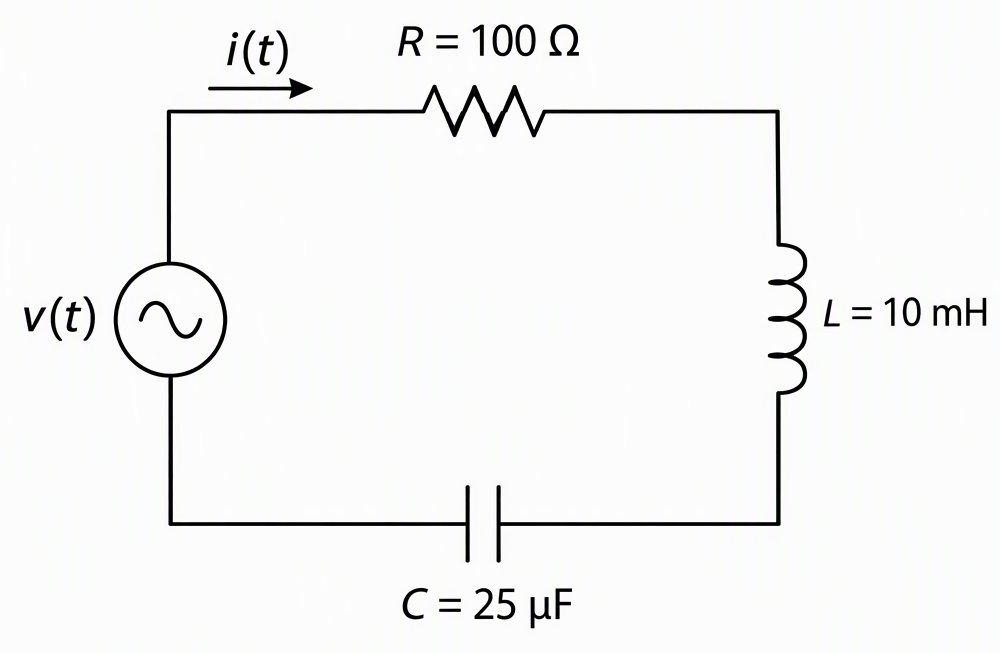
The applied source voltage is:
Find the amplitude of the current flowing through this circuit.
Source: NEET UG 2026, held on 21 June 2026, Code-50, Physics. The question bank classifies this as medium difficulty, not an official exam rating.
How do you read the waveform and calculate both reactances?
Divide peak voltage by impedance, calculating both reactances before replacing impedance with resistance. The official solution starts with:
The current amplitude and voltage amplitude in these equations are both peak quantities. No RMS conversion is needed.
Step 1: Read the waveform. Compare the given expression with the standard sinusoidal form:
The coefficient 2000 is angular frequency, not frequency in hertz. Use it directly in the reactance formulas; do not multiply it by another factor of two pi.
Step 2: Convert inductance and calculate inductive reactance. Convert millihenry to henry before substitution:
Step 3: Convert capacitance and calculate capacitive reactance. Keep the entire product in the denominator:
Inductive and capacitive reactances subtract in the impedance expression. They do not add like ordinary resistances because their voltage contributions have opposite phases relative to current.
Why is the answer 2.2 A, and why is the power factor unity?
Equal inductive and capacitive reactances make the net reactance zero, leaving an impedance of 100 ohms. Dividing peak voltage by this impedance gives option A. Unity power factor is a useful extension, not a quantity requested by the original MCQ.
Step 4: Calculate impedance.
Step 5: Calculate current amplitude.
Check resonance independently by calculating the natural angular frequency. It matches the source angular frequency:
At resonance, only the net reactance vanishes. The inductor and capacitor still each have a reactance of 20 ohms; neither individual reactance becomes zero.
For the power-factor extension, divide resistance by impedance. Their equality gives:
Source voltage and current are therefore in phase. The original question asks for amplitude, so use the given 220 V directly. Do not divide it by the square root of two when calculating peak current.
How can taking the resistance as 10 ohms produce option D?
A possible error path is to recognise resonance correctly, then mistakenly replace the given 100-ohm resistance with 10 ohms. That calculation produces option D:
Resonance permits replacing impedance with resistance. It does not permit changing the numerical value or unit of that resistance.
The impedance cannot be smaller than the resistance. Use this bound to check every option:
The bound rules out all three wrong options. The calculated equality of the two reactances establishes that the circuit actually reaches the bound. Use this as verification, not as a replacement for the worked method.
How do you solve related RMS-current, power and off-resonance questions?
Use RMS quantities for average power and peak quantities for current amplitude. Recalculate both reactances whenever angular frequency changes. These are original practice variations on the supplied circuit, not additional verified NEET PYQs.
What is the RMS current in the original circuit?
The RMS current is approximately 1.56 A. Divide the sinusoidal current amplitude by the square root of two:
What average power does the original circuit draw?
The circuit draws 242 W of average power. Use RMS voltage and RMS current with the unity power factor already established:
Multiplying the two peak values directly gives 484 W, twice the correct average power. At unity power factor, instantaneous power follows a squared sine, whose average over a cycle is one-half.
What are the current amplitude and power factor at 1000 radians per second?
Keeping the same components and 220 V peak source, current amplitude becomes approximately 2.11 A and power factor becomes 0.958. Calculate the new reactances before finding impedance:
Capacitive reactance now exceeds inductive reactance, so current leads source voltage. Redo this variation without looking: calculate both reactances, subtract them, then find impedance before dividing the peak voltage.
Next step: the past-paper archive on NEET JEEnius AI and search past NEET papers by year, subject or chapter, each with a worked solution (100 free searches a month).
Keep going with How to Study Periodic Table NEET: 7 NCERT Steps.
Frequently asked questions
What is the current amplitude in the NEET 2026 LCR circuit question?
The current amplitude is 2.2 A, option A. With L = 10 mH, C = 25 μF and angular frequency 2000 rad/s, both reactances equal 20 Ω, so impedance equals the 100 Ω resistance. The source has a peak voltage of 220 V, giving I₀ = 220/100 = 2.2 A.
Why is the power factor unity at resonance in a series LCR circuit?
At resonance, inductive and capacitive reactances cancel, so impedance Z equals resistance R. Therefore, the power factor is cos φ = R/Z = 1, and source voltage and current are in phase. The individual reactances do not become zero.
What is the difference between current amplitude and RMS current?
Current amplitude is the peak value, while RMS current for a sinusoidal waveform is the peak value divided by √2. In the supplied circuit, the peak current is 2.2 A and the RMS current is approximately 1.56 A. Do not convert the given peak voltage to RMS when calculating current amplitude.
What is the average power consumed by the given LCR circuit?
The average power is 242 W. Use P = VᵣₘₛIᵣₘₛ cos φ, with Vᵣₘₛ = 220/√2 V, Iᵣₘₛ = 2.2/√2 A and power factor 1. Multiplying the peak voltage and peak current directly gives 484 W, twice the correct average power.
What happens to current and power factor at 1000 rad/s?
For the same components and 220 V peak source, the current amplitude becomes approximately 2.11 A and the power factor becomes 0.958. Inductive reactance is 10 Ω and capacitive reactance is 40 Ω, giving an impedance of approximately 104.4 Ω. Current leads source voltage because the circuit is net capacitive.