
How should I study the periodic table for NEET in seven steps?
- Memorise locations and exceptions, then derive comparisons. To study the periodic table for NEET, use NCERT’s Classification of Elements and Periodicity in Properties alongside the applicable NEET syllabus. Prioritise electronic configuration, position, periodic properties and named exceptions, not a decorative chart.
Recall element locations and key configurations; use them to reason through property comparisons. Check the applicable syllabus at neet.nta.nic.in rather than treating a coaching checklist as the final boundary.
- Build a location scaffold. Practise the first 20 elements in order, then place the main-group families on a blank periodic table. Include alkali metals, alkaline earth metals, the boron and carbon families, the nitrogen and oxygen families, halogens and noble gases.
The first 20 are a starting exercise, not the complete exam scope. Add other elements as you meet them in NCERT and the syllabus. Learn their locations alongside their chemistry; do not postpone questions until you can recite the entire table.
- Connect configuration to position. For main-group atoms, the highest occupied principal shell gives the period. The outer-shell configuration identifies the group and block. For chlorine:
Its highest occupied shell is the third, so chlorine belongs to period 3. Seven outer-shell electrons place it in group 17; the last electron enters a p subshell, making it a p-block element. Do not apply this main-group shortcut unchanged to transition elements.
- Build a compact trend-and-reason sheet. Atomic radius generally decreases across a period because effective nuclear charge increases while electrons enter the same principal shell. Down a group, added shells and increased shielding generally make atoms larger.
First ionisation enthalpy and electronegativity generally follow the opposite directions. Stronger attraction makes electron removal harder and increases attraction for bonding electrons. These are broad patterns, not universal ranking rules.
- Place exceptions beside their parent trend. For first ionisation enthalpy, record Be/B and N/O. Boron loses a higher-energy p electron more easily than beryllium loses an s electron; oxygen’s paired p electron is easier to remove than an electron from nitrogen’s half-filled p subshell.
For electron gain enthalpy, record F/Cl and O/S: compact fluorine and oxygen orbitals cause greater repulsion for an incoming electron. Chlorine and sulfur therefore have more negative first electron gain enthalpies than their lighter partners. More negative means greater energy release, not a numerically larger value. This property does not follow a perfectly smooth trend.
- Read NCERT actively. After each property, close the book and reproduce its definition, broad trend and exception. Then check the original explanation.
First ionisation enthalpy concerns removing an electron from an isolated gaseous atom; first electron gain enthalpy concerns adding one. Electronegativity concerns attraction for shared electrons in a bond.
- Use one checklist for every ordering MCQ. Identify the property and requested direction, inspect charge and configuration, select the comparison rule, check exceptions, then match the option.
Apply this override before neutral-atom arrows: for an isoelectronic series, count electrons and compare nuclear charge. At equal electron counts, higher nuclear charge means smaller radius.
How do I order isoelectronic ions by radius?
Count electrons first: all four ions below have ten electrons, so increasing nuclear charge makes their radii smaller. Option A is correct. The charge signs determine which comparison rule applies.
Original practice MCQ: Which is the correct order of decreasing ionic radius for these ions?
- A.
- B.
- C.
- D.
The property is ionic radius, and the requested direction is decreasing. Negative ions have gained electrons; positive ions have lost them:
With the same electron count, stronger nuclear attraction contracts the electron cloud. Compare nuclear charges:
Oxygen’s ion is therefore largest, and magnesium’s ion is smallest: option A. The neutral-atom ordering of oxygen, fluorine, sodium and magnesium is not the question being asked.
Option D gets the anions right but reverses the two cations, despite magnesium having the larger nuclear charge. Same electron count? Higher nuclear charge means smaller radius.
How do I handle both first-ionisation-enthalpy exceptions in one question?
Apply the broad across-period rise, then correct both local reversals: boron lies below beryllium, and oxygen lies below nitrogen. The correct increasing order in this example is option A.
Original practice MCQ: Which is the correct increasing order of first ionisation enthalpy for B, Be, C, N and O?
- A.
- B.
- C.
- D.
Apply the checklist: these are neutral period-2 atoms; the property is first ionisation enthalpy; the direction is increasing. Start with the broad trend, then inspect orbital occupancy.
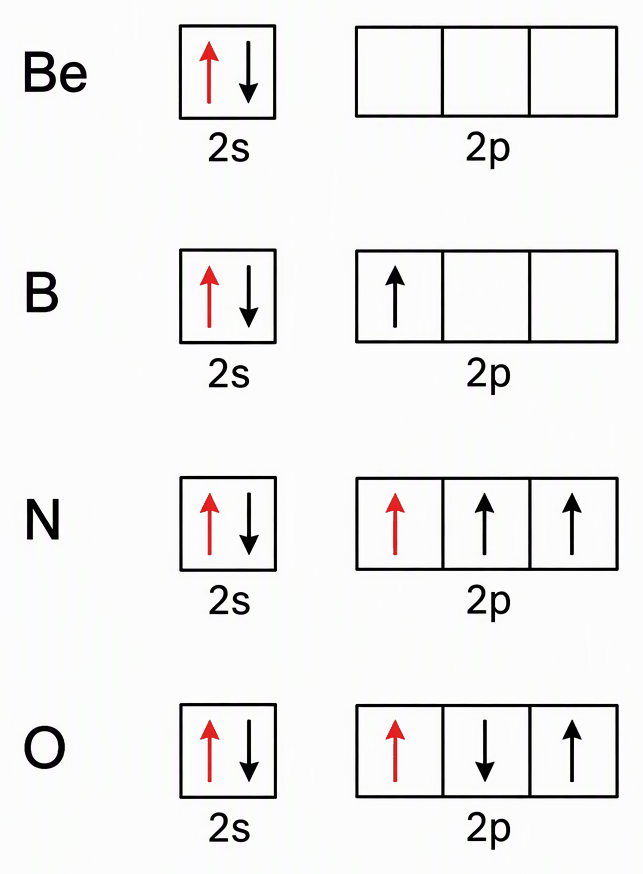
Boron loses a higher-energy, less penetrating 2p electron. Removal is easier than removing beryllium’s 2s electron, so boron has lower first ionisation enthalpy.
Oxygen has a paired 2p electron whose repulsion makes removal easier. Nitrogen has the half-filled 2p arrangement, so oxygen has lower first ionisation enthalpy.
Option A is correct. C remembers only Be/B; D remembers only N/O. “Increases across a period” is a broad trend, not permission to ignore subshell occupancy or electron pairing.
Why does chlorine have more negative electron gain enthalpy than fluorine?
Chlorine releases more energy on gaining its first electron because its larger 3p region creates less electron–electron repulsion for the incoming electron than fluorine’s compact 2p region. Its electron gain enthalpy is therefore more negative.
Original practice MCQ: For F and Cl, which statement about first electron gain enthalpy is correct?
- A. F has the more negative value because it is smaller.
- B. Cl has the more negative value because the incoming electron experiences less repulsion in its larger 3p region.
- C. Both values must be positive.
- D. F and Cl have equal values because they belong to the same group.
Apply the checklist: an electron is added to an isolated gaseous atom. This is neither electron removal nor attraction for a shared pair in a bond. Check the F/Cl exception: lower repulsion in chlorine makes option B correct.
Chlorine’s value is more negative, so electron addition releases more energy; it is numerically smaller, not larger. Fluorine remains more electronegative than chlorine.
Use O/S as the related NCERT recall check: sulfur has more negative first electron gain enthalpy than oxygen. Attach the same compact-orbital repulsion explanation to this pair.
What should I practise after learning periodic trends?
Start with closed-book retrieval: fill a blank table with the location scaffold studied, reconstruct your trend-and-reason sheet and explain all four exception pairs before checking NCERT. Choose single-rule questions before mixed orders because they isolate recall, rule-selection and sign errors.
Use this practice order rather than random MCQs:
- Configuration-to-position questions.
- Neutral atomic-radius comparisons.
- Ionic and isoelectronic comparisons.
- First ionisation enthalpy.
- Electron gain enthalpy.
- Mixed statement and ordering questions.
After each worked example, cover the solution and reproduce the reasoning. Change increasing to decreasing, or the reverse, and rewrite the answer. For the statement MCQ, convert the explanation into both signed orders.
Use four error-log labels:
- Location/configuration error: correct the placement or electron arrangement.
- Wrong comparison rule: name the rule that applies.
- Missed exception: write its orbital or repulsion explanation.
- Reversed direction/sign: rewrite the requested order explicitly.
Record the corrected reason, not merely the right option. Try retrieval the next day, later in the week and the following week as a suggested routine, not a compulsory or proven timetable.
Judge readiness without notes: locate the species, name the governing rule, explain an exception and reject a tempting distractor. Use these checks before moving to mixed practice.
NEET JEEnius AI practice mode offers topic sets that skip questions you have already seen, with 60 free sets a month.
When an error repeats, return to the exact NCERT explanation. Do not collect another mnemonic or reread the entire chapter.
Next step: daily practice problems on NEET JEEnius AI and get a fresh set on a topic every day (20 free attempts a month).
For a worked example of the same idea, see Oscillations Practice Questions NEET: 6 Worked MCQs.
Frequently asked questions
Do I need to memorise the entire periodic table for NEET?
Do not wait until you can recite the entire table before attempting questions. Start with the first 20 elements and main-group family locations, then add other elements as you encounter them in NCERT and the applicable NEET syllabus. The first 20 elements are a starting exercise, not the complete exam scope.
Which periodic trend exceptions should I learn for NEET?
Record Be/B and N/O for first ionisation enthalpy: boron is lower than beryllium, and oxygen is lower than nitrogen. For first electron gain enthalpy, learn F/Cl and O/S: chlorine and sulfur have more negative values than fluorine and oxygen, respectively. Learn the subshell, pairing or compact-orbital repulsion explanation beside each exception.
How do I arrange isoelectronic ions in order of radius?
Count electrons first to confirm that the ions are isoelectronic. At equal electron counts, higher nuclear charge means smaller radius. Thus, the decreasing radius order is O²⁻ > F⁻ > Na⁺ > Mg²⁺, since all four ions have ten electrons.
Why is chlorine's electron gain enthalpy more negative than fluorine's?
An incoming electron experiences less electron–electron repulsion in chlorine's larger 3p region than in fluorine's compact 2p region. Chlorine therefore releases more energy on gaining its first electron, giving it a more negative first electron gain enthalpy. More negative means numerically smaller; fluorine remains more electronegative than chlorine.
What should I practise after learning periodic trends?
Start with closed-book recall of element locations, trends and exception explanations. Practise configuration-to-position questions, neutral atomic radii, ionic and isoelectronic radii, first ionisation enthalpy, and electron gain enthalpy before attempting mixed questions. Log each mistake as a location/configuration error, wrong comparison rule, missed exception or reversed direction/sign, and record the corrected reason.