
Should I start Oscillations practice with chapter questions or a full mock?
Start with worked chapter questions if your mistakes are conceptual, not with a full mock. These free Oscillations practice questions for NEET include six original MCQs with worked solutions below. They test ideal free, undamped oscillations, not the entire chapter.
Choose verified NEET previous-year questions when you understand the basic relationships but need practice with exam wording. Choose full mocks to test performance across the syllabus. The comparison below helps you choose; the questions let you check your reasoning first. Access is free, and these original questions are not actual NEET PYQs.
How do worked Oscillations questions, verified PYQs and full mocks compare?
Use worked questions to repair concepts, verified PYQs to practise authentic exam application, and full mocks to test whole-paper performance. Choose by the problem you need to diagnose, not the size of the question bank.
Each comparison below lists the options in this order: this article’s worked set; verified NEET Oscillations PYQs; NEET JEEnius AI full-length mocks.
- Main purpose: Explain SHM reasoning; practise authentic exam wording and application; assess performance across subjects.
- Chapter focus: Oscillations only; Oscillations questions selected from actual papers; whole-syllabus practice with no guaranteed Oscillations question count.
- Feedback available: Worked explanations and misconception checks; solutions depend on the source; a scored per-subject breakdown.
- Whole-paper pacing: Not measured; isolated PYQs do not measure it; a full 180-question, 720-mark paper lasting 180 minutes.
- Best preparation stage: While repairing concepts; after basic relationships make sense; when testing complete-paper performance.
- Limitation: Six questions are neither exhaustive nor evidence of whole-paper readiness; old PYQs need checking against the current syllabus; subject scores do not identify each chapter-level mistake.
- Cost or access: Free to read here; PYQ availability, solutions and cost depend on the source; 30 free full-length mocks a month.
The full-mock distribution is 45 Physics, 45 Chemistry and 90 Biology questions. Use this option for whole-paper pacing, not as a substitute for focused Oscillations practice.
For PYQs, verify the paper and official answer key. Check older questions against the current syllabus at neet.nta.nic.in before practising them.
Which practice format should I choose at my current stage?
Choose from the mistake you can observe, not your class label. A dropper may still need help with restoring forces, while a Class 11 student may be ready for exam-style chapter questions. Use these decisions rather than a fixed score threshold.
- Class 11, SHM just learned: If you cannot explain the negative sign in acceleration, choose worked chapter questions first. Explain how the acceleration changes direction on opposite sides of equilibrium.
- Class 12, derivations understood: If unfamiliar wording or a changed starting phase causes mistakes, attempt this diagnostic set, then use verified PYQs. Before calculating, identify the equilibrium position, initial position and direction of motion.
- Dropper, chapter questions correct in isolation: If errors appear during a complete paper, prioritise full mocks. Afterwards, separate time-pressure errors from concepts that still need focused revision.
- Theory unfinished: Use a question to locate the gap, repair that specific concept, then attempt another question. Do not turn repeated guessing into a practice routine.
For parents, a larger question bank is not automatically the missing ingredient. Ask the student to explain why the chosen option is correct and why a tempting alternative is wrong. Use that explanation to choose the next resource before paying for more questions.
Can I try six free Oscillations practice questions for NEET now?
Attempt the six questions below before reading the solutions, and write a sentence explaining each choice. Each question has four options and exactly one correct answer. Keep your reasoning even when uncertain: use it later to distinguish a sign error from a misunderstood model.
Original NEET-level practice, not previous-year questions.
Assume ideal free, undamped motion throughout. Extra conditions needed for each model are stated in the question.
Question 1: Which force law guarantees SHM?
For a particle of constant positive mass, displacement is measured from equilibrium. Which net force law guarantees SHM about that equilibrium? The coefficient and constant force magnitude below are positive.
Question 2: What is the spring–mass period?
A mass is attached to an ideal horizontal spring on a frictionless surface. The mass and spring constant are defined below. After displacement and release, what is its period?
Question 3: How does changing pendulum length affect period?
A simple pendulum makes small angular oscillations. Its original length and period are given below. Gravitational acceleration remains unchanged when its length is multiplied by the stated positive factor. What is the new period?
Question 4: What is the kinetic energy away from equilibrium?
An ideal spring oscillator has the spring constant, amplitude and displacement defined below. What is its kinetic energy at that displacement?
Question 5: What are the initial velocity and acceleration?
The displacement of a particle follows the equation below. Both amplitude and angular frequency are positive. Choose its velocity and acceleration at the stated initial instant.
Question 6: What does the acceleration–displacement slope tell you?
An acceleration-versus-displacement graph is a straight line through the origin. Its slope is defined below, with a positive slope magnitude. What is the period?
How do I solve these questions and identify the misconception?
Compare your reasoning with each derivation, not just your option with the key. A correct guess does not establish understanding. For each mistake, identify the step where your reasoning differs from the solution. These six questions cannot predict your NEET score or prove chapter mastery.
Answer key: 1 B, 2 C, 3 D, 4 A, 5 C, 6 B.
Why is a restoring force alone not enough for SHM?
Question 1, B: Force must oppose displacement and be directly proportional to it, with a constant positive proportionality magnitude. A cubic restoring force points towards equilibrium but fails the proportionality condition. A constant force does not reverse direction on opposite sides of equilibrium.
The positive linear-force option pushes the particle away from equilibrium. The mistake to repair is confusing “restoring” with “simple harmonic”.
How do I derive the spring–mass period?
Question 2, C: Newton’s second law gives angular frequency; converting it to period requires the full-cycle factor. Do not stop after finding angular frequency or its reciprocal.
Why does pendulum period follow square-root scaling?
Question 3, D: For small angular oscillations, period depends on the square root of length, not length itself. Keeping gravitational acceleration unchanged gives the following scaling.
How do I find kinetic energy from displacement?
Question 4, A: Subtract spring potential energy from constant total mechanical energy. At equilibrium all the oscillator’s energy is kinetic; at either turning point its kinetic energy is zero.
Why is acceleration nonzero when velocity is zero?
Question 5, C: The particle begins at the positive turning point. Its velocity is momentarily zero, but the restoring force and acceleration point towards equilibrium, in the negative direction.
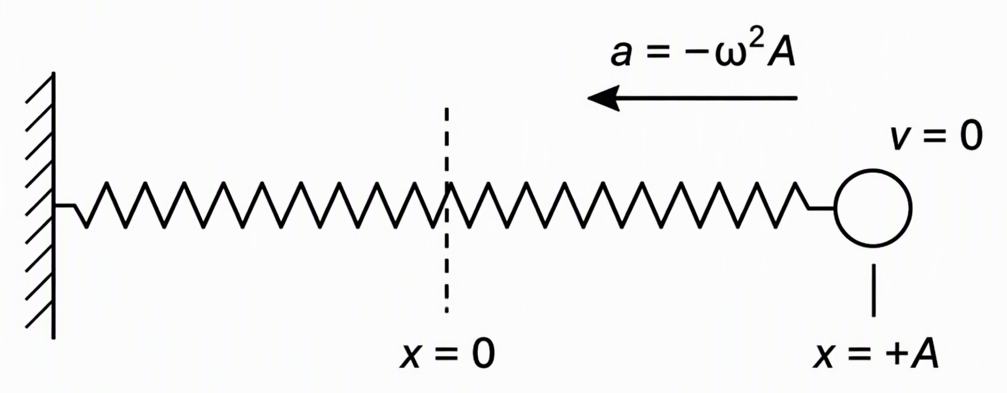
Differentiate displacement once for velocity and twice for acceleration. Evaluate both at the stated initial instant.
How does the graph slope determine the period?
Question 6, B: The acceleration–displacement slope is negative angular frequency squared, not negative angular frequency. Take the square root of its magnitude before calculating the period.
Misconception map:
- Q1: Restoring-force logic: direction alone is insufficient; check proportionality.
- Q2: Period relationships: distinguish period from angular frequency and its reciprocal.
- Q3: Model assumptions: retain small angles and use square-root scaling.
- Q4: Energy bookkeeping: subtract potential energy from total energy; check equilibrium and turning points.
- Q5: Initial phase and signs: zero velocity does not imply zero acceleration.
- Q6: Graph interpretation: slope magnitude gives angular frequency squared.
What should I practise next, and when should I use a full mock?
Stay with focused chapter practice for conceptual mistakes. Move to verified PYQs when unfamiliar phrasing causes trouble despite sound fundamentals. Prioritise full mocks when errors appear mainly under whole-paper conditions, then revisit the concepts missed there.
Use this revision loop:
- Attempt without looking at the solution.
- Record the reasoning error, such as “used angular frequency as period”.
- Revise that specific concept rather than rereading the entire chapter.
- Solve a different question testing the same idea.
- Revisit the original question later without copying the method.
Do not treat chapter-practice time as a rigid per-question NEET allowance. The complete paper has 180 compulsory questions in 180 minutes, but you must allocate time across subjects. Working through a derivation during concept repair serves a different purpose from choosing an answer under exam conditions.
Score mocks using the current scheme below. Separate concept errors from misreading, calculation trouble and rushed selection.
A subject total tells you where to investigate, not automatically what went wrong. Review the reasoning behind missed answers before deciding what to practise next.
If whole-paper performance is now the problem, use NEET JEEnius AI’s 30 free full-length mocks a month and scored per-subject breakdown as the next step, not as an Oscillations question bank. After that mock, choose one missed concept, repair it, and solve a fresh question before taking another paper.
Next step: full-length mock tests on NEET JEEnius AI and sit a full 180-question, 720-mark, 180-minute paper, 45 Physics, 45 Chemistry and 90 Biology, and get a scored per-subject breakdown (30 free a month).
If that step was the hard part, work through Cloning Vectors NEET 2026: pBR322 BamHI Insertion.
Frequently asked questions
Should I practise Oscillations chapter questions or take a full mock?
Start with worked chapter questions if your mistakes involve concepts such as restoring forces, phase or energy. Use verified NEET PYQs when the fundamentals are clear but exam wording causes trouble. Prioritise full mocks when errors appear mainly under whole-paper conditions.
Are these Oscillations questions actual NEET previous-year questions?
No. These are six original NEET-level MCQs with worked solutions, available free in the article. They cover ideal free, undamped oscillations and are neither an exhaustive chapter test nor proof of whole-paper readiness.
Is a restoring force enough to guarantee SHM?
No; the net restoring force must also be directly proportional to displacement from equilibrium. For a constant positive mass, F = -kx with constant k > 0 gives SHM. A cubic restoring force points towards equilibrium but does not satisfy the linear proportionality condition.
How do I find the SHM period from an acceleration-displacement graph?
For SHM, acceleration satisfies a = -ω²x, so the graph's slope is -ω². If the slope is -s with s > 0, then ω = √s and T = 2π/√s. The slope magnitude gives angular frequency squared, not angular frequency.