What is the answer to the magnetic effects NEET 2026 parallel-wire question?
Option B is correct: the minimum height occurs when upward magnetic attraction equals the lower wire’s weight. In this magnetic effects NEET 2026 question, greater heights are also safe because attraction becomes weaker. This is a NEET 2026 Physics question from Magnetic Effects of Current and Magnetism, tagged medium by the question bank, with a bank-listed target solving time of 90 seconds.
Two infinitely long parallel wires carry currents in the same direction. Lower wire A carries current I, has uniform mass per unit length λ, and rests on an insulated floor. Wire B carries twice that current and is fixed directly above A at height h. Find the smallest height that prevents A from lifting.
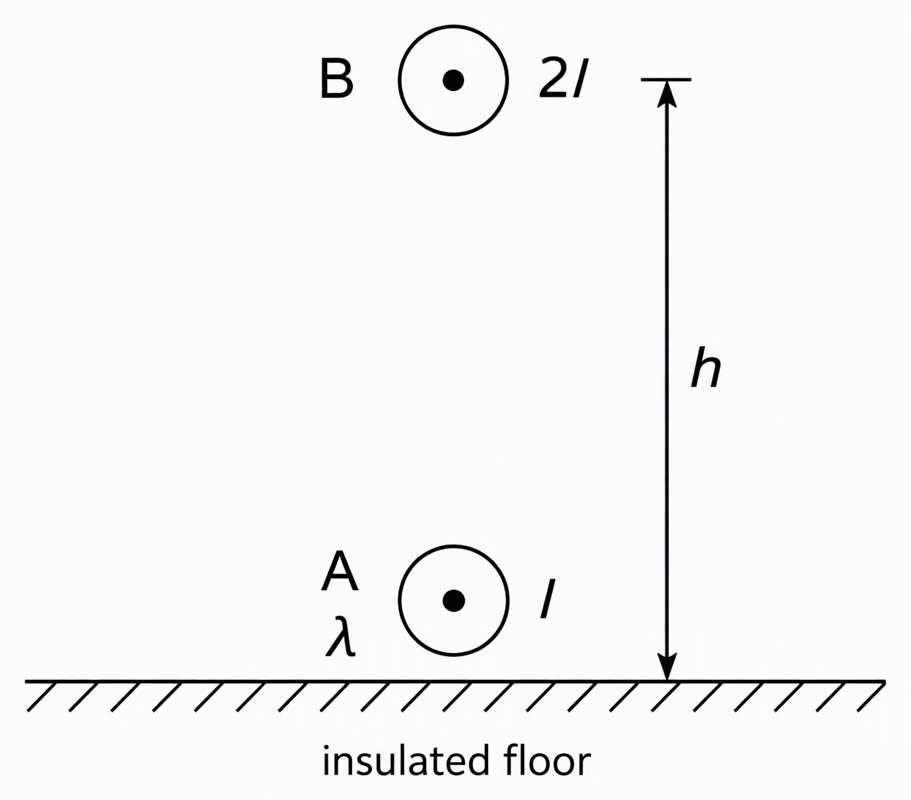
Use these definitions:
The supplied choices are:
- A)
- B)
- C)
- D)
How do you calculate the upward magnetic force per unit length?
Same-direction currents attract, so the magnetic force on lower wire A points upward towards B. Use force per unit length because the wires are infinitely long and the given mass is per unit length. This lets you compare magnetic attraction and weight directly.
Following the official solution, start with the force between long parallel conductors:
The length symbol denotes a representative segment of wire:
Identify the two currents separately, then substitute:
The numerator’s factor of two cancels the denominator’s factor of two. Do not cancel before substituting both currents.
For fixed currents, increasing the separation reduces the attraction. This inverse dependence is why placing B sufficiently high prevents lifting:
Why does the no-lift condition give option B and a minimum height?
Equality marks the threshold of lifting; above it, the floor supports the remaining weight. It is the boundary of allowed heights, not the only height at which A can remain at rest. First obtain that boundary using the official force-per-unit-length method.
For a representative length of A, the mass and weight are:
At the threshold of lifting:
Substitute the magnetic force and solve:
This is option B. To check which heights are allowed, include the floor’s upward normal reaction per unit length:
Vertical balance while A remains on the floor requires:
An ordinary floor can push A upward, but cannot pull it downward. Its normal reaction must therefore be nonnegative:
- Below the minimum: attraction exceeds weight. A would need a downward floor force to stay still, so it lifts.
- At the minimum: attraction equals weight and the normal reaction is zero.
- Above the minimum: attraction is smaller than weight and the floor supplies a positive normal reaction.
The numerator has units of force, while the denominator has units of force per length. Their ratio therefore has units of length:
How does treating the two currents as equal produce option A?
The equal-current shortcut drops a factor of two from the magnetic force. Equating that incorrect force to weight then gives option A. The mistake is in the current substitution, not in the force-balance principle.
The incorrect substitution is:
The actual product is:
Carrying the incorrect product through gives:
Equating that expression to weight per unit length produces:
That is option A, exactly half the correct height. Repair the method by writing both currents separately, substituting their values, and only then cancelling the factor of two.
How do you solve three variations using the same method?
Check the current product, force direction and floor reaction in each variation. These are original practice questions, not additional verified PYQs. Define the original threshold as:
What is the new minimum height if both currents double?
With mass per unit length unchanged, the new minimum height is four times the original threshold. Both currents double, so their product increases fourfold:
Using the same limiting balance:
Stronger attraction requires greater separation to prevent lifting. For an illustrative original threshold of two centimetres:
Can A lift if the current in B is reversed?
No. Opposite currents repel, so B pushes A downward rather than lifting it. Keeping the original current magnitudes, the floor must now support both weight and downward magnetic force:
The normal reaction stays positive. Lifting therefore imposes no positive minimum height for positive separation:
What is the normal reaction when B is at twice the original threshold?
The normal reaction per unit length is half the weight per unit length. With the original same-direction currents:
Vertical balance then gives:
Magnetic attraction supports half the weight; the floor supports the other half. Before substituting numbers in any variation, write the magnetic force direction and the floor-contact balance.
Next step: the past-paper archive on NEET JEEnius AI and search past NEET papers by year, subject or chapter, each with a worked solution (100 free searches a month).
Read next: How to Study Human Physiology NEET: NCERT and Recall.
Frequently asked questions
What is the answer to the NEET 2026 parallel-wire minimum-height question?
Option B is correct: h_min = μ₀I²/(πλg), where λ is the lower wire’s mass per unit length. For same-direction currents I and 2I, the upward magnetic force per unit length is μ₀I²/(πh). Equating this to the weight per unit length, λg, gives the minimum height.
Why is the no-lift height a minimum rather than a maximum?
Magnetic attraction between the wires decreases as their separation increases. At the minimum height, upward attraction equals the lower wire’s weight and the floor reaction is zero. At greater heights, attraction is weaker and the floor supports the remaining weight, so the wire does not lift.
Why is option A wrong in the parallel-wire question?
Option A comes from incorrectly treating both currents as I. The actual currents are I and 2I, so their product is 2I², not I². Missing this factor of two gives a minimum height that is half the correct value.
Can the lower wire lift if the upper wire’s current is reversed?
No. Reversing the upper wire’s current makes the currents opposite, so the wires repel and the magnetic force on the lower wire acts downward. The floor supports both its weight and the downward magnetic force, so lifting imposes no positive minimum separation.