
How should I study Human Physiology for NEET step by step?
For Human Physiology for NEET, reconstructing a pathway without notes exposes gaps that rereading hides. Retrieve the route, predict what changes and check exact NCERT facts before increasing your MCQ count.
- Check what belongs on your checklist. Compare the official syllabus for your attempt year, available through neet.nta.nic.in, with your NCERT edition. Match topics, not just chapter titles. An old playlist or textbook contents page is not proof that a topic is examinable. Build your checklist only after this comparison.
- Follow a connected learning order. For relevant syllabus topics, use: Breathing and Exchange of Gases → Body Fluids and Circulation → Excretory Products and their Elimination → Locomotion and Movement → Neural Control and Coordination → Chemical Coordination and Integration. This is a learning sequence, not a chapter-weightage ranking. Gas exchange connects to blood transport; neural and chemical coordination can then tie systems together.
- Choose one bounded subtopic. Blood flow through the heart is a useful session target; “finish circulation” is too broad. Read that NCERT portion first. Use a targeted explanation only if you cannot explain the mechanism, then return to the text. Do not replace a specific doubt with another full lecture.
- Build a compact, three-part recall sheet. Include a labelled pathway or diagram, a cause → response → effect chain, and an exact-facts box. Put locations, terminology and easily confused statements in that box. Not every fact follows from a mechanism: understanding a hormone’s action does not tell you its site of synthesis.
- Close the book and reconstruct. Redraw the pathway or explain it aloud without looking. Then reopen NCERT and correct missing labels, reversed arrows and imprecise wording. Mark corrections where the failure happened. Copying an open-book diagram does not test whether you can retrieve it during a question.
- Attempt a short single-correct topic set without notes. For every wrong answer and every guessed-right answer, identify the failure: factual recall, sequence, cause-and-effect reasoning or question reading. Record the tested idea, not merely the question number. A correct guess does not establish that you understand the process.
- Repair the failure, then retest after a gap. Relearn the missing fact, rebuild the route or explain the changed variable. Next-day and one-week checks are practical starting points, not scientifically guaranteed intervals or a fixed completion deadline. Shorten the gap if the same error returns.
Class 11 students should build these sheets alongside teaching. Class 12 students and droppers should begin with closed-book recall and MCQs, then relearn only weak portions. Rewatching every lecture is a poor default when the problem may be one reversed arrow.
How do I remember blood flow through the heart?
Learn circulation as a directed route, with oxygenation marked separately. Arteries carry blood away from the heart; veins carry it towards the heart. Oxygen content defines neither vessel. Your recall diagram needs both annotations because confusing them produces different mistakes.
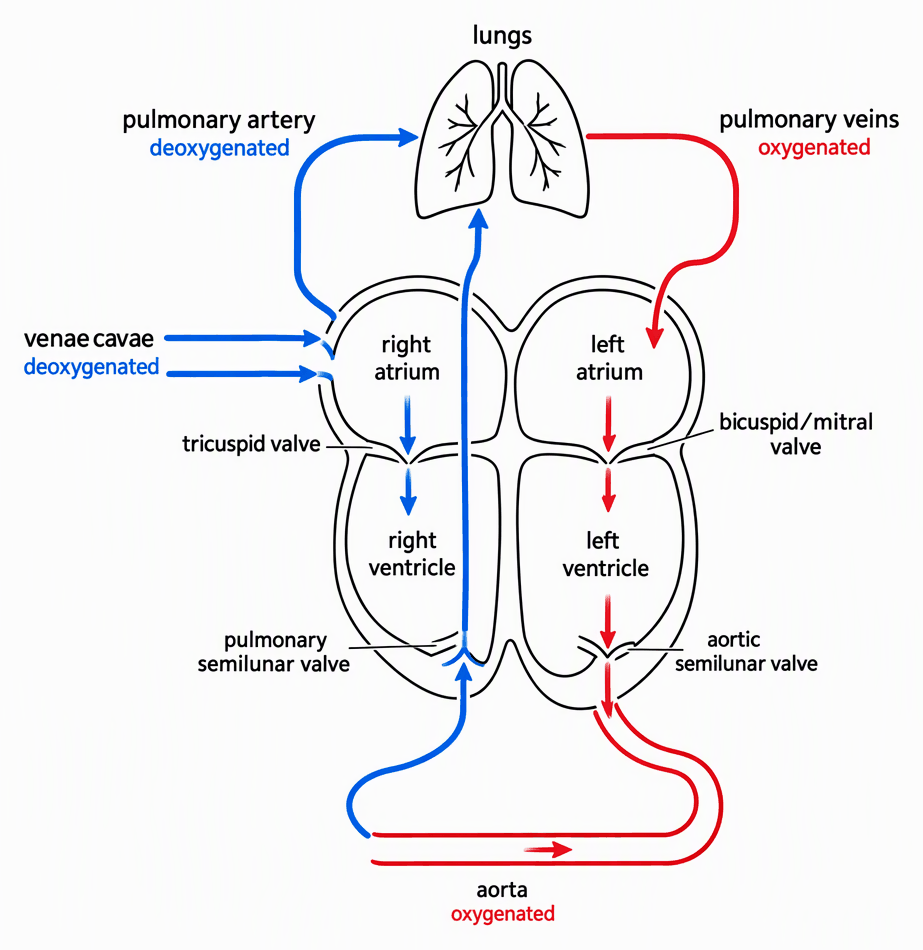
Your compact recall sheet should contain:
- Route: Reproduce the complete labelled pathway above, without looking.
- Cause → response → effect: Ventricular pressure rises above arterial pressure → semilunar valves open → blood enters the pulmonary artery and aorta.
- Exact facts: Pulmonary artery carries deoxygenated blood; pulmonary veins carry oxygenated blood.
Original practice question 1, not a previous-year question: Which vessel carries deoxygenated blood away from the heart in normal adult circulation?
- A. Pulmonary artery
- B. Pulmonary vein
- C. Aorta
- D. Vena cava
Answer: A, pulmonary artery. It carries blood from the right ventricle towards the lungs. The pulmonary vein brings oxygenated blood towards the heart; the aorta carries oxygenated blood away; the vena cava brings deoxygenated blood towards it.
Choosing vena cava calls for redrawing the arrows. Rejecting pulmonary artery because “arteries carry oxygenated blood” calls for correcting the vessel-definition rule.
Closed-book check: Trace blood from the venae cavae to the aorta without reversing a valve or vessel.
How do I predict the effect of ADH on urine?
Follow water back into the blood: increased ADH action increases water reabsorption, leaving less water in urine. Under otherwise unchanged conditions, urine volume falls and concentration rises. Keep this mechanism separate from the exact facts about where ADH is made and released.
Build this recall chain:
- Increased plasma osmolarity → osmoreceptor response → increased ADH release.
- Increased ADH → increased water reabsorption in the later renal tubule and collecting duct.
- More water returns to blood → lower urine volume and more concentrated urine.
Your exact-facts box must distinguish synthesis in the hypothalamus, storage and release by the posterior pituitary, and action at the kidney. These locations answer different questions.
Original practice question 2, not a previous-year question: With other factors unchanged and the kidneys responding normally, increased ADH secretion produces which change?
- A. Lower urine volume with higher concentration
- B. Higher volume with lower concentration
- C. Lower volume with lower concentration
- D. Higher volume with higher concentration
Answer: A. Increased reabsorption removes water from tubular fluid, reducing urine volume while concentrating it. Follow that movement rather than memorising a paired answer.
Reverse-check the mechanism under otherwise unchanged conditions: decreased ADH action produces more dilute urine of greater volume. If volume and concentration get confused, sketch water moving from tubule to blood; if hormone locations get confused, rebuild the synthesis-versus-release comparison.
For another topic-level check, NEET JEEnius AI’s daily practice problems provide a fresh set on a topic every day, with 20 free attempts a month.
What remains unchanged during skeletal muscle contraction?
The A-band length remains unchanged because thick filaments do not shorten. Begin with a labelled sarcomere sketch and identify the Z lines, thin and thick filaments, A band, I band and H zone before attempting the question.
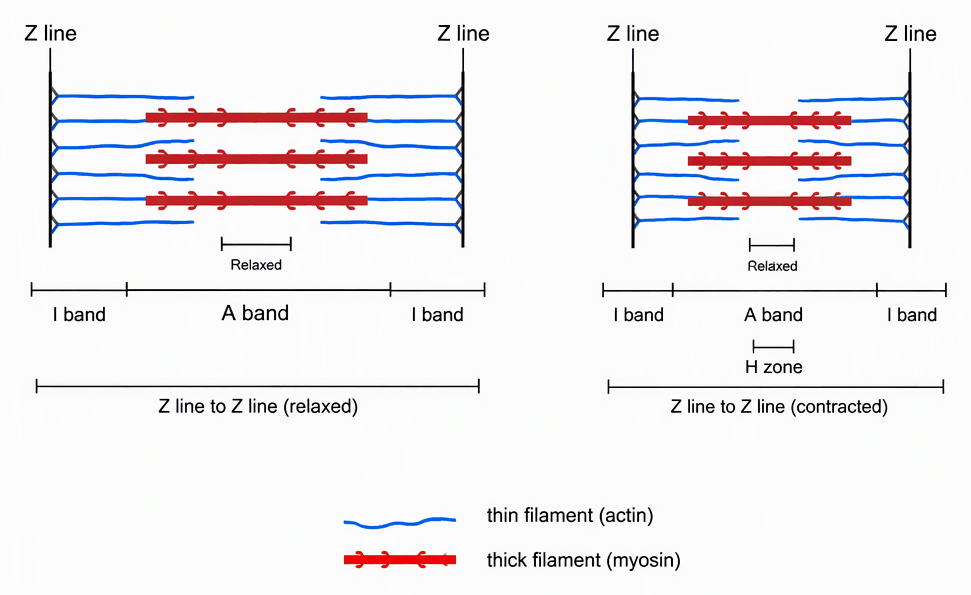
Use this before-and-after comparison on your sheet:
- Sarcomere: Shortens.
- Z lines: Move closer together.
- I band: Shortens.
- H zone: Narrows and may disappear.
- A band: Remains the same length.
Thin filaments slide relative to thick filaments, increasing overlap. Neither type of filament becomes shorter. That mechanism explains the comparison instead of leaving five disconnected facts to memorise.
Original practice question 3, not a previous-year question: Which remains unchanged during skeletal muscle contraction?
- A. A-band length
- B. I-band length
- C. H-zone width
- D. Sarcomere length
Answer: A. The A band spans the thick filaments, whose length stays constant. In the contracted sketch, the thin-only I-band region shrinks, the thick-only H-zone region narrows, and the distance between Z lines decreases.
If you say that myosin becomes shorter, redraw the same thick filament in both states. Change only its overlap with thin filaments and the positions of the Z lines.
What should I practise after these three physiology topics?
Begin with heart-flow, ADH and sarcomere questions, then expand to other syllabus-listed physiology topics. Include direct NCERT facts, diagram labels, event sequences, cause-and-effect changes and statement-based single-correct questions.
- Test application and repair separately. Use unseen questions to test whether you can apply the idea. Reattempt previously missed questions to check the repair, explaining each alternative. Remembering an answer letter does not prove understanding.
- Remove the chapter cue. After topic practice, assemble a mixed physiology set from your own question bank. Without a chapter heading, you must identify the relevant mechanism yourself.
- Keep a usable error log. Record the tested idea, mistake reason, corrected NCERT statement or diagram, and retest result. Include guessed-right answers. For example: vessel direction; chose vena cava; corrected “arteries carry blood away”; retest by tracing the complete route.
Suppose you answer two of the three original questions correctly and one incorrectly. The score alone does not identify what needs repair:
Use the wrong option and your reasoning to choose the repair. Redraw a reversed route; revisit the exact NCERT statement for a factual error.
For adjacent locomotion-and-movement practice, use Human Skeletal System: B, C and E Explained. It concerns skeletal-system identification, not sarcomere contraction.
Move on when you can reconstruct the process without notes, solve an unfamiliar question and explain why the alternatives fail. For the next unseen topic set, NEET JEEnius AI’s practice mode skips questions already seen and offers 60 free sets a month. Retest your weakest idea first.
Frequently asked questions
How should I study Human Physiology for NEET step by step?
First compare the official syllabus for your attempt year with your NCERT edition. Read one bounded subtopic and make a recall sheet containing a labelled pathway, a cause-and-effect chain and exact facts. Reconstruct it without notes, attempt topic MCQs and identify errors, including guessed-right answers. Repair each gap and retest after an interval.
How do I remember blood flow through the heart for NEET?
Draw the complete route from the venae cavae through the right heart, lungs and left heart to the aorta, including the valves. Mark direction and oxygenation separately: arteries carry blood away from the heart, while veins carry it towards the heart. Reproduce the route without notes, then check missing labels and reversed arrows.
Does ADH increase or decrease urine volume?
Increased ADH action increases water reabsorption in the later renal tubule and collecting duct. With other factors unchanged and the kidneys responding normally, urine volume decreases and urine concentration increases. ADH is synthesised in the hypothalamus and stored and released by the posterior pituitary.
Which band stays unchanged during muscle contraction?
The A band remains the same length because thick filaments do not shorten. Thin filaments slide relative to thick filaments, increasing their overlap. The sarcomere and I band shorten, Z lines move closer together, and the H zone narrows and may disappear.
How often should I revise Human Physiology for NEET?
Next-day and one-week checks are practical starting points, not guaranteed intervals. Shorten the gap if the same error returns. Use closed-book recall and MCQs to identify weak ideas, then repair those specific gaps rather than rewatching every lecture.