Which processes can natural selection produce in the NEET 2026 re-held question?
Natural selection produces stabilisation of traits in a population, directional change in a population, and disruption of the population mean. It does not produce genetic drift. This medium-difficulty (tag 2) question appeared in the re-held NEET 2026 paper on 2026-06-21.
The four processes listed were (a) stabilisation of traits in a population, (b) genetic drift, (c) directional change in a population, and (d) disruption of the population mean. The answer choices were (1) (a) only, (2) (a), (c) and (d) only, (3) all four, or (4) (a) and (c) only.
List the three patterns of natural selection before you match any term.
How do you solve the natural selection question from the 2026 NEET re-exam step by step?
Natural selection produces exactly three patterns of selection on phenotypic variation: stabilising, directional, and disruptive. Therefore only statements (a), (c) and (d) are correct, corresponding to option (2).
Statement (a) stabilisation refers to stabilising selection that favours intermediate phenotypes. Statement (c) directional change refers to directional selection that shifts the population mean in one direction. Statement (d) disruption refers to disruptive selection that favours both phenotypic extremes.
Genetic drift is a distinct evolutionary force caused by random fluctuations in allele frequencies, unrelated to differential reproductive success. It operates by chance and has no link to fitness differences that drive the three selection patterns.
Why does recalling only two patterns lead to the wrong option in natural selection questions?
Choosing option (4) – (a) and (c) only – arises from the method error of recalling only two patterns and assuming disruption is not produced by natural selection.
This occurs when a student jumps to matching terms without first listing all three established patterns (stabilising, directional, disruptive). The partial recall creates a gap that makes the two-item option appear safe.
The correct method requires enumerating the three outcomes of natural selection before scanning the given terms to avoid partial selection of options. Write the three patterns on the margin first.
How do stabilising, directional and disruptive selection differ from genetic drift?
Stabilising selection reduces variance around the mean phenotype. Directional selection shifts the mean phenotype in response to environmental pressure. Disruptive selection creates bimodal distribution by favouring both phenotypic extremes.
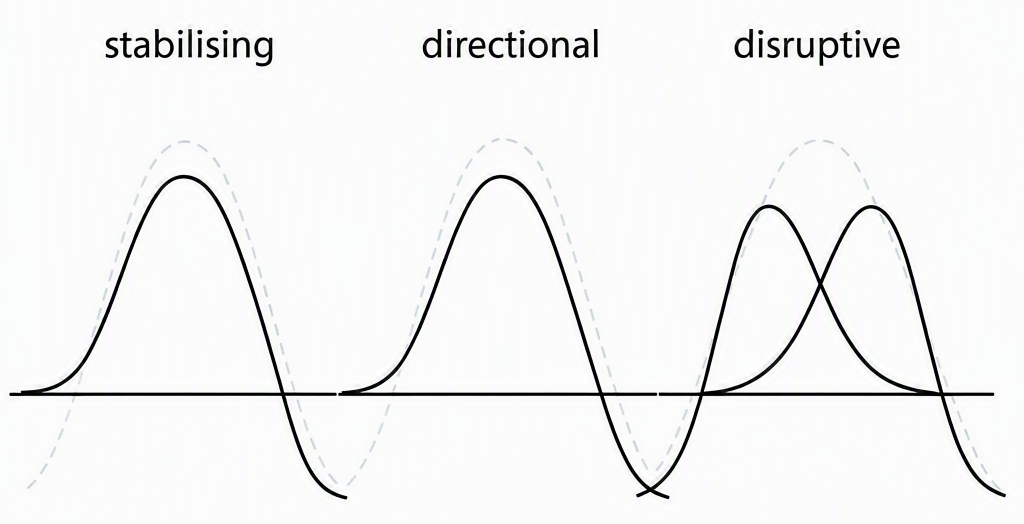
Genetic drift is random, independent of fitness, stronger in small populations, and can cause allele fixation or loss without adaptation. It never responds to phenotype and cannot be classified as a pattern of selection.
What are three related practice questions on natural selection from Genetics and Evolution?
Question 1: Industrial melanism in peppered moths is an example of (a) stabilising (b) directional (c) disruptive (d) artificial selection.
Answer: (b) directional. The population mean moved in one direction under the new selection pressure.
Question 2: Which of the following is not a result of natural selection? (a) adaptation (b) genetic drift (c) increased fitness (d) speciation.
Answer: (b) genetic drift. The other three follow from differential reproductive success.
Question 3: Assertion: Disruptive selection can split a population into two species. Reason: It favours extreme phenotypes at both ends and can produce a bimodal trait distribution that becomes reproductively isolated over time.
Answer: Both assertion and reason are true, and the reason correctly explains the assertion.
Apply the same sequence to these: name the three patterns, map the terms, reject drift.
What 45-second strategy solves combination questions on evolution in NEET?
Step 1: Immediately recall the three canonical patterns produced by natural selection: stabilising, directional, disruptive.
Step 2: Map synonyms – stabilisation equals stabilising, directional change equals directional, disruption equals disruptive.
Step 3: Eliminate genetic drift as one of the five factors disturbing Hardy-Weinberg equilibrium but never a form of selection.
This sequence solves any medium-tier combination question in 30-45 seconds. Practise it on every evolution MCQ until the three patterns appear automatically.
You can search past NEET papers by chapter inside the past-paper archive to locate every similar combination question from Genetics and Evolution.
Next step: photograph a doubt on NEET JEEnius AI and photograph any question you are stuck on and get a step-by-step solution across Physics, Chemistry and Biology (20 free a month).
Keep going with Thermodynamics NEET 2024: Vibrational Modes f in Terms of γ.
Frequently asked questions
What processes can natural selection produce according to the NEET 2026 question?
Natural selection produces stabilisation of traits in a population, directional change in a population, and disruption of the population mean. It does not produce genetic drift, which is a separate random process unrelated to fitness.
What are the three patterns of natural selection for NEET?
The three patterns are stabilising selection, directional selection, and disruptive selection. Stabilising favours intermediate phenotypes, directional shifts the mean toward one extreme, and disruptive favours both extremes.
Why is genetic drift not a result of natural selection?
Genetic drift occurs due to random fluctuations in allele frequencies and is independent of phenotype or fitness. Natural selection always involves differential reproductive success based on heritable traits that affect survival.
How do you avoid mistakes in natural selection NEET questions?
List the three patterns of natural selection first on the margin before matching any terms: stabilising, directional and disruptive. This prevents stopping at only two patterns and selecting the incomplete option that omits disruption.
How do stabilising, directional and disruptive selection differ?
Stabilising selection narrows variance around the mean phenotype. Directional selection shifts the entire mean toward one extreme under pressure. Disruptive selection favours both extremes and produces a bimodal distribution.