What is the answer to the two-lens optics NEET 2026 question?
Option B is correct: the final image lies 60 cm left of the concave lens. This optics NEET 2026 question requires two successive lens-formula calculations, with distances measured from each lens separately. It is from NEET UG 2026, held on 21 June, Code-50; “medium” is the question bank’s difficulty classification, not an official NTA rating.
An object stands 20 cm left of convex lens L1, whose focal length is +10 cm. Concave lens L2, with focal length −10 cm, stands 8 cm right of L1. Find the final image position relative to L2.
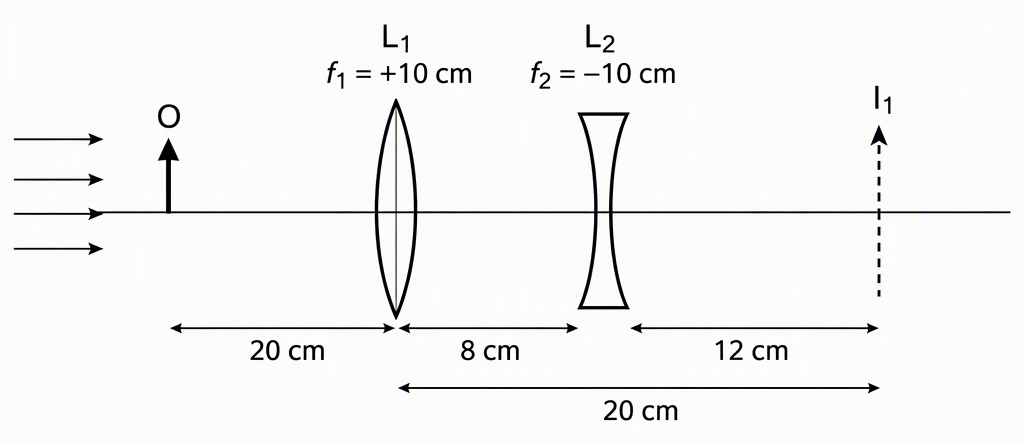
All choices are measured from L2:
This is a separated two-lens combination, not a single-lens problem with fixed object–image separation.
Where would the convex lens L1 form its image?
L1 alone would form an image 20 cm to its right. Follow the official sequential method: first analyse L1, then use its would-be image as the object for L2. Under the Cartesian convention, light travels left to right; distances are measured from the lens being analysed, with left negative and right positive.
The lens formula is:
For the convex lens:
Substituting distances in centimetres:
The positive sign places this image right of L1. L2 intercepts the rays before they reach that point, so this is not the combination’s final image.
Why is the object distance for L2 positive 12 cm?
The object distance is positive because the convergence point lies right of L2. Its magnitude is 12 cm because L2 is already 8 cm right of L1. Keep the same physical image location, but measure its distance from the second lens.
Use this position ledger, taking L1 as the coordinate origin:
Therefore:
Rays reaching L2 are already converging towards a point on its right. That point is a virtual object for L2, even though it is L1’s would-be real image.
The second object distance is neither negative 12 cm nor positive 20 cm. Its sign comes from its side of L2; its magnitude comes from subtracting the lens separation.
Where is the final image formed by L2?
The final image is virtual and lies 60 cm left of L2, so the answer is B. Use the same lens formula, now measuring both distances from L2. The virtual object has a positive object distance, while the concave lens has a negative focal length; assign these signs separately.
Substitute, using centimetres:
Take the reciprocal, keeping the minus sign:
The negative sign places the image left of L2. The emerging rays’ backward extensions meet there, making the image virtual.
As a reference-point check, its coordinate relative to L1 is:
The options ask for distance from L2, not this coordinate from L1.
How does a sign error produce option D?
Dropping the minus sign while taking the reciprocal produces D, not B. Start from the correct intermediate result:
The erroneous move is:
That positive distance means 60 cm right of L2, exactly option D. This is not a rounding or magnitude error: changing the sign moves the image to the opposite side of the lens.
Keep the signed distance through the entire calculation. Translate it into “left” or “right” only in the final sentence, after naming the reference lens.
Which two related optics questions can check this method?
Calculate the combination’s magnification and each lens’s power to check your use of signs and lens separation. These are original related practice questions, not additional verified NEET PYQs. Try each before reading its working.
Related practice 1: What is the combination’s lateral magnification?
Use the supplied distances:
Calculate each lens’s magnification, then multiply:
The positive total magnification means the final image is erect relative to the original object. Its height is five times the original object’s height.
Related practice 2: What are the powers of lenses with focal lengths +10 cm and −10 cm, and is adding them sufficient here?
Convert focal lengths to metres before calculating power:
The simple contact-lens sum is:
But the original lenses are 8 cm apart, not in contact. Treating them as a zero-power contact pair does not solve this arrangement.
Before substituting for any second lens, write its object distance from that lens. Keep the sign attached.
Next step: photograph a doubt on NEET JEEnius AI and photograph any question you are stuck on and get a step-by-step solution across Physics, Chemistry and Biology (20 free a month).
Keep going with How to Study Plant Kingdom NEET: NCERT Recall and MCQs.
Frequently asked questions
What is the answer to the two-lens Optics NEET 2026 question?
Option B is correct: the final image is virtual and lies 60 cm left of the concave lens L2. Applying the lens formula with u2 = +12 cm and f2 = −10 cm gives v2 = −60 cm. The options measure image position from L2, not L1.
Why is the object distance for the second lens +12 cm?
L1 alone would form an image 20 cm to its right, while L2 is positioned 8 cm right of L1. The convergence point is therefore 20 − 8 = 12 cm right of L2, giving u2 = +12 cm under the Cartesian sign convention. Because rays reach L2 while converging towards that point, it acts as a virtual object for L2.
Why is option D wrong in the two-lens question?
The correct calculation gives 1/v2 = −1/60 cm⁻¹, so v2 = −60 cm. Dropping the minus sign when taking the reciprocal incorrectly gives +60 cm, which places the image right of L2 and produces option D.
What is the total magnification of this two-lens combination?
The first lens has magnification m1 = 20/(−20) = −1, and the second has m2 = −60/12 = −5. Multiplying gives a total magnification of +5. The final image is erect relative to the original object and five times its height.
Can I add the lens powers to solve this two-lens problem?
The individual powers are +10 D and −10 D, but their simple sum applies to lenses in contact. Here the lenses are 8 cm apart, so treating them as a zero-power contact pair does not solve the arrangement. Apply the lens formula successively, measuring each object distance from the lens being analysed.