
How do I turn NCERT Plant Kingdom into a useful comparison sheet?
To study Plant Kingdom for NEET, compare NCERT facts, retrieve them from memory, and reject options using evidence. Build a compact sheet with the same six headings for every plant group. Keep algae’s pigment and reserve-food distinctions separate.
Step 1: Set the scope before making notes. Check the official syllabus for your exam year at neet.nta.nic.in, then study the corresponding NCERT text, tables and diagrams. Do not treat a coaching message about a deleted topic as verification.
Step 2: Compare the five groups using six headings. Read each entry in this order: body organisation; vascular tissue; dominant generation; dependence on external water for fertilisation; seeds; representative examples.
- Algae: Mostly thalloid; true vascular tissue absent; life cycles and dominance vary; sexual reproduction generally water-mediated, with varying mechanisms; seeds absent; Chlamydomonas, Spirogyra, Fucus.
- Bryophytes: Thalloid or stem-like and leaf-like bodies; true vascular tissue absent; gametophyte dominant; external water required; seeds absent; Marchantia, Funaria.
- Pteridophytes: True roots, stems and leaves; vascular tissue present; sporophyte dominant; external water required; seeds absent; Selaginella, Salvinia.
- Gymnosperms: Differentiated roots, stems and leaves; vascular tissue present; sporophyte dominant; external water not required; seeds present, with ovules not enclosed by an ovary; Cycas, Pinus.
- Angiosperms: Differentiated roots, stems and leaves; vascular tissue present; sporophyte dominant; external water not required; seeds present, with ovules enclosed within an ovary; maize, pea.
Step 3: Make a separate algae comparison. Read each entry as diagnostic pigments; reserve food; NCERT examples.
- Chlorophyceae: Chlorophyll a and b; starch; Chlamydomonas, Volvox, Chara.
- Phaeophyceae: Chlorophyll a and c, fucoxanthin; laminarin and mannitol; Ectocarpus, Laminaria, Sargassum.
- Rhodophyceae: Chlorophyll a and d, r-phycoerythrin; floridean starch; Polysiphonia, Porphyra, Gelidium.
Pigment and reserve-food questions need finer distinctions than the broad plant-group comparison provides. This sheet is an index back to NCERT, not a replacement for its qualifications, examples and diagrams.
How do I remember examples and eliminate wrong options?
Retrieve the distinguishing fact before looking at the answer choices. Recognising “Selaginella” is not enough: connect it to pteridophytes, vascular tissue, heterospory and absence of seeds.
Step 4: Practise examples in both directions. Start with “Name two heterosporous pteridophytes”, then reverse it: “Place Selaginella and Salvinia in a group and state their distinguishing feature.”
Step 5: Reconstruct land-plant alternation of generations from memory. Mark the chromosome state at each stage and name the process on each connecting arrow.
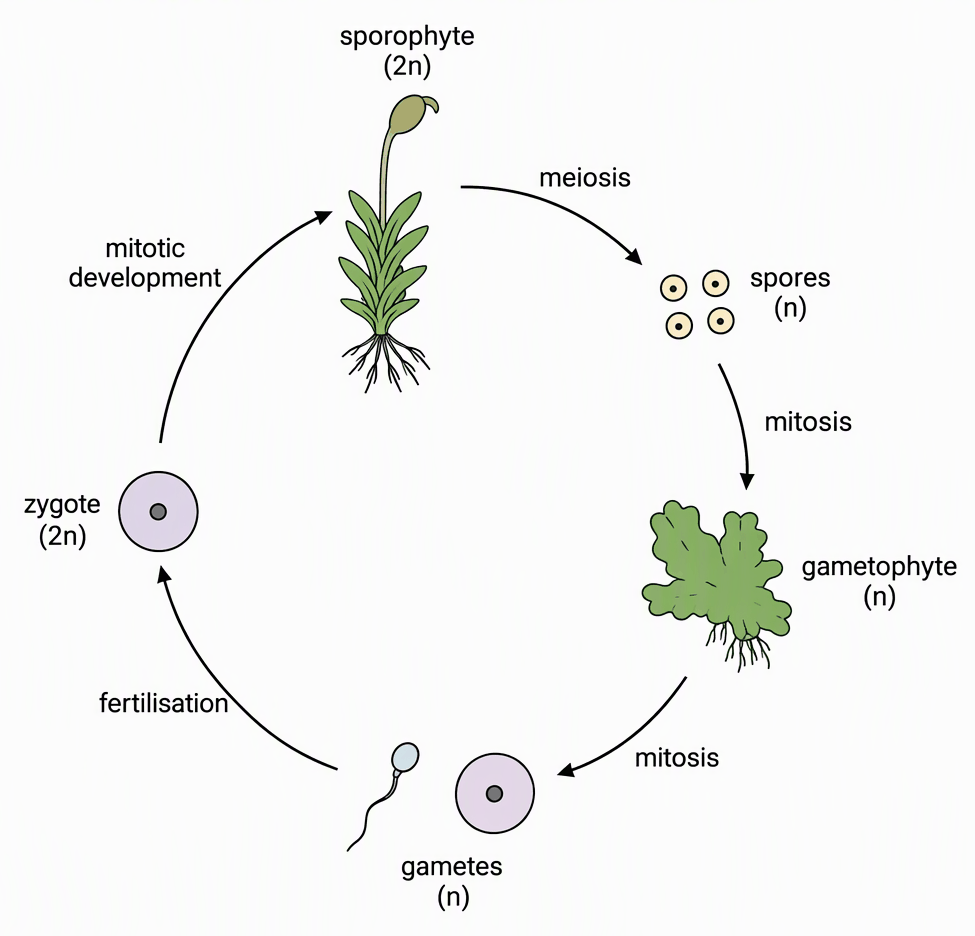
The haploid gametophyte produces gametes by mitosis, not meiosis. Do not import the familiar animal rule into this sequence.
Dominant does not mean independent. The bryophyte gametophyte is dominant, while its sporophyte remains dependent; the pteridophyte sporophyte is dominant and independent, although its gametophyte is commonly free-living.
Step 6: Test each option in order. Use the same checks even when an answer looks familiar.
- Identify the tested feature.
- Recall the relevant comparison.
- Inspect qualifiers such as all and only.
- Reject the option using a specific contradictory fact.
Absolute words demand checking; they do not automatically make statements false. Record errors as my wrong association; correct NCERT fact; preventing contrast.
For example: “Vascular tissue removes water dependence; pteridophytes need external water for fertilisation; transport tissue and sperm delivery are separate features.” For fresh questions, NEET JEEnius AI’s practice mode offers topic sets that skip questions already seen, with 60 free sets a month.
How do I solve an algae reserve-food matching question?
Check the stored food against the algal class, not against how familiar the words sound. Use the separate algae comparison: the broad label “algae” cannot distinguish these options.
Original practice MCQ, not a previous-year NEET question: Which pairing is correct?
- A. Chlorophyceae: floridean starch.
- B. Phaeophyceae: laminarin and mannitol.
- C. Rhodophyceae: starch stored in pyrenoids.
- D. Phaeophyceae: floridean starch.
B is the single correct answer. First identify the tested feature: reserve food. There is no need to recall habitats, flagella or body forms to decide these options.
Check each association against NCERT:
- A is false: Green algae store starch, not floridean starch.
- B is true: Brown algae store laminarin and mannitol.
- C is false: Red algae store floridean starch. Pyrenoids associated with starch storage belong to the NCERT description of green algae.
- D is false: Floridean starch identifies red algae, not brown algae.
“Pyrenoids” is a familiar scientific term, but familiarity cannot rescue an incorrect group–feature pairing. If this question goes wrong, add this exact recall task: cover the reserve-food column and reconstruct all three entries.
Does heterospory mean that a plant produces seeds?
No. Heterospory means producing two kinds of spores, not producing seeds. Selaginella and Salvinia provide the decisive contrast: they are heterosporous pteridophytes, yet they do not bear seeds.
Original single-correct practice MCQ: Evaluate these statements.
- I. Selaginella and Salvinia are heterosporous pteridophytes.
- II. Heterospory means that a plant produces seeds.
Choose the correct option:
- A. Both statements are true.
- B. I is true and II is false.
- C. I is false and II is true.
- D. Both statements are false.
B is correct. Statement I matches the NCERT examples. Statement II replaces the definition of heterospory with a different reproductive feature.
Heterosporous plants produce microspores and megaspores, which develop into male and female gametophytes respectively. Heterospory is relevant to the evolution of seed habit, but it is not equivalent to possessing seeds.
Reject A because II is false, C because both truth assignments are wrong, and D because I is true. The diagnostic contrast is pteridophytes are vascular plants without seeds.
Write the repair in your error log: “Heterosporous means seed-bearing; heterospory means two spore types; Selaginella and Salvinia are seedless counterexamples.” Evolution is not a ladder on which every group automatically acquires all features associated with another group.
How do I solve moss ploidy and cell-division questions?
Trace chromosome state instead of linking “gametes” automatically with meiosis. In moss, meiosis produces haploid spores; mitotic development forms the gametophyte, which produces haploid gametes by mitosis. The two chromosome-state switches are meiosis and fertilisation.
Original practice MCQ: In moss, which combination correctly gives spore ploidy and the division by which the gametophyte produces gametes?
A is correct. A diploid spore mother cell undergoes meiosis to form haploid spores. These develop through mitotic divisions into the haploid gametophyte; gamete formation does not require another reduction division.
For a worked numerical check, suppose a moss spore mother cell has 24 chromosomes. Track the count through each stage:
B is tempting because it imports meiotic gamete production from animals. C and D fail because the spores in this sequence are haploid, not diploid.
Connect the sequence to moss organisation: the dominant plant body is gametophytic. Its sporophyte remains attached to and dependent on it.
What should I practise next if I keep making the same mistakes?
Choose the next exercise from your error log, not simply from the next page. Before checking answers, name the fact that rules out each rejected option. A correct guess still needs review because it does not show that you can solve a fresh version.
Use this progression:
- Algae feature matching.
- Examples and plant-group comparisons.
- Life-cycle and ploidy questions.
- Mixed statement-based questions.
Match each error to a repair:
- Wrong example: Make reverse-recall cards, organism to group and distinguishing feature.
- Confused feature: Rebuild the relevant comparison entry from NCERT.
- Wrong ploidy: Redraw the sequence and label both chromosome-state switches.
- Missed qualifier: Rewrite the statement so that it is accurate.
Try this suggested revision schedule, not a guaranteed memory formula: reconstruct the sheet the next day, revisit weak contrasts after three days, and attempt a mixed set after a week. Judge progress by reconstructing distinctions without looking and explaining fresh answers, not recognising previously solved questions.
For fresh questions, daily practice problems provide a fresh topic set every day, with 20 free attempts a month. Choose the next practice session using the error you have just repaired.
Next step: daily practice problems on NEET JEEnius AI and get a fresh set on a topic every day (20 free attempts a month).
For a worked example of the same idea, see P Block Practice Questions NEET: 5 MCQs and PYQ Guide.
Frequently asked questions
How should I study Plant Kingdom for NEET from NCERT?
Verify your exam year's official syllabus, then compare the five plant groups under six headings: body organisation, vascular tissue, dominant generation, external water requirement for fertilisation, seeds and examples. Make a separate algae table for pigments, reserve food and examples. Reconstruct these comparisons from memory and use specific NCERT facts to reject wrong MCQ options.
How do I remember Plant Kingdom examples for NEET?
Practise recall in both directions: name examples for a feature, then identify the group and distinguishing feature of each example. For instance, link Selaginella and Salvinia to heterosporous, seedless pteridophytes. Record wrong associations alongside the correct NCERT fact and a contrast that prevents the same error.
Does heterospory mean a plant produces seeds?
No. Heterospory means producing microspores and megaspores, which develop into male and female gametophytes respectively. Selaginella and Salvinia are heterosporous pteridophytes but do not produce seeds, so heterospory is not equivalent to seed production.
Are moss spores haploid, and are moss gametes formed by mitosis?
Moss spores are haploid and form through meiosis in a diploid spore mother cell. The spores develop by mitotic divisions into the haploid gametophyte, which produces gametes by mitosis. Fertilisation restores the diploid chromosome state in the zygote.