
Which free p-block practice format should you start with?
For free p-block practice questions for NEET, start with syllabus-checked chapterwise PYQs after revision, then target your weak concepts. Original worked MCQs are available below, free on this page. If you are still learning, begin with explained concept MCQs instead. Use printable sheets for distraction-free recall and online quizzes only when their feedback helps you correct mistakes.
Older PYQs show what appeared in past examinations. They do not prove that every tested detail remains in the syllabus for your target examination.
How do free PYQs, printable sheets and online quizzes compare?
PYQs provide evidence of examination style; printable sheets support uninterrupted attempts; browser quizzes may provide instant feedback. No format guarantees correct answers, current coverage or useful explanations. Compare access and feedback before choosing.
- Best use: PYQs: diagnosing gaps after revision. Sheets: pen-and-paper recall. Quizzes: short attempts followed by explanation-based review.
- Evidence of NEET question style: PYQs: direct evidence when the source is authentic. Sheets: depends on their contents. Quizzes: depends on their contents.
- Syllabus-checking burden: PYQs: confirm the collection was checked for your target year. Sheets: check every included topic. Quizzes: check coverage before trusting the chapter label.
- Explanation quality: PYQs: an official key establishes the accepted answer, not a worked explanation. Sheets: depends on the sheet. Quizzes: instant feedback may be only “correct” or “wrong”.
- Offline use: PYQs: possible with a saved or printed copy. Sheets: their main strength. Quizzes: do not assume offline access.
- Distraction risk: PYQs: depends on the medium. Sheets: low when the phone is away. Quizzes: browser tabs and notifications can interrupt.
- Revisiting mistakes: PYQs: record the year and question reference. Sheets: circle missed items. Quizzes: check whether completed answers and explanations remain accessible.
- Access check: PYQs: can you open questions, keys and explanations without payment? Sheets: does the free file include solutions? Quizzes: check scoring, payment steps, login requirements and free limits before attempting.
A rehosted PYQ collection still needs identifiable sources, accurate wording and answer verification. A printable sheet without reasoning tests recall but does little to repair understanding. A quiz score alone does not explain a mistake.
What should Class 11, Class 12 and drop-year students choose?
Choose by what you can currently explain, not by your class label. A Class 12 student learning the topic for the first time needs concept questions. A Class 11 student who has already revised the relevant material can use syllabus-checked PYQs. Paying for access does not fix passive revision.
- Class 11, first encounter: study the relevant material, then attempt explained concept MCQs. A timed test of unfamiliar facts measures exposure, not understanding.
- Class 12, completed revision: attempt syllabus-checked PYQs, identify missed concepts and practise those concepts separately.
- Dropper, familiar PYQ answers: use unfamiliar original MCQs. Explain why the rejected options are wrong to expose recognition without understanding.
- Phone distraction or patchy internet: print questions and keep the answer key out of sight.
- Considering a browser quiz: use it only if wrong answers can be reviewed with explanations, not just a displayed score.
Inspect a solution before committing to a set. It should explain both the correct principle and the tempting error.
Can you attempt free p-block MCQs before seeing the answers?
The following five single-correct questions are original practice, not NTA questions or verified PYQs. They cover general p-block concepts, not the complete syllabus. Check their scope against the applicable official syllabus at neet.nta.nic.in before using them for your target examination; no target-year syllabus verification is claimed here.
Keep the solutions below out of view. Record your chosen option and mark any answer you are unsure about.
Which options are correct in this original practice set?
Select one option per question, using the condition stated in the stem. Do not replace a defined comparison with a broader rule you remember.
1. Which statement correctly describes p-block valence-shell configurations and helium?
- A. Every group 18 element, including helium, has six electrons in its outermost p subshell.
- B. The usual p-block configuration has two outermost s electrons and one to six p electrons; helium instead has a filled first-shell s orbital.
- C. Helium has a partially filled first-shell p subshell.
- D. The usual p-block configuration has one outermost s electron and one to six p electrons.
2. Using covalent radii for the neutral halogen atoms fluorine, chlorine, bromine and iodine, which order shows increasing atomic size?
- A. Iodine, bromine, chlorine, fluorine.
- B. Chlorine, fluorine, bromine, iodine.
- C. Fluorine, chlorine, bromine, iodine.
- D. Fluorine, bromine, chlorine, iodine.
3. Which statement best expresses the inert-pair effect down group 13?
- A. The lower oxidation state becomes relatively more stable; thallium in oxidation state one is more stable than thallium in oxidation state three.
- B. The higher oxidation state becomes increasingly favoured because the outermost s pair participates more readily.
- C. Both outermost p and s electrons become completely unavailable for bonding in every heavier member.
- D. Oxidation state one becomes less stable relative to oxidation state three.
4. Which pair of properties helps explain nitrogen’s anomalous behaviour compared with heavier group 15 members?
- A. Large atomic size and low electronegativity.
- B. Small atomic size and low electronegativity.
- C. Large atomic size and high electronegativity.
- D. Small atomic size and high electronegativity.
5. Why does nitrogen show less tendency than phosphorus to form extended chains through element–element single bonds?
- A. Nitrogen cannot form any nitrogen–nitrogen bond.
- B. The nitrogen–nitrogen single bond is relatively weak, partly because lone pairs repel strongly on the small adjacent atoms.
- C. The strength of the nitrogen–nitrogen triple bond guarantees strong nitrogen–nitrogen single-bond chains.
- D. Phosphorus atoms are smaller, so their lone pairs repel more strongly.
What are the correct answers and explanations?
The answers are 1 B, 2 C, 3 A, 4 D and 5 B. Review a correct guess too: you should be able to explain why the nearest distractor fails.
1. B: helium is the configuration exception. The usual p-block valence-shell configuration is:
Helium instead has a filled first-shell s orbital. Its configuration is:
Helium belongs to group 18 because of its closed-shell character, but its electrons occupy an s orbital. A is the main trap: there is no first-shell p subshell.
2. C: covalent radius increases through this stated sequence. Successive halogens have additional occupied electron shells, giving the order fluorine, chlorine, bromine, iodine. A reverses the trend: increasing nuclear charge alone does not determine radius because shielding and shell number also matter.
3. A: the lower oxidation state gains relative stability. In heavier group 13 members, the outermost s-electron pair participates less readily in bonding. B reverses the inert-pair argument: reduced participation of this pair favours the lower state.
4. D: nitrogen is small and highly electronegative. These properties help explain differences in its bonding and chemical behaviour compared with heavier group members. B is the main distractor: it gets size right but reverses the electronegativity comparison.
5. B: single-bond strength matters for these chains. Strong lone-pair repulsion helps weaken the nitrogen–nitrogen single bond relative to the phosphorus–phosphorus single bond. C confuses different bonds: nitrogen’s strong triple bond does not establish strong single-bond catenation. Nitrogen’s catenation is limited, not absent.
How can you reject an outdated or unreliable p-block question bank?
Set aside a bank whose sources, conditions or explanations do not support its answers. Before accepting a disputed answer, identify the exact statement being tested and the reference supporting it. A shortened textbook chapter alone does not establish examination scope.
- Separate syllabus from textbook contents. Check the official syllabus for your target examination at neet.nta.nic.in. Do not infer a deleted-topic list from a missing textbook chapter.
- Trace claimed PYQs. Look for an identifiable examination year, accurate wording and a traceable official answer key.
- Check stated conditions. A chemical comparison may depend on acidic or alkaline medium, temperature or physical state. Missing conditions can make an answer ambiguous.
- Demand reasoning. Reject explanations that merely repeat the answer. An explanation contradicting a reliable reference must explain the discrepancy.
- Inspect free access. Open both an answer and its worked solution. Free previews are not free practice with feedback.
- Distinguish errors from exceptions. A genuine exception needs a defined comparison and a sound explanation. Calling every contradiction an “exception” is not acceptable.
If a question fails these checks, set it aside rather than memorising it. Record a knowledge gap only after confirming that the question and key are sound.
How should you turn wrong answers into revision and full-paper practice?
Identify the cause of each mistake, then reattempt the concept after revision. Keep the key hidden during attempts, mark uncertainty and review guessed-correct answers alongside wrong ones. Copying the correct option immediately can create familiarity without fixing the gap.
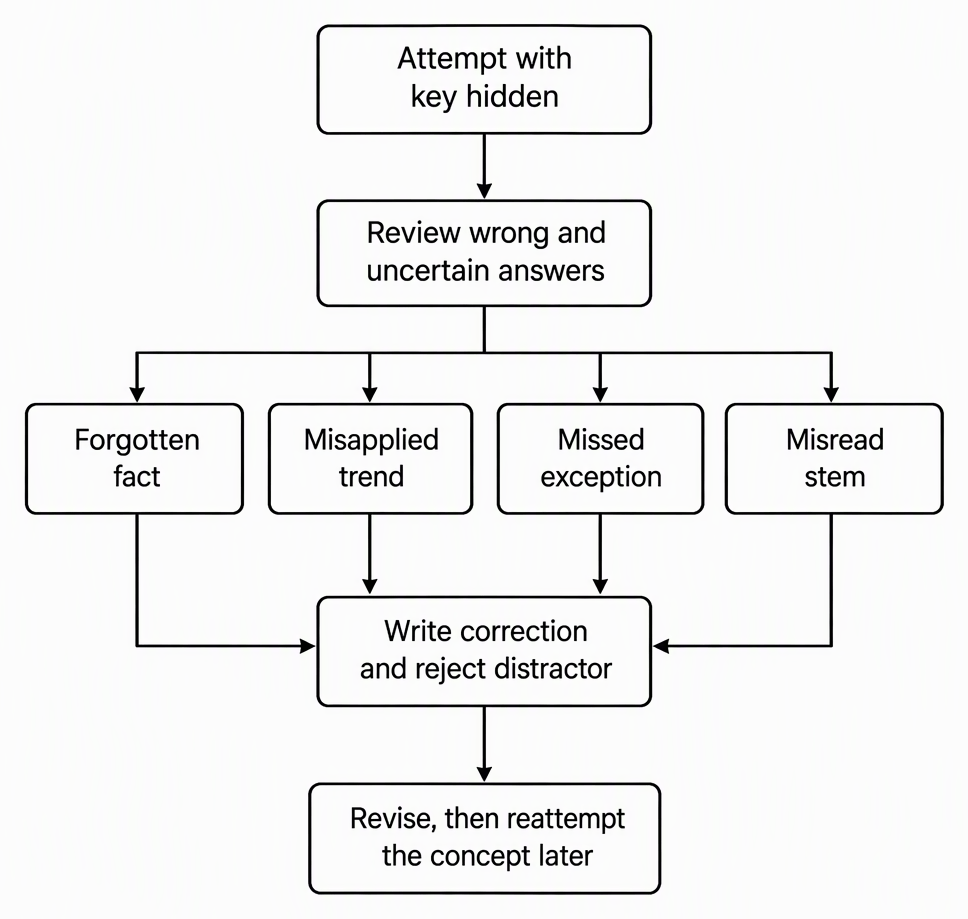
For each flagged answer, record the cause and correction:
- Forgotten fact: write the precise fact you failed to recall.
- Misapplied trend: state the comparison for which the trend is valid.
- Missed exception: explain why the usual trend fails here.
- Misread stem: underline the condition or word you overlooked.
Write why the tempting option was wrong. If periodic trends are the underlying weakness, use How to Study Periodic Table NEET: 7 NCERT Steps before attempting another set.
Score practice with four marks for a correct answer, minus one for a wrong answer and zero for an unattempted question. The full paper has 180 compulsory questions in 180 minutes. That overall average is not a compulsory one-minute limit for every chemistry MCQ; confirm the pattern in the applicable official bulletin for your target examination.
What else should you check before choosing free p-block practice?
Check that solutions are free and that the questions match your target examination’s syllabus. Then judge the set by whether you can explain unfamiliar questions, not by your score on remembered ones.
Are PYQs enough for p-block preparation?
They are a starting point and diagnostic tool, not proof of mastery. If you remember the answer letter, explain the rejected options or attempt an unfamiliar question on the same concept.
Is every older p-block question still relevant?
No. Past appearance does not establish current scope. Check the applicable official syllabus at neet.nta.nic.in, then select questions whose content fits it.
Can I download these questions as a PDF?
No downloadable PDF is provided with this article. Copy the question block into your notes or use your browser’s print function, keeping the solutions separate.
How many p-block questions should I practise?
Let your mistakes determine the next set, not an invented quota. Choose a concept you missed, revise its rule and exceptions, then attempt an unfamiliar question and explain every option before checking the key.
To check chapter learning within a full paper, NEET JEEnius AI offers 30 free full-length mock tests a month, each with 180 questions, 720 marks and 180 minutes: 45 Physics, 45 Chemistry and 90 Biology questions, with a scored per-subject breakdown. This verified full-mock offer is separate from a dedicated p-block bank, which is not verified here.
Next step: full-length mock tests on NEET JEEnius AI and sit a full 180-question, 720-mark, 180-minute paper, 45 Physics, 45 Chemistry and 90 Biology, and get a scored per-subject breakdown (30 free a month).
Frequently asked questions
Which free p-block questions should I practise first for NEET?
After revision, start with chapterwise PYQs checked against your target examination’s syllabus. If you are still learning, begin with explained concept MCQs instead. Use your mistakes to choose the next concepts to practise.
Are PYQs enough for p-block preparation in NEET?
PYQs are a starting point and a diagnostic tool, not proof of mastery. If you remember an answer, explain why the rejected options are wrong or attempt an unfamiliar question on the same concept.
Are older p-block NEET questions still in the syllabus?
Not necessarily: past appearance does not establish current syllabus coverage. Check each topic against the applicable official syllabus at neet.nta.nic.in. A missing textbook chapter alone does not establish that a topic has been deleted from the examination syllabus.
Can I download these p-block practice questions as a PDF?
This article does not provide a downloadable PDF. Copy the question block into your notes or use your browser’s print function, keeping the solutions separate so you can attempt the questions without seeing the answers.