Which pair is correct in the photorespiration NEET 2026 question?
Option B, (c) and (d) only, is correct for the photorespiration NEET 2026 question: photorespiration forms phosphoglycolate and does not generate ATP or NADPH. The task is to choose the correct pair from these four claims:
The answer combinations are:
- A = (a) and (d)
- B = (c) and (d)
- C = (b) and (d)
- D = (a) and (b)
This is a Biology question from Plant Physiology, tagged medium on the question bank’s scale. Its expected solving time is 45 seconds, a question-bank estimate, not a measured student average or compulsory time limit.
Why are statements (a) and (b) false?
Photorespiration occurs in C3 plants, consumes O₂ in its starting reaction and releases CO₂ later in the pathway. Follow the official solution’s order: first check the plant type, then identify what RuBisCO does. Keep the starting reaction separate from later events so that you assign each gas to the correct step.
Step 1: Check the plant type. C3 plants undergo photorespiration, so statement (a) is false. The presence of this pathway, not its absence, is the fact to use here.
Step 2: Check RuBisCO’s role. Here, RuBisCO acts as an oxygenase, rather than a carboxylase. RuBP reacts with O₂ instead of undergoing CO₂ fixation.
The initial RuBisCO oxygenation reaction does not itself release CO₂. CO₂ is released during later events in the photorespiratory pathway.
Thus, two facts defeat statement (b): oxygen participates as a reactant in the initiating reaction, and carbon dioxide is released later in the pathway. Do not compress these events into a claim that RuBisCO directly releases CO₂.
Partial truth check: (a) false; (b) false.
Why are statements (c) and (d) true, making B correct?
Phosphoglycolate is a product of RuBP oxygenation, and photorespiration does not produce ATP or NADPH. These establish statements (c) and (d) as true. The photorespiration NEET 2026 answer is therefore B: (c) and (d) only.
Step 3: Identify the product. Oxygenation of RuBP produces phosphoglycolate along with phosphoglycerate. Phosphoglycolate and phosphoglycerate are different compounds, not alternative names for the same product.
RuBP contains five carbon atoms, while the phosphoglycerate product contains three. The remaining two belong to phosphoglycolate:
All five carbon atoms are accounted for in these initial products. CO₂ release belongs to later pathway events, not this oxygenation step.
Step 4: Check energy output. Photorespiration generates neither ATP nor NADPH, so (d) is true. However, no ATP or NADPH production does not mean no energy requirement: recovery of carbon through the pathway uses energy.
The complete truth sequence is false, false, true, true. Map it to every option:
Why is option C wrong even though statement (d) is correct?
Option C combines (b) and (d), so one false claim makes the whole option wrong. Accepting the no-ATP/no-NADPH statement is only half the check. You must also reject the claim that photorespiration consumes CO₂ and generates O₂.
The faulty method is to borrow the overall description of photosynthesis, CO₂ uptake and O₂ release, and attach it to photorespiration. The shared word “photo” does not establish either gas exchange or energy output.
Oxygen release belongs to the light reactions, while CO₂ fixation involves carboxylation. Neither makes statement (b) true for photorespiration.
Use this process check instead of word association:
- Identify RuBisCO’s role: oxygenase or carboxylase?
- Identify the reacting gas: O₂ or CO₂?
- Check the carbon outcome: fixation or later release?
- Check energy output separately: are ATP and NADPH generated?
Can you apply these checks to two related Plant Physiology questions?
Check RuBisCO’s local CO₂ supply for C4 plants, and distinguish the starting reaction from the complete pathway when choosing organelles. Both questions below are original practice, not additional PYQs.
Original practice question 1: Which feature chiefly suppresses photorespiration in C4 plants?
Answer: B. The CO₂-concentrating mechanism favours RuBisCO’s carboxylase activity over its oxygenase activity. C4 plants do contain RuBisCO; their advantage is the local CO₂ supply around the enzyme, not its absence.
Original practice question 2: Which group of organelles participates in the C3 photorespiratory pathway?
Answer: A. The complete pathway spans chloroplasts, peroxisomes and mitochondria rather than remaining entirely inside the chloroplast. Its initial RuBisCO reaction is only the starting point.
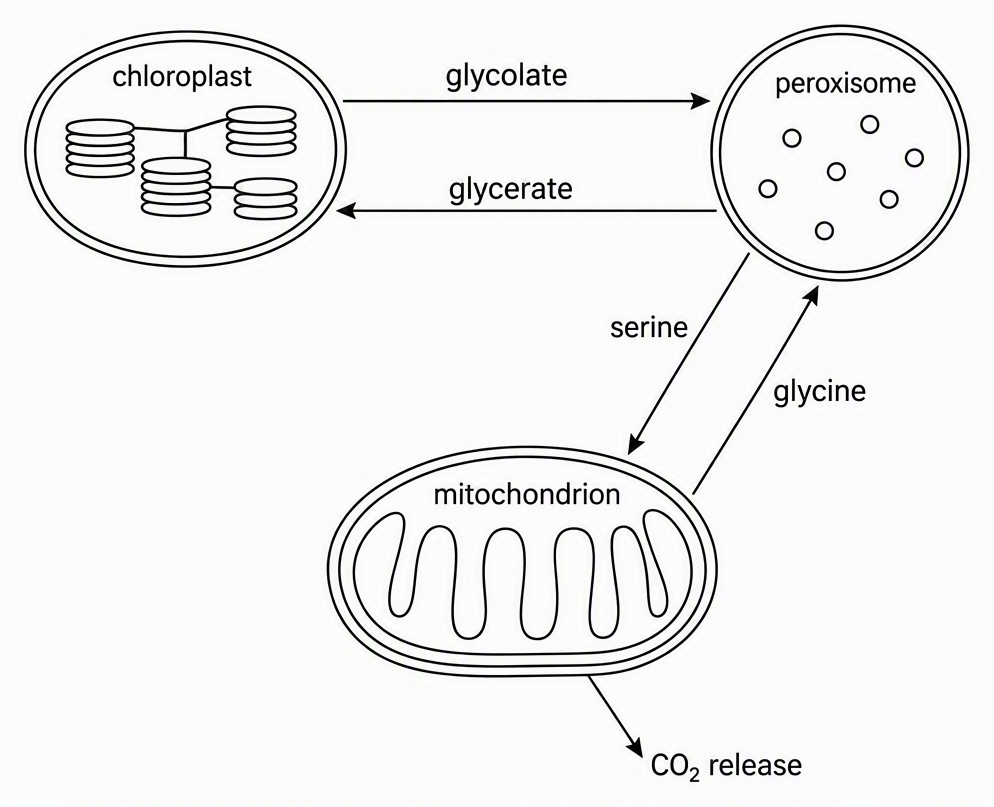
Before moving on, cover the answers and explain why “C4 plants lack RuBisCO” and “photorespiration stays inside the chloroplast” are both false. Give a biological reason for each rejection, not just an answer letter.
Next step: the past-paper archive on NEET JEEnius AI and search past NEET papers by year, subject or chapter, each with a worked solution (100 free searches a month).
Keep going with Chemical Bonding NEET 2025: Four Property Orders Explained.
Frequently asked questions
What is the correct answer to the photorespiration NEET 2026 question?
Option B, (c) and (d) only, is correct: phosphoglycolate is formed, and neither ATP nor NADPH is generated. Statements (a) and (b) are false because C3 plants undergo photorespiration, which consumes O₂ initially and releases CO₂ later.
Does RuBisCO directly release CO₂ during photorespiration?
No. RuBisCO acts as an oxygenase, reacting RuBP with O₂ to form phosphoglycolate and phosphoglycerate. CO₂ is released during later steps of the photorespiratory pathway, not during this initial reaction.
Does photorespiration produce ATP or NADPH?
Photorespiration generates neither ATP nor NADPH. This does not mean the pathway needs no energy: recovery of carbon through photorespiration uses energy.
Why is photorespiration suppressed in C4 plants?
C4 plants concentrate CO₂ around RuBisCO in bundle-sheath cells. This favours its carboxylase activity over its oxygenase activity, suppressing photorespiration. C4 plants do contain RuBisCO.
Which organelles are involved in photorespiration?
The C3 photorespiratory pathway involves chloroplasts, peroxisomes and mitochondria. The initial RuBisCO reaction occurs in the chloroplast, but the complete pathway does not remain confined to it.