What do points a and b measure in this NEET 2026 question?
The answer is D, a ratio of 2, because the series arrangement is measured across only one coil. This Power in AC Circuits NEET 2026 question comes from NEET UG 2026, held on 21 June 2026, Code-50, Physics. “Medium” is the question bank’s difficulty classification, not an official exam rating.
Two identical inductors carry the same specified time-dependent total current in arrangements P and Q. In P, they are in series, but a and b span only the first coil. In Q, both coils are connected in parallel across a and b. Mutual inductance is neglected.
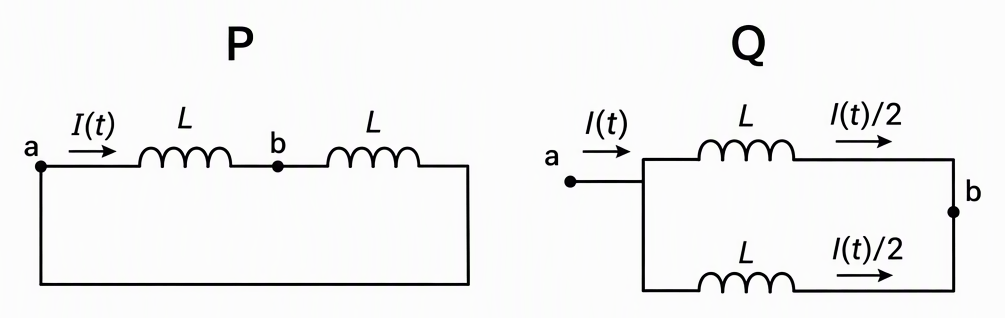
The requested emf-magnitude ratio and options are:
The supplied topic label is Power in AC Circuits, but this question tests self-induced emf, not average power.
Which current belongs in the self-induced emf formula?
Use the current through the particular coil whose emf is being measured, not automatically the total incoming current. The official solution uses self-induction, starting with flux linkage:
The symbols denote flux linkage, constant self-inductance and coil current, respectively. Faraday’s law gives:
The negative sign expresses Lenz’s law: the induced emf opposes the change in current. For the requested magnitude comparison, use:
Keep this working order:
- Locate a and b.
- Identify the measured coil’s current.
- Differentiate that current.
- Take the requested ratio.
RMS values, frequency and power factor are unnecessary here. A time-varying current need not be sinusoidal.
Why does configuration P use only one coil’s inductance?
The marked terminals enclose one coil, even though the complete series path contains two. Both coils carry the total current because there is no branching, so the current through the measured coil is:
Its rate of change is:
Applying the self-induced emf formula gives:
Across the entire series pair, the emf magnitude would instead be:
The full pair’s equivalent inductance is valid for its two outer terminals:
It is not the inductance spanning a and b. The second coil carries current, but its emf is outside the measurement requested in P.
How does the parallel current split give answer D?
Each identical parallel coil carries half the total current, following the official solution’s equal-split assumption. Since both branches connect directly between a and b, the measured emf equals the emf across either branch. Parallel branch emfs are not added.
For either coil in Q:
Differentiate the branch current, keeping the factor of one-half:
The measured emf magnitude is:
For a nonzero current-change rate, the common factors cancel:
Answer: D. As a physical check, P’s measured coil has twice the current-change rate of either Q coil, so its emf magnitude is twice as large.
If the current-change rate is zero, both emfs vanish and their instantaneous quotient is undefined. Their proportionality still holds:
How does reversing the requested ratio produce option B?
The correct emf expressions give option B if you divide Q by P instead of P by Q:
For a nonzero current-change rate, the reversed ratio is:
This is numerator–denominator reversal, not a failure of the self-induction formula. Write the requested ratio before substituting:
Check that the answer exceeds 1 because the measured P coil has the larger current-change rate. A separate mistake is blindly comparing the equivalent inductances of both complete arrangements:
That result is absent from the options and uses the wrong terminal span in P. It does not directly produce option B. Fix the measurement points rather than forcing the calculation into an available option.
How can you apply this method to two related practice questions?
Use the coil-current derivative for induced emf, but use the voltage–current phase difference for average AC power. These are original related practice questions from Electromagnetic Induction and Alternating Currents, not additional verified NEET PYQs.
Related practice question 1: What is the peak emf for a sinusoidal current?
The peak emf is the product of angular frequency, inductance and current amplitude. Find the peak magnitude of self-induced emf for an ideal inductor of constant inductance carrying:
Differentiate the given coil current:
Then apply Faraday’s law:
The maximum absolute value of cosine is 1, so:
No RMS conversion is needed because the question asks for the peak magnitude.
Related practice question 2: What average power does an ideal inductor consume?
An ideal inductor consumes zero average power over a complete cycle in sinusoidal steady state. Current lags voltage by 90 degrees, giving:
Zero average power does not mean zero instantaneous emf or zero stored energy. The inductor stores magnetic energy and returns it during the cycle:
Before choosing a formula, mark exactly what is asked: emf between which terminals, peak emf, or average power. Then identify the relevant coil current.
Next step: the past-paper archive on NEET JEEnius AI and search past NEET papers by year, subject or chapter, each with a worked solution (100 free searches a month).
For a worked example of the same idea, see NEET Revision Strategy: A 30-Day Plan for the Last Month.
Frequently asked questions
Why is the emf ratio 2 in this NEET 2026 inductor question?
In arrangement P, the measured coil carries the total current I(t), so its emf magnitude is L|dI/dt|. In arrangement Q, each identical parallel coil carries I(t)/2 under the equal-split assumption, giving an emf magnitude of (L/2)|dI/dt|. Therefore, E_P/E_Q is 2, option D, when the current-change rate is nonzero.
Why can't I use 2L for the series arrangement?
The marked points a and b span only one coil in the series arrangement, so the measured emf uses that coil's inductance L. The equivalent inductance 2L applies across the two outer terminals of the entire series pair, not across a and b.
What is the peak induced emf when current is I0 sin(omega t)?
For a constant inductance L, differentiating i(t) = I0 sin(omega t) gives di/dt = omega I0 cos(omega t). Using the self-induced emf formula, the peak magnitude is omega L I0. No RMS conversion is needed.
Why does an ideal inductor consume zero average AC power?
In sinusoidal steady state, current through an ideal inductor lags voltage by 90 degrees. Hence, P_avg = V_rms I_rms cos(90 degrees) = 0 over a complete cycle. The inductor stores magnetic energy and returns it during the cycle, so zero average power does not mean zero stored energy.