What is the correct order in the NEET 2026 renin–angiotensin question?
Option D is correct: C, E, D, B, A. The NEET 2026 renin-angiotensin mechanism question starts with a fall in glomerular filtration rate (GFR), not its recovery. This Biology single-correct question falls under Human Physiology, with a medium difficulty tag and an expected solving time of 60 seconds on the question bank’s scale, not an official NEET rating.
Arrange these five events in their correct causal order:
- Event A: Blood pressure and GFR rise.
- Event B: Aldosterone promotes sodium and water reabsorption from distal parts of the tubule.
- Event C: GFR decreases.
- Event D: Angiotensin II constricts blood vessels and stimulates aldosterone release.
- Event E: The renin-initiated pathway forms angiotensin I and then angiotensin II.
The supplied answer choices are:
Why does the fall in GFR come before angiotensin formation?
Step 1 is event C: the fall in GFR is the initiating disturbance in this question. Reduced renal perfusion or glomerular pressure activates the juxtaglomerular mechanism, leading to renin release. The rise in GFR is the corrective outcome, so it cannot start this chain.
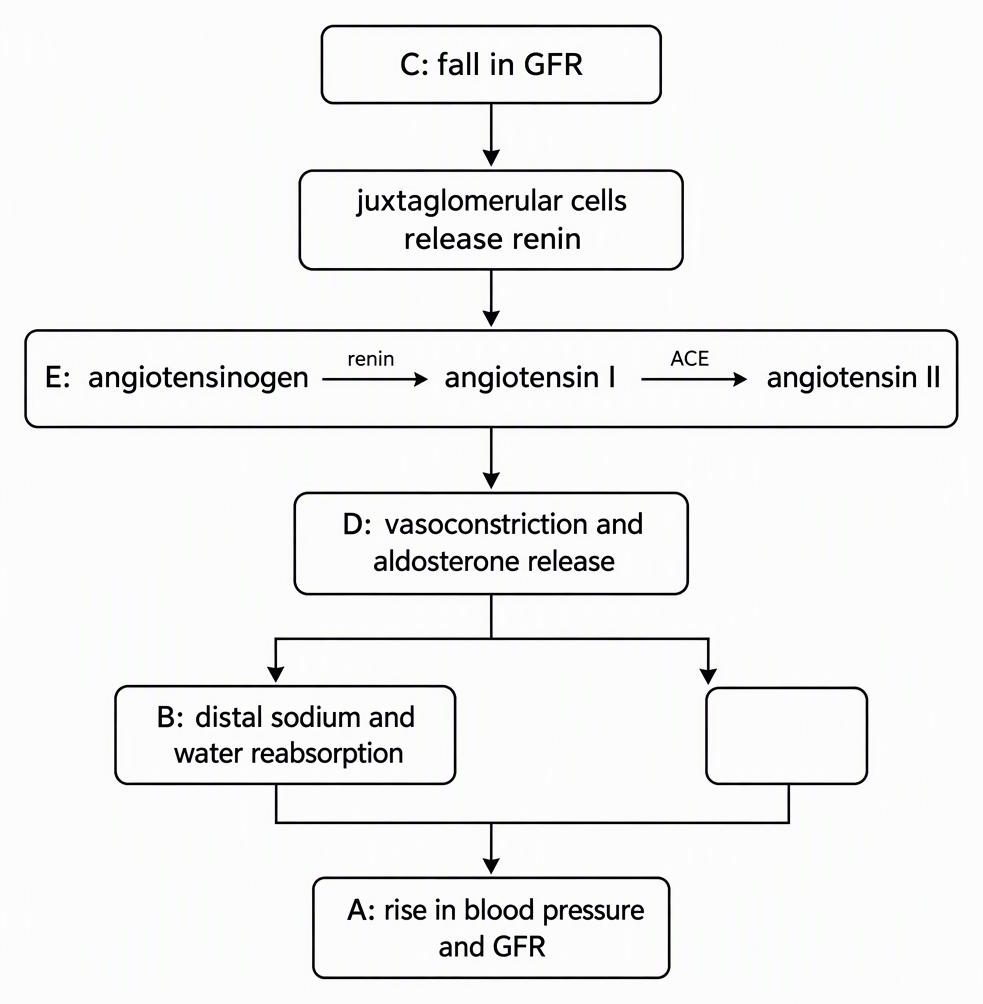
Step 2 is event E: renin converts angiotensinogen into angiotensin I. Angiotensin-converting enzyme, or ACE, subsequently converts angiotensin I into angiotensin II.
Event E compresses two enzyme-controlled conversions into one statement. It does not mean that renin directly catalyses both conversions.
Angiotensin II must be formed before its listed effects can occur. The partial sequence is therefore:
How do angiotensin II and aldosterone restore pressure and filtration?
Steps 3, 4 and 5 are D, B and A: angiotensin II acts, aldosterone produces its tubular response, and pressure and filtration recover. Keep the direct vascular action separate from the aldosterone-mediated tubular effect.
Step 3, event D: angiotensin II causes vasoconstriction and stimulates aldosterone secretion from the adrenal cortex. Vasoconstriction increases vascular resistance and supports a rise in blood pressure.
Step 4, event B: aldosterone promotes sodium reabsorption in distal nephron segments, with associated water retention. This supports blood volume and explains D before B: aldosterone release must precede the tubular effect attributed to it.
Step 5, event A: vascular constriction and increased fluid retention support the rise in blood pressure and restoration of GFR described in the question. The response counteracts the initiating fall rather than causing it.
In the body, these grouped actions can overlap in time. Vasoconstriction need not wait for all tubular effects to finish. The official order represents the question’s causal chain, not five separate time slots.
Which option should I mark, and how can I check it?
Correct answer: option D. The complete event sequence is:
In words: fall in GFR → angiotensin formation → vasoconstriction and aldosterone release → sodium and water reabsorption → rise in blood pressure and GFR.
Answer option D is not event D. Event D is only the third event within the correct answer.
Use three checks for the supplied 60-second target:
- Start with C, the disturbance.
- End with A, the recovery.
- Place E before D before B, formation before action before tubular response.
For a paper pattern of 180 minutes for 180 compulsory questions, the average planning allowance is:
This matches the question bank’s target. It does not mean every question must take exactly one minute.
Why is option B wrong even though it starts with falling GFR?
Option B puts recovery before the mechanism that produces it. Its mistake is recognising that low GFR should eventually be corrected, then placing that correction immediately after the disturbance without tracing the intervening actions.
The sequence under discussion is option B:
- C to A: an unsupported jump from the disturbance to the outcome, ahead of the listed regulatory actions.
- B before D: the aldosterone-mediated tubular response appears before the event specifying aldosterone release.
- D before E: angiotensin II acts before it has been formed.
Starting with C is not enough to make an option correct. For each adjacent pair, check whether the cause needed for the next event has already occurred.
How can I apply this mechanism to related Human Physiology questions?
Check the hormone’s source, the enzyme’s action and the direction of feedback. These three original practice questions, not verified PYQs, test those links.
Which cells release renin?
- Juxtaglomerular cells
- Podocytes
- Adrenal cortical cells
- Posterior pituitary cells
Answer: juxtaglomerular cells. These specialised renal cells release renin as part of the juxtaglomerular response. Keep the sources separate: renin comes from the kidney; aldosterone comes from the adrenal cortex.
Which conversion is directly catalysed by renin?
- Angiotensinogen to angiotensin I
- Angiotensin I to angiotensin II
- Angiotensin II to aldosterone
- Aldosterone to angiotensinogen
Answer: angiotensinogen to angiotensin I. ACE performs the subsequent conversion of angiotensin I into angiotensin II. Angiotensin II stimulates aldosterone secretion; it is not converted into aldosterone.
Which signal opposes renin–angiotensin activity when increased blood volume stretches the atria?
- Atrial natriuretic factor
- Renin
- Angiotensin II
- Aldosterone
Answer: atrial natriuretic factor. Increased blood volume stretches the atria and promotes its release. Its vasodilatory, blood-pressure-lowering action opposes the pressure-raising direction of renin–angiotensin activity.
Cover the worked answer and rebuild the five-event sequence from these prompts: disturbance, formation, hormone action, tubular response, recovery. For each arrow, state the causal link before checking the letters.
Next step: photograph a doubt on NEET JEEnius AI and photograph any question you are stuck on and get a step-by-step solution across Physics, Chemistry and Biology (20 free a month).
Read next: Solutions NEET 2026: Raoult’s Law and Deviations.
Frequently asked questions
What is the correct order in the NEET 2026 renin-angiotensin question?
For the listed events, option D is correct: C, E, D, B, A. The chain is falling GFR → angiotensin formation → vasoconstriction and aldosterone release → sodium and water reabsorption → rise in blood pressure and GFR.
Does renin convert angiotensin I into angiotensin II?
No. Renin converts angiotensinogen into angiotensin I, while angiotensin-converting enzyme (ACE) converts angiotensin I into angiotensin II. Renin is released by juxtaglomerular cells in the kidney.
How does aldosterone help restore blood pressure and GFR?
Aldosterone promotes sodium reabsorption in distal nephron segments, with associated water retention supporting blood volume. Together with angiotensin II-mediated vasoconstriction, this supports the rise in blood pressure and restoration of GFR described in the question.
Why is option B wrong in the renin-angiotensin sequence?
Option B gives C, A, B, D, E, placing recovery immediately after falling GFR and before the listed corrective actions. It also places aldosterone's tubular effect before its release and angiotensin II's action before its formation. Starting with C does not make the remaining sequence correct.
Which hormone opposes the renin-angiotensin mechanism?
Atrial natriuretic factor (ANF) opposes the pressure-raising direction of renin-angiotensin activity. Increased blood volume stretches the atria and promotes ANF release, producing vasodilation and helping lower blood pressure.