What is the correct answer to the Solutions NEET 2026 question?
Option A is correct: statements A and B only. This Solutions NEET 2026 Chemistry question tests ideal behaviour and deviations from Raoult’s law. The question bank tags it medium, with an expected solving time of 75 seconds, not an official time limit.
Decide which claims hold when two liquids are mixed:
- Statement A: An ideal liquid mixture follows Raoult’s law at every composition.
- Statement B: Chloroform mixed with acetone has vapour pressure below the Raoult’s-law prediction.
- Statement C: Aniline mixed with phenol has vapour pressure above that prediction.
Keep the option labels separate from the statement labels:
Why is statement A true for an ideal solution?
An ideal solution obeys Raoult’s law throughout the composition range, not merely at one composition. Start with this definition, as the official solution does, before considering either named mixture. Use component indices to avoid confusing them with statement labels:
The symbols mean:
Adding the component pressures gives the ideal total pressure:
The defining condition must hold from mixtures rich in the first component to mixtures rich in the second. Agreement at a single composition cannot establish this. First verdict: statement A is true.
Why does chloroform mixed with acetone show negative deviation?
Mixing chloroform and acetone creates stronger attractions between unlike molecules. Hydrogen bonding occurs between chloroform’s hydrogen and acetone’s carbonyl oxygen. For this pair, these new interactions are stronger than the intermolecular interactions in the pure components.
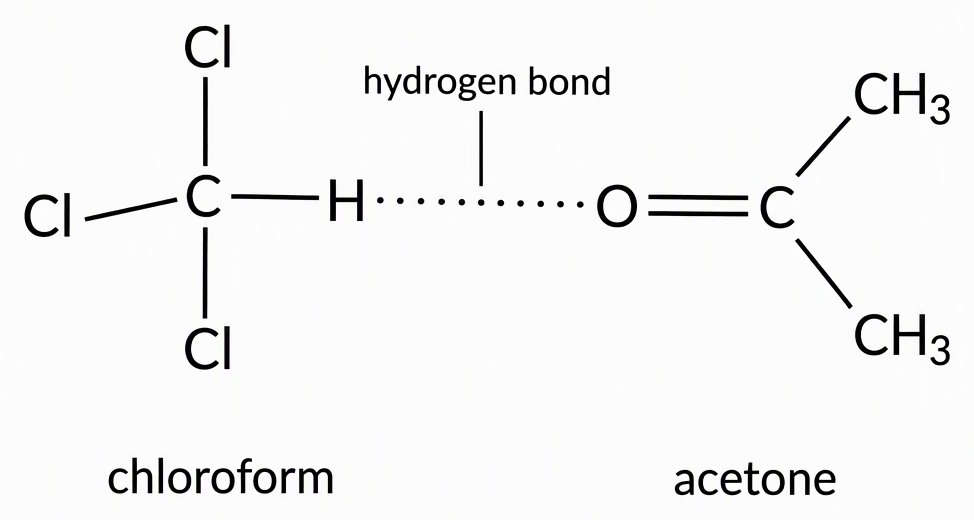
Follow the official argument in order:
- The unlike molecules attract each other more strongly in the liquid.
- Their tendency to escape into vapour decreases.
- The actual vapour pressure falls below the ideal prediction.
The comparison is:
Both pressures must refer to the same temperature and composition. “Lower vapour pressure” does not mean that the mixture must have a lower pressure than either pure liquid. The reference is the Raoult’s-law prediction.
The deviation is negative, so statement B is true. The sign follows from the interaction-strength comparison, not simply from memorising the mixture’s name.
Why is statement C false, and which option survives?
Aniline–phenol shows negative deviation, not the positive deviation claimed in statement C. Aniline and phenol form strong intermolecular interactions with one another, including hydrogen bonding. The official reasoning is the same as for chloroform–acetone: stronger unlike attractions reduce the tendency to escape into vapour, lowering pressure relative to the ideal prediction.
Positive deviation would instead require:
Statement C therefore assigns the wrong sign. The complete truth sequence is statement A true, statement B true, statement C false.
Eliminate the other options:
- Option B fails: It includes false statement C.
- Option C fails: It omits true statement B.
- Option D fails: It includes false statement C and omits true statement B.
Correct option A: statements A and B only.
How can a rigid hydrogen-bonding rule lead to option C?
Rejecting chloroform–acetone solely because chloroform lacks an O–H, N–H or F–H bond would wrongly reject statement B. A student could accept statement A, correctly reject statement C, then make this error. That mistake would lead to option C.
The mistake is treating a useful introductory hydrogen-bonding rule as an exhaustive test. Chloroform’s polarised C–H group can participate in hydrogen bonding with acetone’s carbonyl oxygen. This does not mean that every C–H bond forms a significant hydrogen bond.
Use the interaction-strength comparison instead:
- Identify the unlike-molecule interaction.
- Compare its strength with the interactions in the pure components.
- Infer the vapour pressure relative to Raoult’s law.
The correct option earns 4 marks; the incorrect option earns minus 1. The score difference is:
This is a five-mark difference between the outcomes. It is not a five-mark penalty for a wrong answer.
Can you apply the same reasoning to three related Solutions questions?
Use the full-range definition for ideality and the interaction-to-pressure chain for deviation. These are original practice questions, not additional verified PYQs. Each tests one part of the reasoning used above.
Does obeying Raoult’s law at one measured composition prove ideality?
No. If a binary liquid mixture follows Raoult’s law at one measured composition, that does not establish ideal behaviour throughout the composition range. The observation supports agreement only at that composition.
Statement A tests the stronger condition: the law must hold across the entire range. Do not replace “throughout” with “at one point”.
What deviation occurs when total vapour pressure is below the ideal sum?
Negative deviation. At a fixed temperature and composition, the given comparison is:
The right-hand side is the ideal reference, so the sign follows directly. In the two mixtures studied here, stronger unlike attractions explain this lower pressure by reducing escape from the liquid.
What happens when unlike-molecule attractions are weaker?
The escaping tendency increases, vapour pressure lies above the ideal prediction, and the deviation is positive. Weaker unlike attractions hold molecules less strongly than the relevant attractions in the pure liquids.
Before checking a deviation answer, write the pressure inequality. Then justify its direction using the attraction strength.
Next step: the past-paper archive on NEET JEEnius AI and search past NEET papers by year, subject or chapter, each with a worked solution (100 free searches a month).
Related on NEET JEEnius AI: Optics NEET 2026: Two-Lens Image Position and Signs.
Frequently asked questions
What is the correct answer to the Solutions NEET 2026 question?
Option A is correct: statements A and B only. Ideal solutions obey Raoult’s law at every composition, and chloroform–acetone shows negative deviation. Statement C is false because aniline–phenol also shows negative deviation, not positive deviation.
Why does chloroform mixed with acetone show negative deviation?
Chloroform’s polarised C–H group forms a hydrogen bond with acetone’s carbonyl oxygen, creating stronger unlike-molecule attractions. These attractions reduce the tendency of molecules to escape into vapour. The mixture’s vapour pressure therefore falls below the Raoult’s-law prediction at the same temperature and composition.
Does aniline with phenol show positive or negative deviation?
Aniline–phenol shows negative deviation from Raoult’s law. Strong unlike-molecule interactions, including hydrogen bonding, reduce escape into vapour and lower vapour pressure relative to the ideal prediction.
Does obeying Raoult’s law at one composition prove a solution is ideal?
No, agreement at one composition does not establish ideal behaviour. An ideal solution must obey Raoult’s law throughout the composition range.