Which two statements are false in the restriction enzymes NEET 2026 question?
Statements C and D are false, so option (4) is correct. This restriction enzymes NEET 2026 Biology question is tagged medium in the question bank. Its target solving time is 60 seconds, not an official per-question time limit.
The stem asks for two incorrect claims about restriction endonucleases. The five statements are paraphrased below:
- A: They serve as molecular scissors.
- B: They limit bacteriophage multiplication in E. coli.
- C: They cleave DNA exclusively at the midpoint of a palindromic site.
- D: Their activity is limited to removing terminal nucleotides from DNA fragments.
- E: They recognise particular palindromic base-pair sequences.
The answer combinations are:
- A and B only
- A and E only
- D and E only
- C and D only
Keep statement letters separate from option numbers. Select the false pair, not two familiar, correct descriptions.
Why are C and D false in steps 1–3?
C wrongly makes central cutting compulsory; D assigns end-removal to an endonuclease. Follow the supplied official solution by testing these cutting claims first. Separate sequence recognition, cleavage position and terminal nucleotide removal.
Step 1: Mark the task as “FALSE pair”. The stem asks for statements that are not true. Exclude correct biological descriptions from your final pair.
Step 2: Test C against the cleavage rule. The official explanation says restriction endonucleases usually cut slightly away from the centre of palindromic sites. Recognition identifies the target sequence; it does not impose a universal midpoint-cutting rule.
The word “only” makes C false. Keep “usually” in your correction: saying restriction endonucleases never cut centrally would introduce another false absolute.
Step 3: Test D against the endonuclease–exonuclease distinction. Endonucleases cleave within DNA. Exonucleases remove nucleotides from DNA ends, so D describes the wrong action.
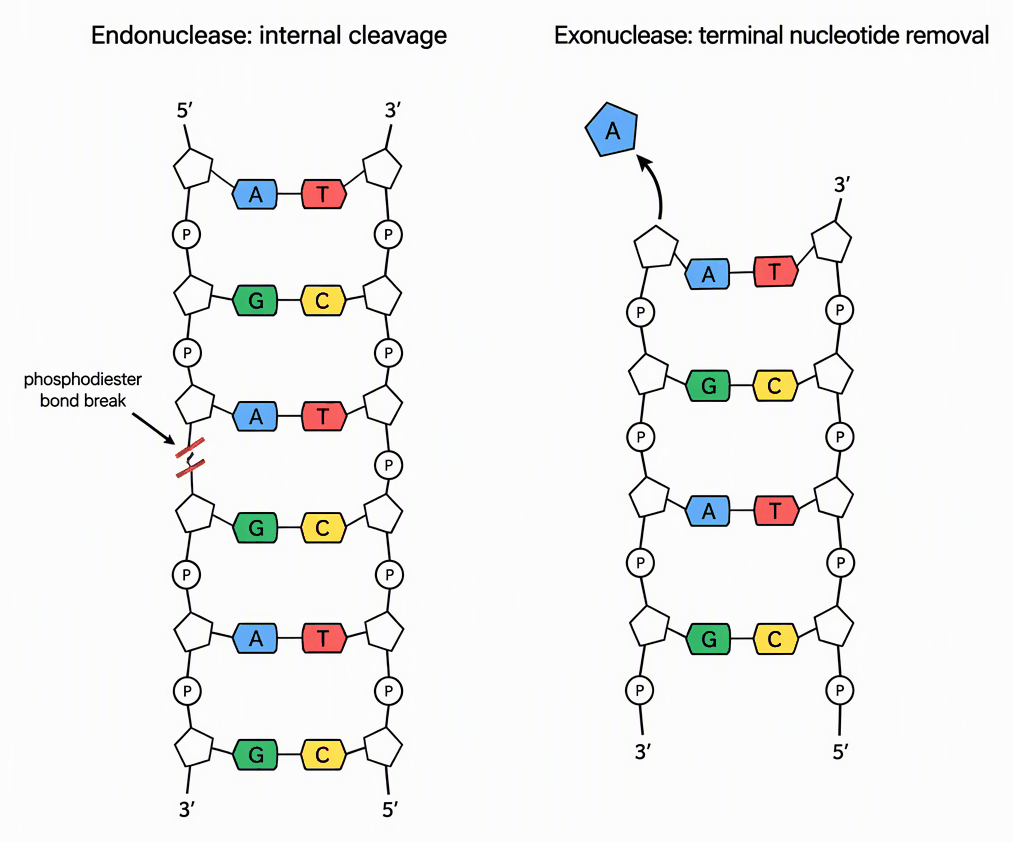
The supplied official solution calls terminal removal “restriction exonuclease” activity; the defining action is exonuclease activity, not internal cleavage. Our provisional false pair is therefore C and D.
How do steps 4–5 confirm option (4)?
A, B and E are true, leaving C and D as the required pair. Step 4 checks that neither false statement has been confused with a correct description.
Step 4: Verify the remaining claims.
- A is true: Restriction endonucleases cut DNA, which is why they are called molecular scissors.
- B is true: They restrict bacteriophage growth in E. coli by cleaving invading phage DNA.
- E is true: The restriction enzymes described in this question recognise specific palindromic base-pair sequences.
A DNA palindrome gives the same sequence when each complementary strand is read in the same direction:
This does not mean reading both written strands from left to right. Complementary DNA strands run in opposite directions.
The statement verdicts are:
- A: True
- B: True
- C: False
- D: False
- E: True
Step 5: Select option (4), C and D only. The supplied answer bank labels this option D. Statement D is false, while answer option D is correct because it contains the two false statements.
How does answering the opposite question produce option (2)?
Option (2), A and E, results from selecting true statements instead of false ones. A solver can correctly recall “molecular scissors” and “palindrome recognition”, then choose this pair using the wrong selection rule. The recall is correct, but the stem asks for statements that are not true.
Option (1) also contains two true statements. Finding a true pair does not answer this negative-stem question.
If the marking scheme awards four marks for a correct answer and deducts one mark for an incorrect answer, the difference between choosing option (4) and option (2) is:
Correct the method before inspecting combinations:
- Write “FALSE pair” beside the stem.
- Assign every statement a true or false verdict.
- Match only the false pair to a numbered option.
Which enzyme joins an insulin gene fragment to a vector?
DNA ligase seals the DNA backbone once compatible ends are prepared. This is original chapter practice, not an additional verified NEET PYQ.
In a simplified recombinant insulin-production step, a DNA fragment carrying the required coding sequence and a plasmid already have compatible ends. Which enzyme seals their sugar–phosphate backbones to produce the recombinant molecule?
- DNA ligase
- Restriction endonuclease
- Exonuclease
- RNA polymerase
Answer: option (1), DNA ligase. Compatible ends can pair, but pairing alone does not seal the backbone. Ligase forms the required phosphodiester bonds.
Keep these actions separate when checking statement D in the main question:
- Restriction endonucleases: Cut within DNA.
- Exonucleases: Remove terminal nucleotides.
- DNA ligase: Joins DNA.
Which insect-gut condition enables Bt protoxin activation?
Alkaline conditions enable the ingested Bt protoxin to become active. This is original chapter practice from Biotechnology and Its Applications, not a question attributed to a past paper.
An insect ingests crystals containing Bt protoxin. Which gut condition enables its activation?
- Alkaline conditions
- Acidic conditions
- Restriction-enzyme cleavage of the toxin protein
- Ligase action on the toxin protein
Answer: option (1), alkaline conditions. The alkaline gut environment solubilises the crystals and permits protoxin activation through processing by gut proteases.
Restriction endonucleases act on DNA, not toxin proteins. DNA ligase also acts on DNA, so neither enzyme supplies the protein-processing mechanism here.
For your next practice question, identify the substrate and action before assigning an enzyme or mechanism.
Next step: the past-paper archive on NEET JEEnius AI and search past NEET papers by year, subject or chapter, each with a worked solution (100 free searches a month).
Related on NEET JEEnius AI: Acidic Strength of Phenols NEET 2026: p-Nitrotoluene.
Frequently asked questions
Which statements are false in the restriction enzymes NEET 2026 question?
Statements C and D are false, so option (4) is correct. C incorrectly says cleavage occurs exclusively at the midpoint of a palindromic site. D assigns terminal nucleotide removal to restriction endonucleases, although that is exonuclease activity.
Do restriction enzymes always cut at the centre of a palindrome?
No, restriction endonucleases do not always cut at the centre of a palindromic recognition site. The supplied solution says they usually cut slightly away from the centre. Recognising a sequence does not impose a universal midpoint-cutting rule.
What is the difference between endonucleases and exonucleases?
Endonucleases cleave within DNA, whereas exonucleases remove nucleotides from DNA ends. This distinction makes statement D false in the question. DNA ligase has a different role: it joins DNA by sealing the sugar–phosphate backbone.
How do you read a palindromic DNA sequence?
Read each complementary strand in the 5′ to 3′ direction. A palindromic DNA sequence gives the same sequence in that direction on both strands. Because the strands run in opposite directions, this does not mean reading both written strands from left to right.