What is the correct answer to the Some Basic Concepts NEET 2001 virus question?
Option B is correct for the Some Basic Concepts NEET 2001 cylindrical-virus question. Divide molar volume by specific volume, then convert grams to kilograms.
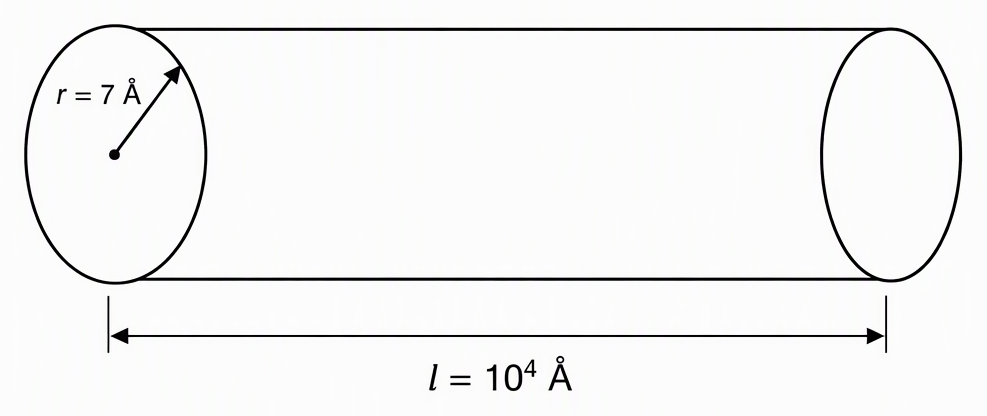
A virus particle is modelled as a cylinder with the radius, length and specific volume given below. Find its molar mass in kilograms per mole using the supplied Avogadro constant.
Choose from these four answers:
- A)
- B)
- C)
- D)
The question bank labels this hard, with an expected solving time of 120 seconds. That is its practice benchmark, not an official exam time allowance. Follow the supplied solution’s three stages: particle volume, molar volume, then molar mass.
How do you convert the dimensions and find one particle’s volume?
Use centimetres because they match the volume unit in the supplied specific volume. Convert both dimensions before using the cylinder formula so that each length multiplier stays visible.
Keep the original numerical multiplier in each conversion:
Use the cylinder-volume formula and the approximation from the supplied calculation:
Squaring the radius squares both the numerical value and its power of ten:
Rewriting the coefficient in scientific notation shifts the final exponent:
This is the volume of one particle, not one mole. Do not attach “per mole” yet: no particle-count conversion has happened.
How do you scale one particle’s volume to one mole?
Multiply the particle volume by Avogadro’s constant. One mole contains the supplied number of particles, so multiply by that count to obtain the summed volume. This is where the mole concept enters the official solution.
Separate the coefficient arithmetic from the exponent arithmetic:
This is the summed volume of the virus particles in one mole, not a container volume including gaps between particles. Keep this stage separate from the next conversion, which gives mass per mole.
Why do you divide by specific volume to get molar mass?
Specific volume means volume per unit mass, so divide molar volume by it to obtain molar mass. Density means mass per unit volume, the reciprocal quantity. The supplied value is not a density to multiply by.
Rearranging for molar quantities gives:
The units confirm the operation:
Substitute the molar volume:
The displayed coefficient 9.27 is rounded. Retaining 9.2708 gives the same stated final answer.
Convert grams to kilograms by dividing by one thousand:
Select option B. The question calls this “molecular weight”, but the unit-bearing answer is a molar mass; relative molecular mass is dimensionless.
Check the operations in this order:
How does dropping the length multiplier produce option A?
Replacing the whole length with the conversion factor alone makes the answer smaller by ten thousand. This is one error that produces A, not a claim about how often students choose it.
The correct conversion retains the numerical length:
The incorrect substitution is:
That is the size of one ångström, not the converted value of every length expressed in ångströms. With the radius unchanged, cylinder volume is proportional to length, so both volume and final molar mass become ten thousand times smaller.
This gives option A. Repair the conversion by always writing numerical value multiplied by conversion factor before combining exponents.
Which three practice questions check the same method?
These original practice questions, not additional verified PYQs, test reciprocal units, the complete calculation sequence and radius-squared scaling. Attempt each before reading its worked answer.
- A substance has the following specific volume. What is its density?
Density is the reciprocal of specific volume:
Check that the units reverse too. Taking only the reciprocal of the number is an incomplete answer.
- Find the molar mass from these particle-volume and specific-volume values.
First find the volume of one mole, then divide by specific volume:
Check all three stages: particle volume to molar volume, division by specific volume, then conversion to kilograms per mole.
- In the original virus model, double the radius while keeping length and specific volume fixed. What is the new molar mass?
Cylinder volume scales with the square of radius, so molar mass becomes four times larger:
Do not recalculate every constant. Identify what changed, apply its scaling power, then retain the original answer’s units.
Next step: photograph a doubt on NEET JEEnius AI and photograph any question you are stuck on and get a step-by-step solution across Physics, Chemistry and Biology (20 free a month).
If that step was the hard part, work through Magnetic Effects NEET 2026: Parallel-Wire Minimum Height.
Frequently asked questions
What is the answer to the Some Basic Concepts NEET 2001 virus question?
Option B is correct: the virus has a molar mass of 1.54 × 10⁴ kg/mol. Calculate one particle's cylindrical volume, multiply by Avogadro's constant, then divide by the specific volume. This gives 1.54 × 10⁷ g/mol, which you divide by 1,000 to convert to kg/mol.
How do I convert the virus dimensions from angstroms to centimetres?
Use 1 Å = 10⁻⁸ cm and retain the numerical value of each dimension. The radius becomes 7 × 10⁻⁸ cm, and the length becomes 10⁴ × 10⁻⁸ = 10⁻⁴ cm. Substituting these into V = πr²l gives a particle volume of approximately 1.54 × 10⁻¹⁸ cm³.
Why do we divide molar volume by specific volume?
Specific volume is volume per unit mass, not density. Dividing molar volume in cm³/mol by specific volume in cm³/g gives molar mass in g/mol. Multiplication would be correct if the supplied quantity were density in g/cm³.
Why do I get option A in the NEET 2001 virus question?
One error that produces option A is using 10⁻⁸ cm as the length instead of converting 10⁴ Å to 10⁻⁴ cm. This drops the length multiplier and makes both particle volume and molar mass 10,000 times smaller. The resulting 1.54 kg/mol matches option A, but the correct answer is 1.54 × 10⁴ kg/mol.