What does the spermatogenesis NEET 2026 question ask?
Spermatids become spermatozoa by differentiation, not another division. That distinction helps solve the spermatogenesis NEET 2026 question from Reproduction, rated medium on this question bank’s scale. The bank’s expected solving time is 60 seconds, not a measured student average.
Assess five claims about the divisions and transformations leading from spermatogonia to spermatozoa. Select the answer combination containing only true claims:
- Statement A: Every division of a spermatogonium is meiotic.
- Statement B: Primary spermatocytes produce secondary spermatocytes through mitosis.
- Statement C: Secondary spermatocytes undergo meiosis II to form haploid spermatids.
- Statement D: A spermatid divides mitotically to become a spermatozoon.
- Statement E: The transformation of spermatids into spermatozoa is called spermiogenesis.
Choose one combination before reading the solution:
Several statements can be true, but you select one answer combination. This is not a multiple-response OMR task.
Why are C and E the only correct statements?
Option (2), C and E only, is correct. Test each statement by matching its starting cell to the process it undergoes and the cell it produces.
- A: False. Spermatogonia undergo mitotic divisions. Sperm formation includes meiosis, but that does not make spermatogonial divisions meiotic.
- B: False. Primary spermatocytes undergo meiosis I to produce secondary spermatocytes. The proposed division is wrong: it is meiosis I, not mitosis.
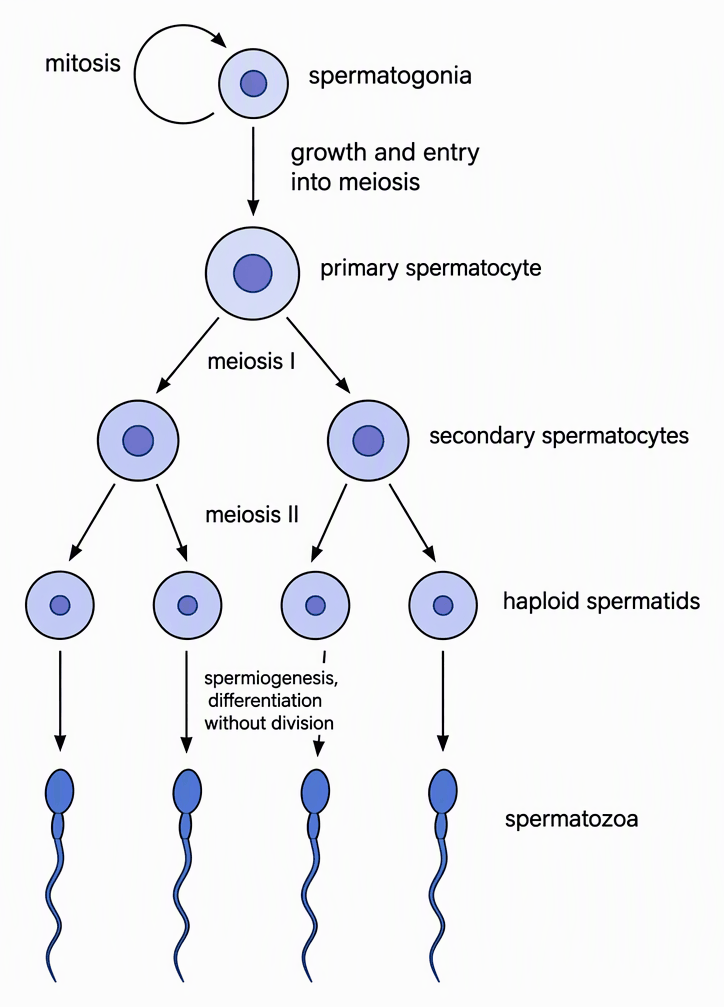
- C: True. Secondary spermatocytes undergo meiosis II to produce haploid spermatids. Meiosis I has already established the haploid state by separating homologous chromosomes. Meiosis II separates sister chromatids; its products remain haploid.
- D: False. Spermatids differentiate into spermatozoa. This transformation changes the cell’s structure without a mitotic division.
- E: True. Spermiogenesis converts spermatids into spermatozoa. Spermiogenesis names that differentiation process, not an extra division after meiosis.
The complete sequence is: spermatogonia divide mitotically; cells entering the meiotic pathway become primary spermatocytes. Meiosis I produces secondary spermatocytes, meiosis II produces spermatids, and spermiogenesis produces spermatozoa.
Worked numerical check: One primary spermatocyte produces two secondary spermatocytes. Each produces two spermatids, so the spermatid yield is:
With all cells completing development, those four spermatids become four spermatozoa. Spermiogenesis does not double the count.
The verdict sequence is false, false, true, false, true. This maps to option (2), labelled B in the supplied answer list. Answer option B is not statement B, which is false.
Eliminate the remaining combinations:
Why does option (3), A, C and E only, fail?
A makes the whole combination incorrect, even though C and E are valid. The error is transferring a fact about the overall pathway to the wrong cell: spermatogenesis includes meiosis, but spermatogonia do not therefore always divide meiotically.
“Spermatogenesis” names the complete sperm-forming pathway. “Spermatogonium” names a particular cell stage within it. Similar names do not mean that every process in the pathway occurs in that cell.
Check each statement in this order:
- Underline the starting cell.
- Identify its next process.
- Check the resulting cell before accepting the claim.
The word “always” invites careful checking, but it is not itself proof that a statement is false. Reject A because spermatogonia undergo mitosis, not because its wording is absolute.
What division does a primary spermatocyte undergo?
Meiosis I produces secondary spermatocytes from a primary spermatocyte. These three questions are original practice from Reproduction, not additional verified NEET PYQs.
Question 1: A primary spermatocyte produces secondary spermatocytes through which process?
- Mitosis
- Meiosis I
- Meiosis II
- Spermiogenesis
Answer: Meiosis I. Meiosis II belongs to secondary spermatocytes, while spermiogenesis acts on spermatids. Statement B in the main question is false because it assigns mitosis to a transition that requires the first meiotic division.
Does meiosis II make spermatids diploid?
No. The resulting spermatids remain haploid. Another division does not restore diploidy; check what separates during that division rather than counting how many divisions have occurred.
Question 2: Secondary spermatocytes are already haploid. After meiosis II, are their spermatids haploid or diploid, and why?
Answer: Haploid. Meiosis I separates homologous chromosomes, establishing the haploid state in secondary spermatocytes. Meiosis II then separates sister chromatids without restoring homologous pairs. Statement C is therefore correct: a secondary spermatocyte undergoes another division while its products remain haploid.
What is the difference between spermiogenesis and spermiation?
Spermiogenesis is differentiation; spermiation is release. Neither term denotes a mitotic division.
Question 3: Name these events in the same order:
- Spermatids becoming spermatozoa.
- Spermatozoa being released from Sertoli cells into the seminiferous-tubule lumen.
Answer: Spermiogenesis and spermiation, respectively. The first changes the cell into its sperm form. The second releases spermatozoa from their association with Sertoli cells into the lumen. When choosing between these terms, check whether the question describes transformation or release.
Primary: meiosis I; secondary: meiosis II; spermatid: spermiogenesis.
Next step: the past-paper archive on NEET JEEnius AI and search past NEET papers by year, subject or chapter, each with a worked solution (100 free searches a month).
For a worked example of the same idea, see Some Basic Concepts NEET 2001: Virus Molar Mass.
Frequently asked questions
Do spermatogonia divide by mitosis or meiosis?
Spermatogonia undergo mitotic divisions. Cells entering the meiotic pathway become primary spermatocytes, which undergo meiosis I to produce secondary spermatocytes.
How many spermatozoa form from one primary spermatocyte?
One primary spermatocyte produces two secondary spermatocytes, which together produce four spermatids. If all cells complete development, these become four spermatozoa through spermiogenesis, without another division.
Are spermatids haploid after meiosis II?
Yes, spermatids remain haploid after meiosis II. Meiosis I establishes the haploid state by separating homologous chromosomes; meiosis II separates sister chromatids without restoring homologous pairs.
What is the difference between spermiogenesis and spermiation?
Spermiogenesis is the differentiation of spermatids into spermatozoa. Spermiation is the release of spermatozoa from their association with Sertoli cells into the seminiferous-tubule lumen. Neither process is a mitotic division.