What is the answer to the standing waves in pipes NEET 2026 question?
Option C is correct for the standing waves in pipes NEET 2026 question: both pipes have five displacement nodes, so their node-count ratio is one. This medium-tier Physics question comes from NEET 2026, held on 21 June 2026, Code-50. It belongs to Oscillations and Waves.
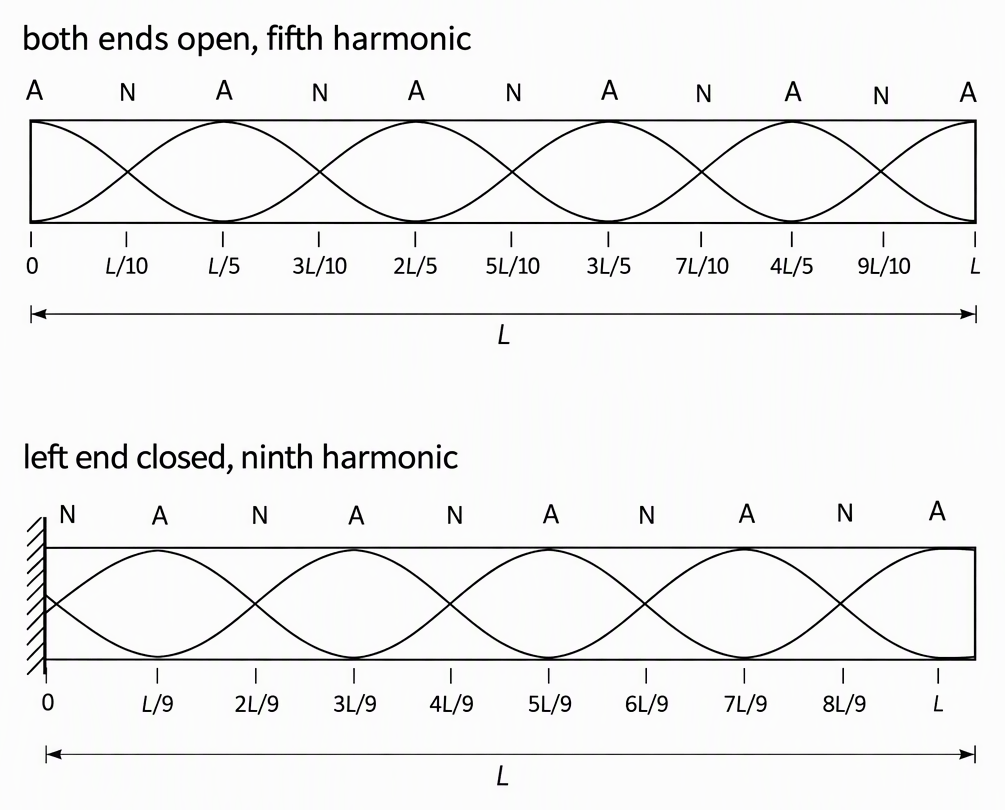
The same pipe first vibrates in its fifth harmonic with both ends open. One end is then closed, and its ninth harmonic is considered. Find the ratio of the open-pipe displacement-node count to the closed-pipe displacement-node count.
The supplied options are:
How do you count nodes in the fifth harmonic of an open pipe?
The fifth harmonic has five displacement nodes, all inside the pipe. The official solution counts displacement nodes: an open end is a displacement antinode, while a closed end is a displacement node. Start with these boundary conditions, not with a rule that harmonic number always equals node count.
Define the length and harmonic number:
Both ends must be antinodes. The pipe therefore contains a whole number of half-wavelength segments, running from one antinode to the next:
Each half-wavelength segment contains exactly one displacement node. The number of segments equals the harmonic number, giving:
The fundamental has one central node. The second harmonic has two nodes at:
For the fifth harmonic, substitute:
Neither open endpoint adds a displacement node. Both are antinodes.
How do you count nodes in the ninth harmonic of a closed pipe?
The ninth harmonic has five displacement nodes, including the closed endpoint. The closed end must be a node and the open end an antinode. These end conditions allow only odd harmonics, so the open-pipe counting rule cannot be carried over unchanged.
Define the harmonic label:
This is not the harmonic’s position in the allowed-mode sequence. The ninth harmonic contains nine quarter-wavelengths; in general:
Begin at the closed-end node:
Successive displacement nodes are separated by half a wavelength. The final node lies one quarter-wavelength before the open-end antinode, so the distance from the first node to the last is:
Divide this distance by the node spacing to find the number of node-to-node intervals:
Intervals are not the same as points. Add the starting endpoint node to obtain the total:
For the ninth harmonic:
These are the five nodes marked in the lower panel. The closed endpoint contributes one and must not be omitted.
What ratio do the two node counts give?
The requested ratio is one, so option C is correct. Both counts refer to displacement nodes, with the closed endpoint included in the second count:
- Open-open pipe: fifth harmonic, five displacement nodes.
- Closed-open pipe: ninth harmonic, five displacement nodes, including the closed end.
Equal node counts do not require equal harmonic numbers because the boundary conditions differ. An open end is a pressure node, but pressure-node counting is not the convention used in this official solution. Do not switch between pressure and displacement midway.
Why does the wrong counting rule give option A?
Option A follows from incorrectly giving the closed pipe nine displacement nodes because it is in its ninth harmonic. The incorrect chain is:
The mistake is applying the open-pipe rule, “node count equals harmonic number”, to a pipe closed at one end. Nine quarter-wavelengths do not mean nine nodes: adjacent displacement nodes are separated by half a wavelength, not a quarter-wavelength.
Repair the method in this order:
- Identify the endpoint conditions.
- Place the first node at the closed end.
- Count half-wavelength spacings to the final node.
- Include the starting closed-end node.
Keep harmonic number separate from allowed-mode number and overtone number. The closed-pipe harmonic sequence is:
Thus, the ninth harmonic is the fifth allowed mode and fourth overtone. The fundamental counts as the first mode, but it is not an overtone.
How can I practise counting nodes in open and closed pipes?
Use the endpoint conditions first, then count nodes or identify the allowed harmonic. These are original related practice questions, not verified past-paper questions. Work each one before checking the answer immediately below it.
- What is the node-count ratio for an open-open pipe’s third harmonic and a closed-open pipe’s fifth harmonic?
The open pipe has three displacement nodes. For the closed pipe, include the closed endpoint:
- How many displacement nodes and antinodes occur in a closed pipe’s seventh harmonic?
There are four of each. Count the closed endpoint as a node and the open endpoint as an antinode; the node and antinode positions alternate.
- Which harmonic is a closed pipe’s fourth overtone, and how many displacement nodes does it have?
Enumerate the allowed harmonics, starting with the fundamental:
The four entries after the fundamental are the first through fourth overtones. Therefore, the fourth overtone is the ninth harmonic, with:
Before selecting an option, mark each endpoint as a displacement node or antinode. Then count half-wavelength spacings and include any endpoint node.
Next step: photograph a doubt on NEET JEEnius AI and photograph any question you are stuck on and get a step-by-step solution across Physics, Chemistry and Biology (20 free a month).
For a worked example of the same idea, see How to Study Work Energy Power NEET: A Practice Plan.
Frequently asked questions
What is the answer to the standing waves in pipes NEET 2026 question?
Option C is correct: the displacement-node count ratio is 1. The open pipe's fifth harmonic has five displacement nodes, and the closed pipe's ninth harmonic also has five, including the closed endpoint.
How many nodes are in the fifth harmonic of an open pipe?
A pipe open at both ends has five displacement nodes in its fifth harmonic. Both endpoints are displacement antinodes, so all five nodes lie inside the pipe. In general, its pth harmonic has p displacement nodes.
Why does a closed pipe's ninth harmonic have five nodes, not nine?
For a pipe closed at one end, the displacement-node count is (q + 1)/2, where q is the actual odd harmonic number. Substituting q = 9 gives five nodes, including the closed endpoint. Nine quarter-wavelengths do not mean nine nodes because adjacent nodes are half a wavelength apart.
Is the ninth harmonic of a closed pipe the fourth overtone?
Yes, for a pipe closed at one end, the ninth harmonic is the fourth overtone and fifth allowed mode. Its allowed harmonics begin 1, 3, 5, 7, 9. The fundamental is the first mode but is not an overtone.