What is the answer to the stationary waves in pipes NEET 2026 question?
Option C is correct: both patterns have five displacement nodes, so their ratio is one. This stationary waves in pipes NEET 2026 question is from Code-50, Physics, Oscillations and Waves. “Medium” is the question bank’s difficulty classification, not a claim about student performance.
Take a pipe open at both ends in its fifth harmonic. Then close one end of the same pipe and consider its ninth harmonic. Compare their displacement-node counts and find the ratio of the first count to the second.
The required ratio is:
The supplied options are:
The question bank’s expected solve time is 75 seconds.
Why does the fifth harmonic of the open pipe have five nodes?
Five half-wavelength sections give five displacement nodes. The official solution counts displacement nodes, and both open ends are displacement antinodes, not nodes. Air at an open end can oscillate with maximum displacement in the ideal standing-wave pattern.
For the fifth harmonic, the pipe length is:
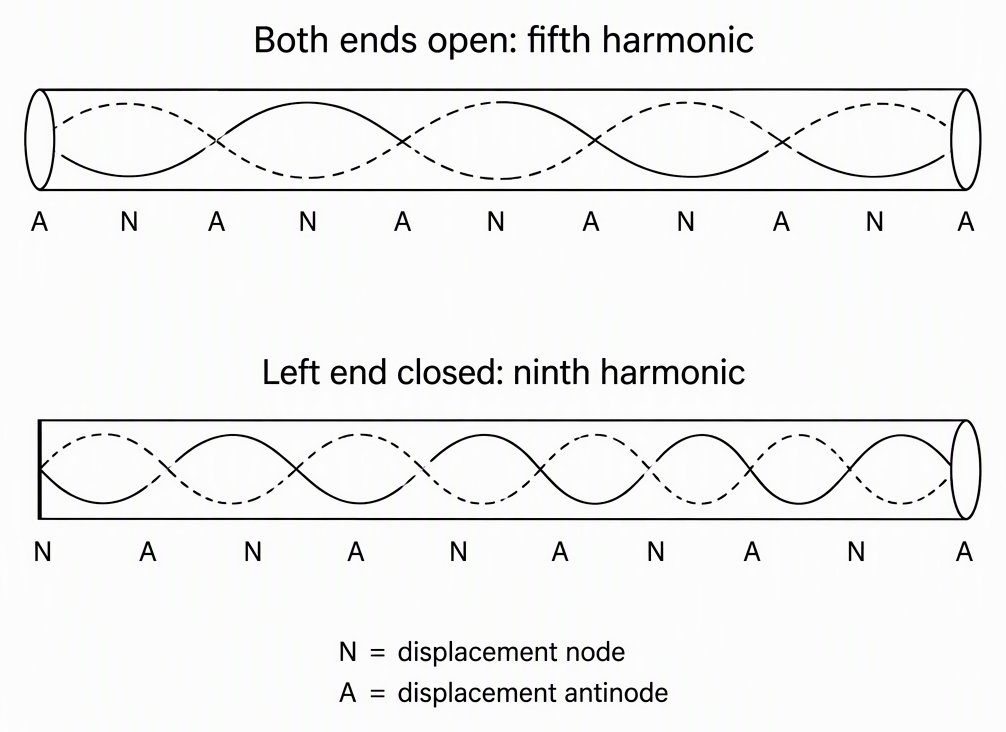
This means five half-wavelength sections fit along the pipe. Each section runs from one displacement antinode to the next, with exactly one displacement node between them.
Read the upper schematic from left to right:
- The pattern begins at an antinode.
- Five antinode-to-antinode sections follow.
- The pattern ends at an antinode.
There are six antinode positions separated by five nodes. The two boundary labels belong to the antinode count; neither is an extra node.
No frequency calculation is needed. Neither sound speed nor a numerical pipe length is needed, because the boundary conditions and harmonic number already specify the pattern.
Why does the ninth harmonic of the closed pipe also have five nodes?
The ninth harmonic contains five displacement nodes, including the closed-end node. A closed end prevents air displacement, so it is a displacement node. The open end remains a displacement antinode. These different end conditions allow only odd harmonics in an ideal pipe closed at one end.
For its ninth harmonic:
The pipe contains nine quarter-wavelength segments. Each segment joins a node to an antinode, so nine segments produce ten alternating marked positions, not nine nodes.
Starting at the closed end, the sequence is:
N–A–N–A–N–A–N–A–N–A
Count the first, third, fifth, seventh and ninth positions. All five are nodes, including the closed-end node.
The requested ratio gives option C:
The wavelength symbols are separate deliberately. An unchanged pipe length does not make the wavelengths of these two modes equal:
After counting directly, use this compact check. An open-pipe harmonic has as many displacement nodes as its harmonic number:
For a pipe closed at one end, use the odd-harmonic rule:
Why is option A wrong?
Option A transfers the open-pipe counting rule to a pipe with different boundary conditions. The incorrect method assigns each node count directly from its harmonic number:
It then gives:
The first assignment works for an open pipe. The second fails because, in the closed pipe’s ninth harmonic, nine counts quarter-wavelength segments, not displacement nodes.
Correct the method by starting at the closed-end node and alternating N and A across all nine segments. Counting node positions gives five; counting the spaces between successive marked positions gives nine. The harmonic number tells you how many quarter-wavelength segments to mark here, not how many nodes to count.
Harmonic number and overtone number are also different. The allowed closed-pipe harmonics are:
The ninth harmonic is the fifth allowed mode and fourth overtone. It is not the ninth overtone.
How can you practise counting displacement nodes?
Use the same boundary-first method for these original related practice questions, not verified past-paper questions. Try each count before reading its worked answer. The last question also checks the difference between an overtone and a harmonic.
How many nodes and antinodes occur in an open pipe’s fourth harmonic?
There are four displacement nodes and five displacement antinodes. Both ends must be antinodes, so the pattern begins and ends with A:
A–N–A–N–A–N–A–N–A
Four half-wavelength sections fit inside the pipe:
Each section contains one node between its bounding antinodes. Adjacent sections share an antinode, giving five antinodes overall, not eight.
How many displacement nodes occur in a closed pipe’s third harmonic?
There are two displacement nodes, including the closed-end node. The third harmonic contains three quarter-wavelength segments:
Starting from the closed end gives N–A–N–A. Three segments create four marked positions, of which two are nodes.
Do not count only the interior node. The closed wall is also a zero-displacement position and belongs in the answer.
Which harmonic is the fifth overtone of a closed pipe, and how many nodes does it have?
It is the eleventh harmonic, with six displacement nodes. The fundamental is the first allowed mode, so the fifth overtone is the sixth allowed mode.
Enumerate the allowed harmonics:
The sixth entry is eleven. Now apply the closed-pipe node rule:
Identify the end conditions, mark displacement nodes and antinodes, then count. Do not use the harmonic label alone.
Next step: photograph a doubt on NEET JEEnius AI and photograph any question you are stuck on and get a step-by-step solution across Physics, Chemistry and Biology (20 free a month).
Keep going with Free NEET Physics Mock Test: Choose the Right Format.
Frequently asked questions
What is the answer to the stationary waves in pipes NEET 2026 question?
Option C is correct: the displacement-node ratio is 1. The open pipe's fifth harmonic has five displacement nodes, and the pipe closed at one end also has five in its ninth harmonic.
How do you count displacement nodes in open and closed pipes?
For a pipe open at both ends, the hth harmonic has h displacement nodes; both ends are displacement antinodes. For a pipe closed at one end, the hth harmonic has (h + 1)/2 displacement nodes, where h is odd. Include the closed-end node in the count.
Why is the node ratio not 5/9?
The closed pipe's ninth harmonic contains nine quarter-wavelength segments, not nine displacement nodes. Its pattern is N–A–N–A–N–A–N–A–N–A, giving five nodes. The open pipe's fifth harmonic also has five nodes, so the ratio is 5/5, not 5/9.
Which harmonic is the fifth overtone of a closed pipe?
The fifth overtone of a pipe closed at one end is the eleventh harmonic. Only odd harmonics are allowed, and the fifth overtone is the sixth allowed mode: 1, 3, 5, 7, 9, 11. It has six displacement nodes, including the closed-end node.