What is the steps of respiration NEET 2026 question and its answer?
Option C is correct: C, B, E, A, D. In this steps of respiration NEET 2026 Biology question from Human Physiology, arrange five events from air entering the lungs through oxygen use by cells. The supplied question bank rates it medium difficulty, with a suggested solving time of 45 seconds.
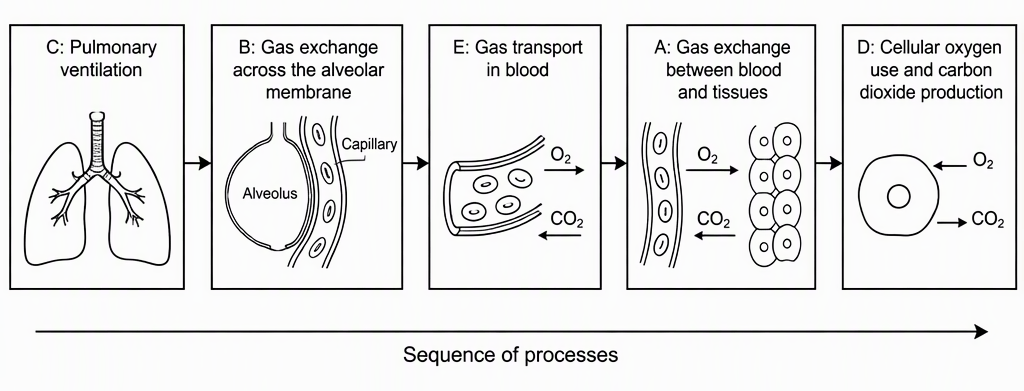
The given steps are:
- A: Gas exchange between blood and tissues.
- B: Gas exchange across the alveolar membrane.
- C: Breathing air in and expelling carbon-dioxide-rich alveolar air.
- D: Cellular respiration.
- E: Carriage of respiratory gases in blood.
Choose from:
Step labels and answer-option labels are separate. The sequence starts with step C and happens to appear under answer option C.
How do you work out all five steps by following oxygen?
The supplied official solution places ventilation first, lung exchange second, blood transport third, tissue exchange fourth and cellular respiration last. Track oxygen’s location rather than memorising letters: it must enter blood at the lungs before blood can carry it to tissues. The two diffusion events belong at different points because they occur at different interfaces.
- Step 1, C: Pulmonary ventilation. Breathing brings atmospheric air into the lungs and releases carbon-dioxide-rich alveolar air. This moves air between the atmosphere and lungs; it does not itself transfer oxygen into blood.
- Step 2, B: Exchange across the alveolar membrane. Oxygen diffuses from alveolar air into blood, while carbon dioxide diffuses from blood into the alveoli. Oxygen has now crossed the lung exchange surface and entered the circulation.
- Step 3, E: Transport by blood. Blood carries oxygen towards tissues and carbon dioxide towards the lungs. This transport links the lung exchange surface to tissue exchange surfaces elsewhere in the body.
- Step 4, A: Exchange between blood and tissues. Oxygen diffuses from blood towards tissues, while carbon dioxide enters blood from tissues. This is a second diffusion event at a different location.
- Step 5, D: Cellular respiration. Cells utilise oxygen in catabolic reactions, with carbon dioxide released as a result of cellular respiration. This is metabolic use inside cells, not the mechanical movement of air during breathing.
Correct answer: option C. The verbal recall chain is: ventilate → exchange at lungs → transport → exchange at tissues → cellular use.
These processes operate continuously in the body. The question asks for their functional order, not five globally separate time intervals.
Why does option D put tissue exchange too early?
Its first broken link jumps from breathing directly to tissue exchange. Oxygen must first cross the alveolar membrane into blood, then be transported to tissues. Starting with ventilation and ending with cellular respiration is not enough; check the middle links in the distractor:
The first transition is the error:
The method mistake is treating the two diffusion events as interchangeable because both involve oxygen and carbon dioxide. Repair it by attaching a location to each label before ordering:
- B: Alveoli ↔ blood.
- A: Blood ↔ tissues.
Conditional marking check: if the applicable scheme awards 4 marks for a correct response and deducts 1 for a wrong response, correcting an answer changes the score by:
Check the middle links before selecting the option.
What immediately follows diffusion across the alveolar membrane?
Transport of gases by blood comes next. Alveolar diffusion gets oxygen into blood; transport carries it towards tissues before tissue-level diffusion occurs. The following three questions are original related practice from Human Physiology, not additional verified PYQs.
Question: In the standard sequence of human respiration, which process follows diffusion across the alveolar membrane?
Answer: B) Transport of gases by blood. The relevant segment is:
Which way do oxygen and carbon dioxide diffuse at tissues?
Oxygen moves from blood into tissues; carbon dioxide moves from tissues into blood. Tissues use oxygen and produce carbon dioxide, supporting these net movements down the gases’ respective partial-pressure gradients.
Question: At the blood–tissue interface, which pair of net diffusion directions is correct?
Answer: C. Contrast this with the lungs: oxygen moves from alveoli into blood, while carbon dioxide moves from blood into alveoli. Identify the exchange site before choosing directions.
Which event is cellular respiration rather than breathing?
Cellular oxygen use in catabolic reactions belongs to cellular respiration. Ventilation moves air between the atmosphere and lungs; cellular respiration concerns metabolic oxygen use and carbon dioxide production.
Question: Which event belongs to cellular respiration rather than pulmonary ventilation?
Answer: D. The complete sequence is:
Answer option C. Next, practise identifying prerequisites in Renin-Angiotensin Mechanism NEET 2026: Correct Order, and justify each adjacent pair before checking the answer.
Frequently asked questions
What is the correct order of the five steps of respiration?
The functional order is pulmonary ventilation → alveolar gas exchange → blood transport → tissue gas exchange → cellular respiration. For the labels in this question, that gives C, B, E, A, D, which is option C. These processes run continuously; the sequence does not imply five separate time intervals.
Why is option D wrong in the steps of respiration question?
Option D gives C, A, B, E, D, placing tissue exchange immediately after ventilation. Oxygen must first cross the alveolar membrane into blood and then travel in blood to the tissues. The first incorrect link is therefore C → A.
What comes after diffusion across the alveolar membrane?
Transport of respiratory gases by blood follows alveolar diffusion in the functional sequence. Once oxygen enters blood at the lungs, blood carries it towards tissues before tissue-level gas exchange occurs.
What is the difference between breathing and cellular respiration?
Breathing, or pulmonary ventilation, moves air between the atmosphere and lungs. Cellular respiration involves metabolic oxygen use inside cells and carbon dioxide production. In this question’s functional sequence, ventilation comes first and cellular respiration comes last.