What is the correct answer to the thermal expansion NEET 2026 sphere question?
Option C is correct for the thermal expansion NEET 2026 sphere question. A metal sphere has an initial radius R, its temperature rises slightly by ΔT, and its material has linear expansion coefficient α. The task is to find the approximate volume gained, not the final volume.
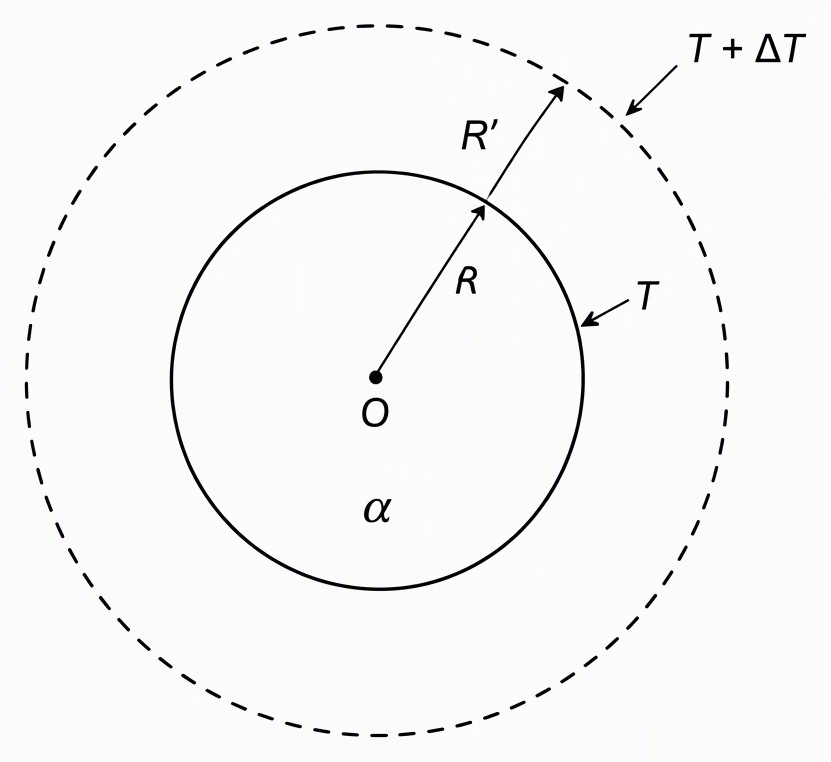
The supplied choices are:
This Physics MCQ belongs to Properties of Solids and Liquids. Its medium difficulty and 45-second target are question-bank metadata, not measured student performance. Keep two factors separate: the sphere’s geometric factor four-thirds and the material’s volume-expansion factor three.
What initial volume and expansion coefficient should I use?
Use the complete sphere-volume formula and the volumetric expansion coefficient. The given linear coefficient describes expansion in one direction, so it cannot be inserted unchanged into a volume-change formula. First write the geometry, then choose the coefficient.
The initial volume is:
The coefficient symbols mean:
Under the usual isotropic assumption, the metal expands equally in all directions. For small expansion:
Within the first-order calculation, write:
Keep the two numerical factors visible:
- Geometry: the sphere-volume formula supplies the factor four-thirds.
- Expansion law: converting the linear coefficient to the volumetric coefficient supplies the factor three.
Both belong in the substitution before cancellation.
How does substitution give option C?
Substitution gives option C, because the expansion factor three cancels the denominator in the sphere’s geometric factor. Keep the initial volume visible until that cancellation is complete.
First substitute the volumetric coefficient:
Then substitute the initial sphere volume:
Simplify the numerical factors:
Therefore:
Select C. This expression is the increase alone. For the final volume, the initial volume must also be included:
What does “approximate” allow, and how can I check the answer?
“Approximate” means retaining only the first-order thermal-expansion term, not rounding away a geometric factor. The actual smallness condition is:
Retain terms proportional to:
Neglect terms of this order and higher:
Check the result by dividing the increase by the initial volume. It must give the first-order fractional volume expansion:
Check the dimensions too:
The coefficient and temperature-rise units cancel, leaving volume units. For an ordinary metal with a positive expansion coefficient, heating must produce a positive volume increase.
For the question bank’s 45-second target, practise this recall sequence: initial volume, three times the linear coefficient, substitute, cancel, select C. Retain the factors in your working rather than memorising the final expression alone.
How does dropping the sphere’s geometric factor produce option B?
Option B follows from dropping the sphere’s factor four-thirds while keeping the correct volume-expansion coefficient. The error is turning a scaling statement into an incomplete geometry formula.
The valid scaling statement is:
It does not mean:
Using that incorrect volume gives:
This matches option B. Proportionality tells you how volume changes when radius changes; it does not supply the shape’s numerical prefactor.
The incorrect result still has volume units, so dimensional analysis alone cannot reject it. Write the complete geometry formula before inserting the thermal-expansion coefficient. Here, preserving four-thirds separates C from B; the small-expansion approximation does not permit dropping it.
How can I solve three related thermal-expansion questions?
Keep the small-expansion assumption, but choose the law for the quantity asked: fractional volume, surface area or density. These are original related practice questions, not additional verified NEET PYQs. Each reuses the original sphere, heating and symbols.
What is the fractional increase in the sphere’s volume?
Divide the volume gained by the initial volume:
The radius cancels because both volumes contain the same radius-cubed factor. Under the same heating, spheres of this material have the same fractional expansion despite different sizes.
What is the approximate increase in the sphere’s surface area?
Use the area-expansion factor two, not the volume-expansion factor three. Start with the initial surface area:
Apply the first-order area-expansion law:
The radius-squared factor supplies area units. A volume-change expression has the wrong dimensions here.
What is the approximate density after heating if no mass is lost?
Density decreases because the same mass occupies a larger volume. Using the first-order expanded volume gives:
The reciprocal approximation neglects second-order and higher terms. The approximate decrease is:
Cover the worked answers and redo the main question against the 45-second question-bank target. Write the full sphere-volume formula before substituting.
Next step: the past-paper archive on NEET JEEnius AI and search past NEET papers by year, subject or chapter, each with a worked solution (100 free searches a month).
If that step was the hard part, work through How to Study Electromagnetic Induction NEET: 6 Steps.
Frequently asked questions
What is the answer to the Thermal Expansion NEET 2026 sphere question?
Option C is correct: the approximate volume gained is ΔV = 4πR³αΔT. Substitute V = (4/3)πR³ into ΔV = 3αVΔT. This gives the increase alone; the final volume is V + ΔV.
Why do we use 3α for volume expansion?
The linear expansion coefficient α describes expansion in one direction. For an isotropic material undergoing small expansion, the volumetric expansion coefficient is approximately 3α. Use this coefficient with the initial volume in the volume-change formula.
What does approximate mean in the sphere expansion question?
The first-order approximation requires |αΔT| ≪ 1. Retain terms proportional to αΔT and neglect terms containing (αΔT)² and higher powers. The approximation does not allow you to drop the sphere's geometric factor 4/3.
Why is option B wrong in the sphere expansion question?
Option B results from incorrectly using V = πR³ instead of V = (4/3)πR³. Multiplying that incomplete volume formula by 3αΔT gives 3πR³αΔT. The wrong result still has volume units, so dimensional analysis alone cannot catch this error.