
How should I start studying Electromagnetic Induction for NEET?
- Repair only the prerequisites you cannot use. In Electromagnetic Induction for NEET, identify what changes before choosing a formula. Separate three decisions: the cause of induction, emf magnitude and current direction.
Check four skills before proceeding:
- Vector dot product: use it to select a component.
- Area normal: identify the direction perpendicular to a loop’s plane.
- Magnetic force: find the force direction on a positive moving charge.
- Ohm’s law: connect emf and current using circuit resistance.
Repair the missing skill, not the entire Magnetism chapter. Study NCERT in this order: magnetic flux, Faraday’s law and Lenz’s law, motional emf, then self and mutual induction. Read its diagrams and physical reasoning, not just highlighted equations.
- Write a change statement for every question. State whether the magnetic field, enclosed area, orientation or current producing the linked flux changes.
For a uniform field across a flat loop:
The angle is between the field and the area normal, not the plane.
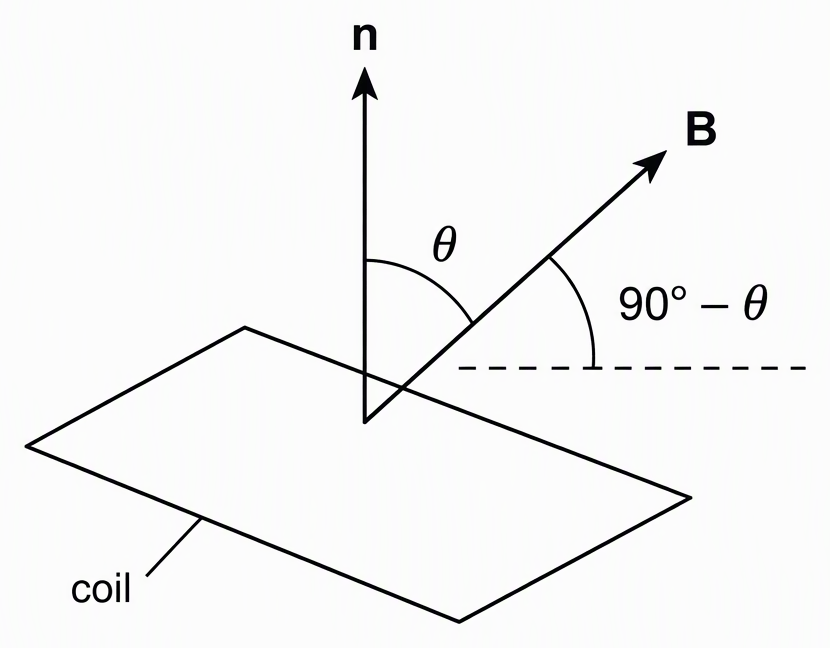
Motion alone does not guarantee a net emf. A rigid loop translating wholly within a uniform, steady field has unchanged flux and no net emf around it.
How do I choose the emf formula and determine direction?
- Calculate magnitude from the change statement first. Keep direction separate until the magnitude is settled. Choose the equation by what changes and the stated geometry:
- Average emf: use the flux change over the stated interval.
- Instantaneous emf: use the rate at the requested instant.
- Moving rod: use this when rod length, velocity and magnetic field are mutually perpendicular.
- Self-induction: use this for constant self-inductance.
Flux here means flux through one turn, with identical linkage through the turns. Do not multiply by the number of turns twice.
Average and instantaneous rates agree throughout an interval only when flux changes linearly. The moving-rod expression is not universal: check geometry before substituting.
- Determine direction through a fixed chain: identify the external flux change, choose the induced field opposing that change, then apply the right-hand grip rule.
- Increasing into-page flux: induced field points out of the page, giving counterclockwise current.
- Decreasing into-page flux: induced field points into the page, giving clockwise current.
Point your right thumb along the induced field; curled fingers give conventional current direction. Lenz’s law opposes the change in flux, not necessarily the original field.
For a moving rod, the force direction on positive charges follows:
What should I check after finding the induced emf?
- Identify the quantity actually requested. Stop at emf if that is the question; calculate further only for current, charge, force or energy. An open conductor can have induced emf without a sustained conduction current.
For a simple closed resistive circuit with negligible inductive effects:
Use total circuit resistance, not just the most visible resistor. For charge, connect current to time; for force or energy, identify the relevant mechanical or magnetic relation.
- Check SI units, angle convention, limiting cases and energy consistency. Zero flux change means zero net induced emf around a stationary loop.
Build a short formula sheet with a condition beside every expression. Alongside the equations above, include stored energy for constant self-inductance:
For constant mutual inductance, the emf magnitude in the second coil is:
Add two conceptual prompts: how do eddy currents produce magnetic braking and damping, and why do laminations reduce core losses? Laminations interrupt large conducting paths and increase their resistance, reducing circulating currents and heating.
Keep this sheet about induction, not AC-circuit analysis. For a small daily follow-up, NEET JEEnius AI daily practice problems provide a fresh topic set every day, with 20 free attempts a month.
How do I solve a changing-field question with an angle trap?
Use the angle from the area normal, not the coil’s plane. In this example, the induced emf is one volt, constant during the stated linear increase.
This and the next two problems are constructed teaching examples, not previous-year NEET questions.
A stationary coil has the following number of turns, area per turn and angle between its normal and a uniform field:
The field increases linearly:
Find the induced emf magnitude. Change statement: only the magnetic field changes; area and orientation remain fixed.
The linear field increase makes the instantaneous emf magnitude equal to this average throughout the interval. If the stated angle were measured from the coil’s plane, the projection factor would instead be:
Check: making the normal perpendicular to the field would make this field-change contribution zero.
How do I find emf, polarity and current in a sliding rod?
Use changing loop area to determine current direction, then cross-check polarity using magnetic force. Here, the rod develops an emf of one volt, with its upper end at higher potential; the circuit current is counterclockwise.
A vertical conducting rod slides right along horizontal rails. A resistor joins the rails on the left; the rails and rod lie in the page, and the uniform field points into the page.
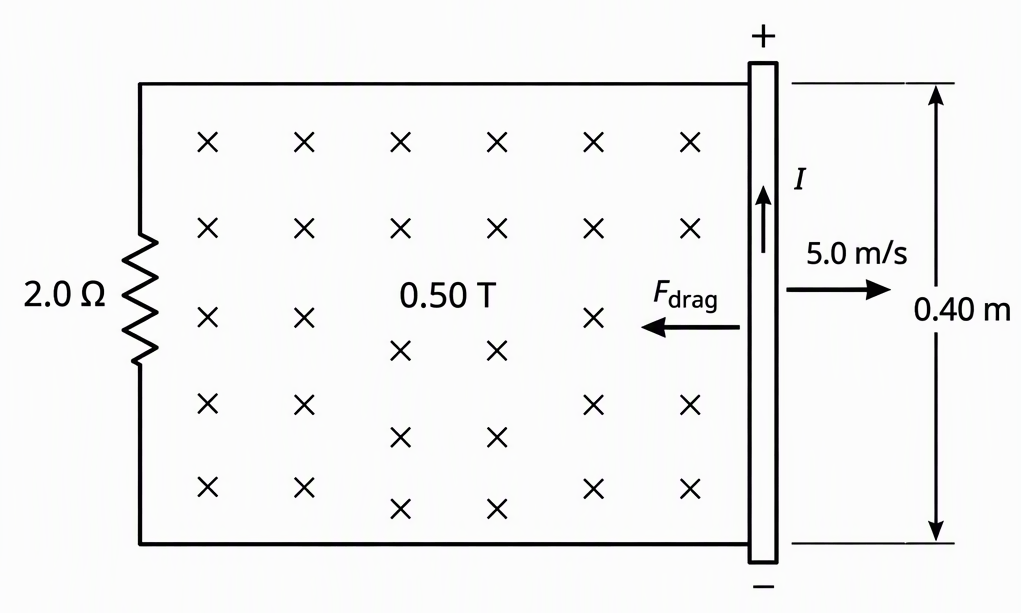
Circuit inductance is negligible. The given values are:
Change statement: enclosed area increases, so into-page flux increases.
Lenz’s law requires an out-of-page induced field and counterclockwise current: upward through the rod. Velocity crossed with magnetic field also points upward, so positive charges are pushed towards the upper end.
Check the magnetic drag and the external power needed to maintain speed:
Trap: magnetic drag opposes motion. Induction supplies no free mechanical energy.
How do I solve self-induction when current decreases?
Use the rate of current change for emf magnitude; determine direction separately. Here, the self-induced emf magnitude is forty volts, and the initial stored magnetic energy is 0.40 joule. The emf tends to maintain the original current because the coil opposes the fall in its linked flux.
A coil has constant self-inductance, and its current falls uniformly to zero:
Find the emf magnitude and initial stored energy. Change statement: the coil’s current, and therefore its linked magnetic flux, decreases.
Do not call the magnitude negative. A signed emf requires a reference direction.
An inductor opposes change in current; a resistor opposes current. Do not infer the final circuit current without knowing the rest of the circuit.
What should I practise next if I keep making mistakes?
Begin with NCERT worked examples and relevant exercise questions, then practise individual types before mixing them. Memorising equations alone is insufficient: you must identify their conditions and determine direction.
Use this finite sequence:
- Attempt two questions each on changing field, changing area or angle, Lenz-law direction, moving rods, self-induction, mutual induction and eddy-current concepts.
- For every wrong attempt, record only the failed step: classification, angle, direction, equation conditions, circuit resistance, units or arithmetic.
- Apply the matching correction before another question.
- Reattempt incorrect questions without the solution visible.
- Move to an unseen mixed set, using verified previous-year questions where available.
Match the correction to the error:
- Angle: redraw the area normal.
- Direction: write the external-flux change before applying the grip rule.
- Emf versus current: distinguish an open conductor from a closed circuit.
If magnetic-force or field-direction basics are weak, use Magnetism Practice Questions NEET: 6 Worked MCQs before returning to moving rods. Your exit criterion is specific: justify the equation and current direction before consulting the answer options.
For the unseen-set stage, NEET JEEnius AI practice mode offers topic sets that skip questions already seen, with 60 free sets a month; choose the topic matching your failed step.
Frequently asked questions
How should I start studying electromagnetic induction for NEET?
Check that you can use vector dot products, identify an area normal, determine magnetic-force direction and apply Ohm's law. Repair only the missing skills, then study NCERT in this order: magnetic flux, Faraday's and Lenz's laws, motional emf, then self and mutual induction.
How do I find induced current direction using Lenz's law?
Identify whether the external magnetic flux increases or decreases, then choose the induced field that opposes that change. Apply the right-hand grip rule: point your thumb along the induced field, and your curled fingers give conventional current direction. Increasing into-page flux gives counterclockwise current; decreasing into-page flux gives clockwise current.
When can I use emf = Blv in NEET questions?
Use the moving-rod expression when the rod length, velocity and magnetic field are mutually perpendicular. Check the geometry before substituting values. Motion alone does not guarantee net emf: a rigid loop translating wholly within a uniform, steady field has unchanged flux and no net emf around it.
What should I practise if I keep making mistakes in electromagnetic induction?
Start with NCERT worked examples and relevant exercises, then attempt two questions each on changing field, changing area or angle, Lenz-law direction, moving rods, self-induction, mutual induction and eddy-current concepts. Label each error by its failed step, such as angle, direction, equation conditions or circuit resistance, and apply the matching correction. Reattempt wrong questions without viewing solutions before moving to an unseen mixed set.