
Which free Magnetism practice should I start with for NEET?
Start with worked MCQs if you cannot explain your answers, verified PYQs to check exam alignment, and full-length mocks to test whole-paper performance. For free Magnetism practice questions, NEET students can attempt the six-question worked starter set below.
This page covers Moving Charges and Magnetism plus Magnetism and Matter. Electromagnetic Induction and Alternating Current are separate topics, not bundled into Magnetism.
How do worked MCQs, verified PYQs and full-length mocks compare?
Worked MCQs explain reasoning, verified PYQs establish what was actually asked, and mocks test performance across subjects. Choose by the feedback you need, not the size of the question bank.
Each comparison follows the same order: this page’s original worked MCQs; verified NEET Magnetism PYQs; NEET JEEnius AI full-length mocks.
- Best use: Repair a specific concept; check authentic exam wording; assess performance across a complete paper.
- Topic focus: Six selected Magnetism skills; Magnetism questions identified within past papers; all three subjects, not a dedicated Magnetism set.
- Answer support: Worked laws, assumptions and traps; an official final key establishes the accepted answer but may not explain it; a scored per-subject breakdown.
- Exam authenticity: Original NEET-style practice, not PYQs; actual questions when traced to official papers; paper simulation, not evidence of past-paper frequency.
- Feedback: Compare your reasoning with each explanation; check answers and investigate mistakes separately; review subject scores and individual errors.
- Free-access scope: All six questions and solutions are below; check that a chosen free PYQ source exposes its questions and promised answers; 30 free full-length mocks a month, each with 180 questions, 720 marks and 180 minutes.
- Main limitation: Not a complete chapter test; chapter classification may require manual work; a Physics score is not a Magnetism-specific diagnostic.
Which option fits my class and current preparation?
Choose worked questions when the rule is uncertain, PYQs when familiar examples feel too predictable, and full papers when chapter knowledge is sound but performance varies. Readiness matters more than your class label.
- Class 11, studying ahead: Learn the relevant vectors, force and current concepts first. Unfamiliar Class 12 content is not evidence of poor ability.
- Class 12, chapter just completed: Begin with worked MCQs. Explain the governing rule before substituting values.
- Comfortable with familiar examples, weak when wording changes: Attempt verified PYQs without opening the key first.
- Dropper with sound chapter knowledge: Use full mocks and inspect Magnetism errors for knowledge gaps, execution errors and time pressure.
- Repeated direction mistakes: Repair the direction rule itself. More questions do not correct a faulty method.
For parents, targeted practice repairs a skill; paper simulation tests how skills hold together. Neither a larger question count nor a paid label proves that a resource fits the student’s present need.
Can I try free Magnetism practice questions for NEET now?
Attempt these six questions before reading the solutions, and write one reason beside each choice. This is original NEET-style starter practice, not actual NEET questions, a complete chapter test or a predicted paper. The set samples selected skills and cannot establish mastery of the full Magnetism syllabus.
Mark every guessed answer, even if it turns out correct. Check its reasoning during review rather than counting it as a mastered concept.
Question 1: What force acts on a charge moving parallel to a magnetic field?
A particle with nonzero charge moves at nonzero speed parallel to a uniform magnetic field. What is the magnetic force on it?
- A. Zero
- B. Charge magnitude multiplied by speed and field magnitude
- C. Half the quantity described in B
- D. Twice the quantity described in B
Question 2: What happens to the circular-path radius when speed doubles?
A non-relativistic charged particle moves perpendicular to a uniform magnetic field. Its speed doubles while mass, charge magnitude and field remain constant. The new radius is:
- A. Half the original
- B. Unchanged
- C. Twice the original
- D. Four times the original
Question 3: What happens when both wire current and observation distance double?
A long straight wire carries a steady current. Both the current and the perpendicular distance of the observation point from the wire double. The magnetic-field magnitude becomes:
- A. Half the original
- B. Unchanged
- C. Twice the original
- D. Four times the original
Question 4: What happens when a circular coil’s radius doubles?
The radius of a circular coil doubles. Its current and number of turns are held constant. The magnetic field at its centre becomes:
- A. One-quarter of the original
- B. Unchanged
- C. Twice the original
- D. Half the original
Question 5: When is the torque on a current loop maximum?
A planar current loop has fixed magnetic-moment magnitude in a uniform magnetic field of fixed magnitude. Torque magnitude is maximum when its magnetic moment is:
- A. Parallel to the field
- B. Antiparallel to the field
- C. Perpendicular to the field
- D. At an angle of thirty degrees to the field
Question 6: Which magnetic material has small negative susceptibility?
A material has small negative magnetic susceptibility and is weakly repelled from the stronger-field region of a non-uniform magnetic field. It is:
- A. Paramagnetic
- B. Diamagnetic
- C. Ferromagnetic
- D. An ideal non-magnetic material with zero susceptibility
What are the answers and worked explanations?
The answers are 1-A, 2-C, 3-B, 4-D, 5-C and 6-B. Check the governing rule as well as the letter. A correct guess still needs review; a wrong answer with the right law may need only an angle or proportionality correction.
1. A, zero magnetic force. The force depends on the angle between velocity and magnetic field:
Parallel motion makes that angle zero, so the sine factor vanishes. We are finding magnetic force only; the trap is using the perpendicular-motion result merely because the particle is charged and moving.
2. C, twice the radius. For perpendicular, non-relativistic motion under the magnetic force alone:
With mass, charge magnitude and field fixed, radius is directly proportional to speed. Choosing four times the radius confuses its speed dependence with that of kinetic energy.
3. B, unchanged field. For an ideal long straight wire in vacuum, or air to the usual approximation:
Doubling the numerator and denominator leaves the ratio unchanged. The trap is noticing the increased current but ignoring the increased perpendicular distance.
4. D, half the field. At the centre of a circular coil with closely spaced turns:
Current and turn count stay fixed, so doubling radius halves the field. An inverse-square answer is incorrect here; allowing the current to change also contradicts the question.
5. C, magnetic moment perpendicular to the field. The magnetic moment points normal to the loop’s plane. Therefore, maximum torque occurs when the loop’s plane is parallel to the field, not perpendicular.
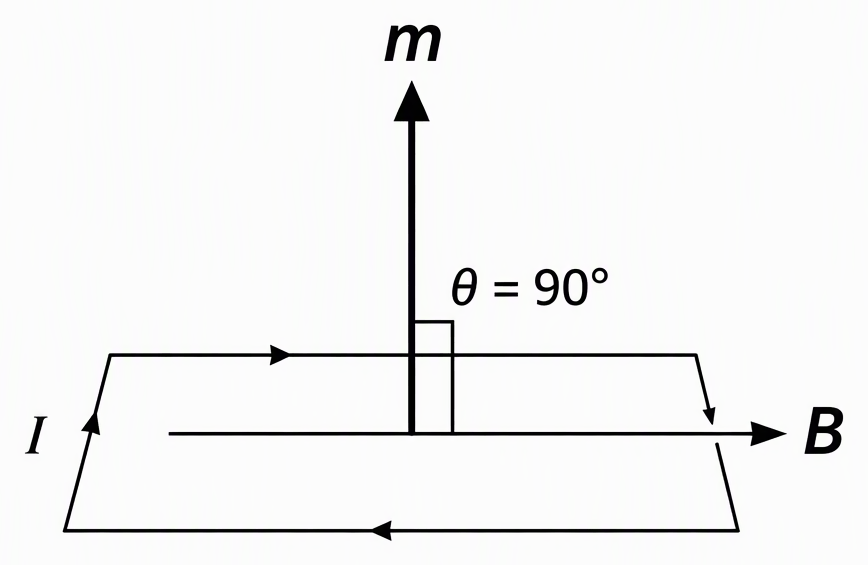
Here, the angle is between magnetic moment and field. With their magnitudes fixed, the sine factor must be maximum; using the angle between the plane and field is the trap.
6. B, diamagnetic. In the usual weak-field classification, diamagnetic materials have small negative susceptibility: their induced magnetisation opposes the applied field. They are weakly repelled from stronger-field regions.
The trap is confusing “weak” with paramagnetism, which has small positive susceptibility and weak attraction. Zero susceptibility would mean no induced magnetisation in this ideal classification.
When are PYQs better, and how can I check a free set?
Move to PYQs when you can explain the starter answers independently and want authentic exam wording. They show how a concept was actually asked. Do not accept a publisher’s “PYQ” label as verification by itself.
- Trace the question: Require a year and paper or question identifier, then match it to the official paper and final answer key.
- Check current scope: Older papers may contain material outside the current syllabus. Consult the current official syllabus at neet.nta.nic.in rather than assuming every old question remains relevant.
- Check the free-access claim: Both questions and promised answers should be accessible without an undisclosed payment step.
- Check the explanation: An answer-only collection is not enough when you cannot explain your mistakes.
Official verification establishes that a question was asked, not that the collection explains it well. Use worked reasoning to find the faulty step instead of repeatedly checking answer letters.
How should I review mistakes before taking a full mock?
Classify every wrong or guessed answer before choosing more practice. For optional scoring, use the current rule: award 4 marks for a correct answer, deduct 1 for a wrong answer, and award 0 for an unattempted question. This small set cannot predict your NEET score.
- Concept error: Restate the governing law and when it applies.
- Direction or geometry error: Redraw the velocity, field, force or loop normal; mark the relevant angle.
- Proportionality or calculation error: Write the proportional relationship before calculating.
- Reading error: Identify the missed condition, such as “current held constant,” and underline it on reattempt.
For charge-motion and force errors, use Laws of Motion practice questions with worked solutions to revisit the force-to-motion link. Reattempt the Magnetism question after correcting that step.
What should I check before choosing more Magnetism practice?
Check whether your remaining problem is an unexplained concept, unfamiliar wording or performance under a whole-paper time limit. Pick a resource that addresses that problem rather than chasing a daily question quota.
Are PYQs alone enough?
They provide authentic past-paper wording, but they do not automatically repair an unresolved concept. Return to a worked example whenever you cannot explain why your chosen answer fails.
Does this cover both Magnetism chapters?
Yes, the scope includes Moving Charges and Magnetism and Magnetism and Matter. The six-question starter is selective, not exhaustive; success here does not certify full-chapter readiness.
What makes a solution worth using?
It states the applicable law, its conditions and the reasoning that connects it to the answer. An answer letter alone does none of those jobs.
How many questions should I solve before moving on?
Move on when you can reason independently and recurring errors stay corrected on unfamiliar questions. Reattempt each wrong or guessed starter question with the solution hidden, and write the condition you missed.
Once corrections hold without help, use a full paper to check whether chapter learning survives competing demands. NEET JEEnius AI provides 30 free full-length mocks a month, each with 180 compulsory questions in 180 minutes: 45 Physics, 45 Chemistry and 90 Biology.
The 180-minute limit is a whole-paper constraint, not a rule that every Physics question deserves exactly the same time. Use the scored per-subject breakdown to assess paper performance, then manually review individual Magnetism errors for knowledge, execution and time pressure rather than expecting a chapter-specific report.
Next step: full-length mock tests on NEET JEEnius AI and sit a full 180-question, 720-mark, 180-minute paper, 45 Physics, 45 Chemistry and 90 Biology, and get a scored per-subject breakdown (30 free a month).
Frequently asked questions
Where should I start with free Magnetism practice for NEET?
Start with the six worked MCQs if you cannot consistently explain your answers. Attempt each question before opening its solution, write one reason for your choice and mark every guess for review.
Does this practice set cover both NEET Magnetism chapters?
The set samples Moving Charges and Magnetism plus Magnetism and Matter. It does not include Electromagnetic Induction or Alternating Current. Six questions are not a complete chapter test and cannot establish full-chapter readiness.
How do I check whether a Magnetism question is a real NEET PYQ?
Look for a year and paper or question identifier, then match the question to the official paper and final answer key. Check the current official syllabus at neet.nta.nic.in because older questions may fall outside its scope. A publisher's PYQ label alone is not verification.
Are PYQs alone enough for NEET Magnetism?
PYQs provide authentic past-paper wording, but they do not automatically repair unresolved concepts. Return to a worked example whenever you cannot explain why your answer fails. Use full-length mocks once corrections hold independently to test performance across the whole paper.