What is the answer to the NEET 2026 three-media question?
Option B, 1 cm, is correct: the total internal reflection NEET 2026 question needs two apparent-depth calculations, not a critical-angle calculation. It is from NEET UG 2026, held on 21 June 2026, Code-50, Physics, Optics. The question bank classifies its difficulty as medium.
A 5 cm slab Q, of refractive index 1.25, separates extended media P and R, whose refractive indices are 1 and 1.5. Object O lies halfway through Q. Separate observers in P and R view O nearly perpendicular to their respective interfaces.
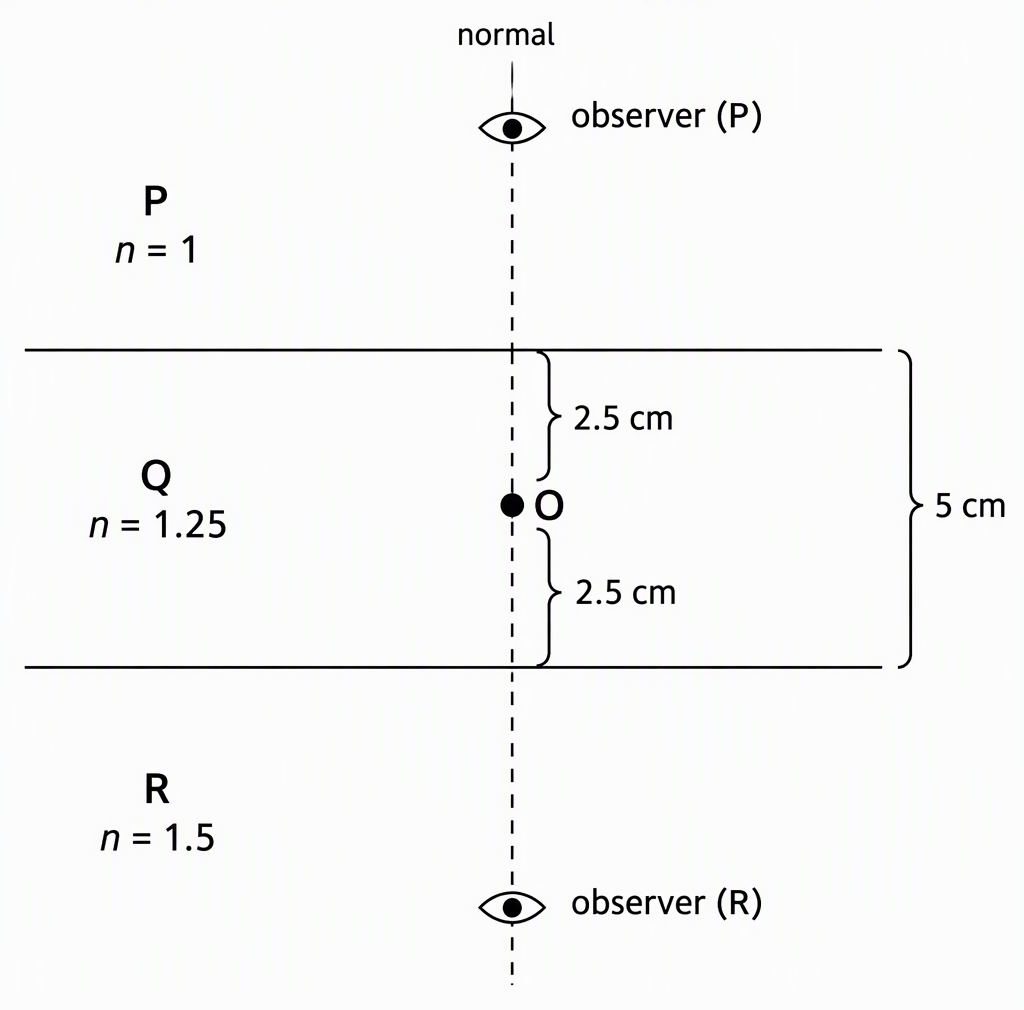
The apparent depths use different reference interfaces. For observations from P and R, respectively, define:
Find their absolute difference in centimetres:
Why is the viewing-medium index in the numerator?
A higher viewing-medium index gives a smaller refracted angle and a greater apparent depth, placing that index in the numerator. The question bank’s total internal reflection tag does not change the method: the observations concern transmitted rays near the normal, so no critical-angle calculation is needed.
Define the real object-to-interface distance, apparent distance, object-medium index and viewing-medium index, respectively, as:
The ray angles to the normal in the object and viewing media are, respectively:
Snell’s law gives:
Near the normal, angles are small and measured in radians, so:
Let a ray meet the interface at a transverse distance from the normal through O, labelled:
The real ray and the backward extension of the transmitted ray give:
Using the small-angle approximation for the tangents:
For a nonzero transverse distance, cancellation and rearrangement yield:
This ratio is not restricted to viewing from air. Identify the viewer’s medium first, rather than memorising “real depth divided by refractive index”.
How do we calculate both apparent depths and get option B?
The apparent depths are 2 cm from the upper interface and 3 cm from the lower interface, giving a difference of 1 cm. Use the same object-medium index in both calculations because O remains inside Q. Only the viewer’s medium and the reference interface change.
Since O is central, its real distance from either interface is:
For the observer in P:
For the observer in R:
Therefore:
Select option B. The physical checks agree: viewing from lower-index P makes the object appear shallower, while viewing from higher-index R makes it appear deeper.
These are depths measured from their respective interfaces, not two coordinates measured from one origin. Each viewing path crosses only its adjacent interface: P–Q for the upper observer and Q–R for the lower observer. The opposite interface does not enter that calculation.
How does using the full slab thickness produce option C?
Option C follows from using the entire 5 cm slab thickness instead of the object-to-interface distance. This is a geometry error, not a failure of the apparent-depth formula. The central object is only 2.5 cm from each viewing interface.
The incorrect substitutions produce:
Their erroneous difference is:
That is option C. Both depths have been doubled because the starting distance was doubled; correct index ordering cannot repair that mistake.
Mark the object and the viewing interface first, then measure the real distance between those two locations. Do not automatically use the largest length supplied in the question.
What changes if the object is not at the centre?
The real distances must be calculated separately; for the variation below, the apparent-depth difference is 4 cm. Equal real depths in the original question came from O’s central position, not from a general optical rule.
Original practice variation, not another verified NEET PYQ: retain the same indices and 5 cm slab, but place O 1 cm from the P–Q interface. Find the absolute difference in apparent depths.
Use the existing figure as the reference, with only O’s position changed. The two real distances are:
Apply the ratio independently:
Thus:
Where could total internal reflection occur in these three media?
Only the Q-to-P boundary can produce total internal reflection for a ray travelling from Q. Original conceptual variation using the same three media: which boundary permits it, and what is its critical angle?
Both requirements must hold:
- Light must travel from higher to lower refractive index.
- Its incidence angle must exceed the critical angle.
For Q to P:
Total internal reflection requires incidence greater than the critical angle:
For Q to R:
Light enters a higher-index medium, so total internal reflection cannot occur in that direction. The main question’s near-normal observation uses transmitted rays and does not call for the critical-angle condition.
Next, practise sign choices in Optics NEET 2026: Two-Lens Image Position and Signs, a separate optics problem, not another apparent-depth example.
Frequently asked questions
What is the answer to the NEET 2026 three-media optics question?
Option B, 1 cm, is correct. The apparent depths are 2 cm from the P–Q interface and 3 cm from the Q–R interface, so their absolute difference is 1 cm.
What is the apparent-depth formula when the observer is not in air?
For near-normal viewing across a plane interface, apparent depth equals real depth multiplied by the viewing-medium refractive index divided by the object-medium refractive index. The viewing-medium index belongs in the numerator, so viewing from a higher-index medium makes the object appear deeper.
Why is no critical-angle calculation needed in this question?
Both observers view the object nearly perpendicular to their respective interfaces, using transmitted rays. Despite the total internal reflection tag, the solution requires two apparent-depth calculations rather than a critical-angle calculation.
Why do I get 2 cm instead of 1 cm in the slab question?
Using the full 5 cm slab thickness gives incorrect apparent depths of 4 cm and 6 cm, producing option C, 2 cm. The object is at the centre, so its real distance from each viewing interface is only 2.5 cm.
At which boundary can total internal reflection occur for light travelling from Q?
For light travelling from Q, total internal reflection is possible only at the Q-to-P boundary, where the refractive index decreases from 1.25 to 1. The critical angle is arcsin(1/1.25), approximately 53.1°, and incidence must exceed this angle. It cannot occur from Q to R because R has the higher refractive index, 1.5.