
Which free NEET Biology practice source should you choose?
Choose a free NEET Biology question bank with chapter-wise questions and checkable answers for daily learning. Use official previous-year papers with final answer keys to understand actual exam questions, and full-length mocks to test performance across subjects. Biology contributes 90 questions and 360 of the paper’s 720 marks, so unreliable answers can undermine a large part of your preparation.
Choose a chapter collection only after checking its questions, answers and access conditions. A large question count cannot compensate for a doubtful key or explanations locked behind payment.
This is a comparison of practice routes, not an independently tested ranking of competing apps. A full-paper mock serves a different purpose from a chapter-wise Biology bank.
How do chapter-wise MCQs, official PYQs and free mocks compare?
Chapter collections target what you are learning, previous-year questions show what the exam has asked, and mocks test whole-paper performance. Choose by the task, not the advertised library size. Organisation, explanations, syllabus alignment and access restrictions need checking collection by collection.
For whole-paper practice, NEET JEEnius AI’s verified offer is 30 free full-length mocks a month, not a verified standalone chapter-wise Biology bank. Each mock has 180 questions, 720 marks and 180 minutes: 45 Physics, 45 Chemistry and 90 Biology questions, followed by a scored per-subject breakdown.
- Best use
- Chapter-wise collections: Learning and repairing a specific Biology chapter.
- Official PYQs with final keys: Understanding actual question wording and checking the officially accepted answer.
- Full-length mocks: Testing Biology alongside Physics and Chemistry under a full-paper time limit.
- Chapter targeting
- Chapter-wise collections: Check the organisation. A chapter label does not guarantee that every question belongs there.
- Official PYQs with final keys: A complete paper covers multiple topics; select relevant questions for chapter revision.
- Full-length mocks: The verified offer is whole-paper testing, not chapter-targeted practice.
- Answer checking
- Chapter-wise collections: Require a usable key and check disputed answers against NCERT.
- Official PYQs with final keys: Match the paper, question number and paper code to the final official key, not a provisional or coaching key.
- Full-length mocks: A scored per-subject breakdown provides performance feedback. It does not settle a disputed Biology concept.
- Explanation availability
- Chapter-wise collections: Inspect actual solutions before committing. Explanations vary by collection.
- Official PYQs with final keys: A final key is authoritative for the accepted exam answer, but it is not a worked explanation.
- Full-length mocks: Do not assume that a score includes worked explanations; these are not established by the verified offer.
- Current-pattern fit
- Chapter-wise collections: Check syllabus relevance and single-correct MCQ format separately.
- Official PYQs with final keys: Papers from 2021 to 2024 used optional Section B. That format does not match the compulsory-question format introduced in 2025.
- Full-length mocks: The verified question count, subject split and time limit match the current whole-paper structure.
- Offline usability
- Chapter-wise collections: An authorised download supports offline practice if both questions and key remain accessible.
- Official PYQs with final keys: A downloaded paper and matching key can be used offline.
- Full-length mocks: Offline usability is not established by the verified offer. Screen-based practice does not itself practise filling an OMR sheet.
- Free-access conditions
- Chapter-wise collections: Check question access, keys, explanations, repeat attempts and any login or usage limits individually.
- Official PYQs with final keys: Use publicly released official files from neet.nta.nic.in rather than a reseller’s repackaged copy.
- Full-length mocks: The allowance is 30 free full-length mocks a month. It is not unlimited.
- Main limitation
- Chapter-wise collections: Topic labels provide clues, and isolated practice cannot measure whole-paper performance.
- Official PYQs with final keys: Older questions need syllabus screening; remembered answers can exaggerate apparent mastery.
- Full-length mocks: Full-paper testing cannot replace chapter-specific learning or repair.
Which option fits Class 11, Class 12, droppers and shared-phone users?
Students learning chapters should prioritise targeted questions. Students who have covered the syllabus should add whole-paper testing to check timing, subject switching and recall. For a shared phone or weak connection, reliable access to questions and answers matters more than extra functions.
- Class 11, just finished a chapter: Start with chapter-wise MCQs. Unfamiliar chapters should not overwhelm a session meant to check what you have just learned.
- Class 12, revising completed material: Combine chapter-wise repair with relevant PYQs. Check older questions against the current official syllabus before making them revision priorities.
- Dropper, recognising answers but struggling in tests: Use full-length mocks to check for timing, subject-switching and guessing problems. Then return to chapter questions for the concepts behind the errors.
- Weak connectivity or a shared phone: Prefer an authorised downloadable collection with a usable key, if available. Do not assume an online platform works offline.
- Substantial syllabus still unfinished: Keep chapter study and targeted questions central. Full-length mocks can expose gaps, but they cannot teach the missing material.
- Parent considering a paid bank: Check whether the free source already provides relevant questions and checkable answers. Pay for a specific missing function, not merely a larger advertised question count.
Keep one primary chapter collection if its answers are dependable and you can revisit it. Add another only when it solves a specific problem, such as missing syllabus coverage or unusable explanations.
How can you check the questions, answers and meaning of “free”?
Test a source on a chapter you already know before committing revision time to it. Attempt questions without the key, check disputed answers against NCERT, and then inspect access restrictions. This checks whether the material is accurate, relevant and genuinely usable without payment.
- Choose a chapter you have already studied. Inspect the questions themselves, not only the heading. Check whether they test relevant NCERT content or rely on unexplained facts outside your preparation scope.
- Attempt questions closed-book. Keep the key hidden until you have selected your answers. Questions intended to simulate the current paper should be single-correct MCQs.
- Check answers against the relevant NCERT passage. A useful explanation says why the chosen option is correct and why a tempting distractor is wrong. A bare option letter, or a sentence repeating it, does not teach that distinction.
- Separate factual correctness from syllabus relevance. An old question can be scientifically correct yet outside current exam practice. Check the current official syllabus at neet.nta.nic.in rather than assuming every PYQ remains in scope.
- Inspect the full free-access path. Check whether “free” includes questions, answers, explanations and repeat attempts. Inspect login requirements and usage limits without assuming every provider applies the same restrictions.
- Check that the material is authorised. Prefer official papers or collections shared with permission. Do not use pirated scans of paid books as your free practice route.
A Biology source should distinguish spermiogenesis, the transformation of spermatids into spermatozoa, from spermatogenesis, the broader process of sperm formation. An explanation that treats these terms as interchangeable is a reason to question the source’s reliability.
For a disputed item, record the source and question before consulting the relevant NCERT passage. For an official PYQ, also check the matching final official key to establish the accepted exam answer. Set unresolved items aside rather than memorising a doubtful option.
How should you turn chapter questions into lasting Biology recall?
Read the relevant NCERT text, diagrams and tables, then attempt chapter questions closed-book before checking answers. Write a concept correction for each error and retest without the previous solution. Include guessed-correct responses in your review because selecting the right option without a reason does not demonstrate recall.
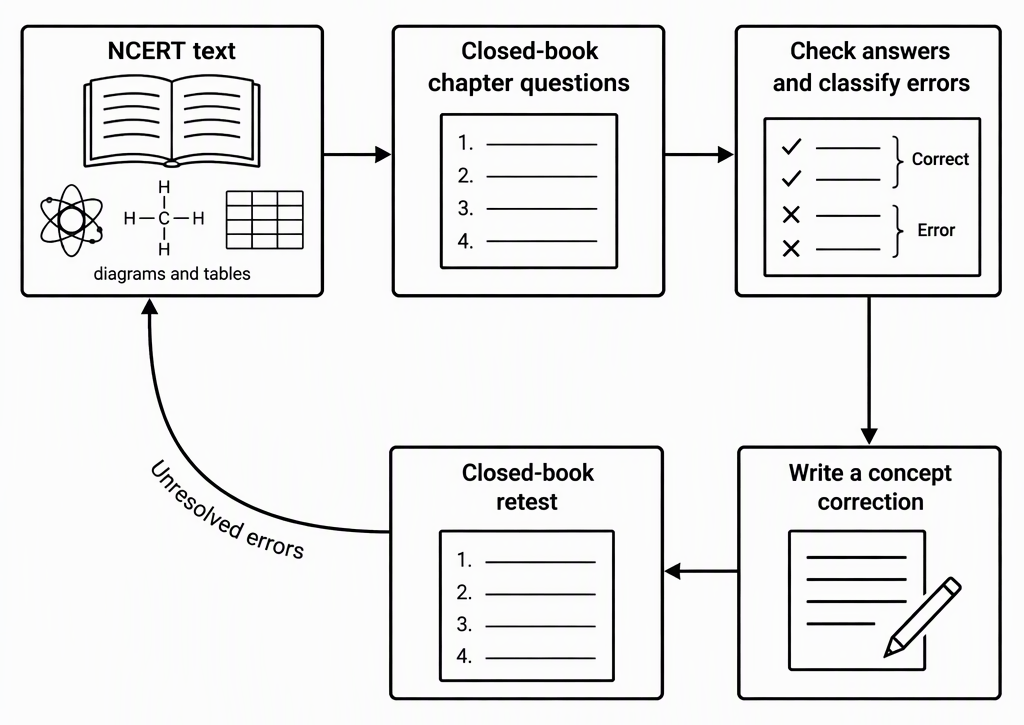
Classify each error by its cause. Use the category to decide what to repair.
- Missing knowledge: You could not recall the needed fact, relationship or sequence. Return to the relevant passage.
- Confused terminology: You swapped related terms. Write the distinction explicitly.
- Misread wording: You missed a word such as “incorrect” or “except.” Record exactly which word changed the task.
- Unsupported guessing: You selected an option without a defensible reason. Review it even if the key marks it correct.
Keep an error-log entry for each reviewed question. Use these fields rather than copying the entire solution:
- Question source: Collection or paper name, chapter, question number and paper code where relevant.
- Tested concept: The specific fact or distinction being checked.
- Reason for the error: Knowledge gap, terminology confusion, misreading or unsupported guessing.
- Textbook reference: NCERT chapter, subsection and relevant passage, diagram or table.
- Written correction: A brief explanation of the concept in your own words.
- Retest outcome: Correct with a reason, still confused, or correct only through guessing.
For example, consider a question asking what converts spermatids into spermatozoa. Choosing “spermatogenesis” instead of “spermiogenesis” substitutes the broad process for a specific stage.
Write: “Spermiogenesis transforms spermatids into spermatozoa; spermatogenesis is the broader process of sperm formation.” Contrast this with spermiation, the release of spermatozoa from Sertoli cells. Copying only the correct option letter would preserve none of these distinctions.
Retest by distinguishing formation, transformation and release without opening the previous solution. Then attempt another relevant question and record whether you can justify the answer.
During revision, mix completed chapters so topic labels no longer supply clues. For applying this approach to linked systems, use How to Study Human Physiology NEET: NCERT and Recall.
When should you add free full-length mocks?
Add full-length mocks when you need to assess Biology alongside Physics and Chemistry, not to teach yourself unfinished chapters. Use them to check whether recall holds under time pressure and subject switching. Review the errors afterwards; a total score alone does not tell you what to study next.
The current paper has 180 compulsory questions in 180 minutes. Biology contains 45 Botany and 45 Zoology questions, so Biology practice must eventually fit the demands of the whole paper.
Apply the marking scheme when reviewing practice. Count unattempted questions separately from wrong answers:
- Correct answer: Award four marks.
- Wrong answer: Deduct one mark.
- Unattempted question: Award zero marks.
Calculate the Biology practice score as:
A scored per-subject breakdown is a starting point for review, not a chapter-level diagnosis. Inspect the Biology errors yourself and use your error log to identify the concepts that need repair.
NEET remained pen-and-paper with OMR through 2026, so add OMR practice to online testing. Selecting an answer on a screen does not practise matching question numbers to bubbles or avoiding marking shifts. Do not plan around a future computer-based format unless it is officially confirmed.
If you are still learning chapters, audit and choose a chapter collection first. If you are ready for whole-paper practice, use NEET JEEnius AI’s verified allowance of 30 free full-length mocks a month, with its scored per-subject breakdown, then use your next study session to repair the concepts behind your Biology errors.
Next step: full-length mock tests on NEET JEEnius AI and sit a full 180-question, 720-mark, 180-minute paper, 45 Physics, 45 Chemistry and 90 Biology, and get a scored per-subject breakdown (30 free a month).
Frequently asked questions
How do I choose a free NEET Biology question bank?
Choose a chapter-wise collection with relevant questions and checkable answers, not merely a large advertised question count. Test it on a chapter you know and check disputed answers against NCERT. Verify whether questions, keys, explanations and repeat attempts remain accessible without payment.
Where can I download official NEET previous-year papers and answer keys?
Use publicly released official papers and final answer keys from neet.nta.nic.in. Match the paper, question number and paper code to the final key rather than a provisional or coaching key. Screen older questions against the current official syllabus before using them for revision.
Does NEET JEEnius AI offer a free chapter-wise Biology question bank?
The verified offer is 30 free full-length mocks a month, not a verified standalone chapter-wise Biology bank. Each mock contains 180 questions across Physics, Chemistry and Biology, with a 180-minute limit and a scored per-subject breakdown. Use these mocks for whole-paper testing, not as a replacement for chapter-specific learning.
How should I review mistakes in NEET Biology MCQs?
Check each error against the relevant NCERT passage, diagram or table, then classify its cause as missing knowledge, confused terminology, misreading or unsupported guessing. Record the source, tested concept, textbook reference and a brief correction in your own words. Retest closed-book and review guessed-correct answers too.