
How should I study Dual Nature for NEET in six steps?
To study Dual Nature for NEET, check whether emission is possible before calculating electron energy. Identify what changes, check the threshold, then choose the energy or momentum equation. Read NCERT in the six-step order below rather than memorising formulas without their conditions.
- Read the experiment and observations first.
Read NCERT’s photoelectric-effect experiment before its equations. On the setup, identify incident frequency, light intensity, collector potential and photocurrent. Stopping potential is the retarding collector potential that just reduces photocurrent to zero; use its positive magnitude in calculations.
Interference and diffraction demonstrate wave behaviour. The photoelectric observations require the photon description: light transfers energy in packets.
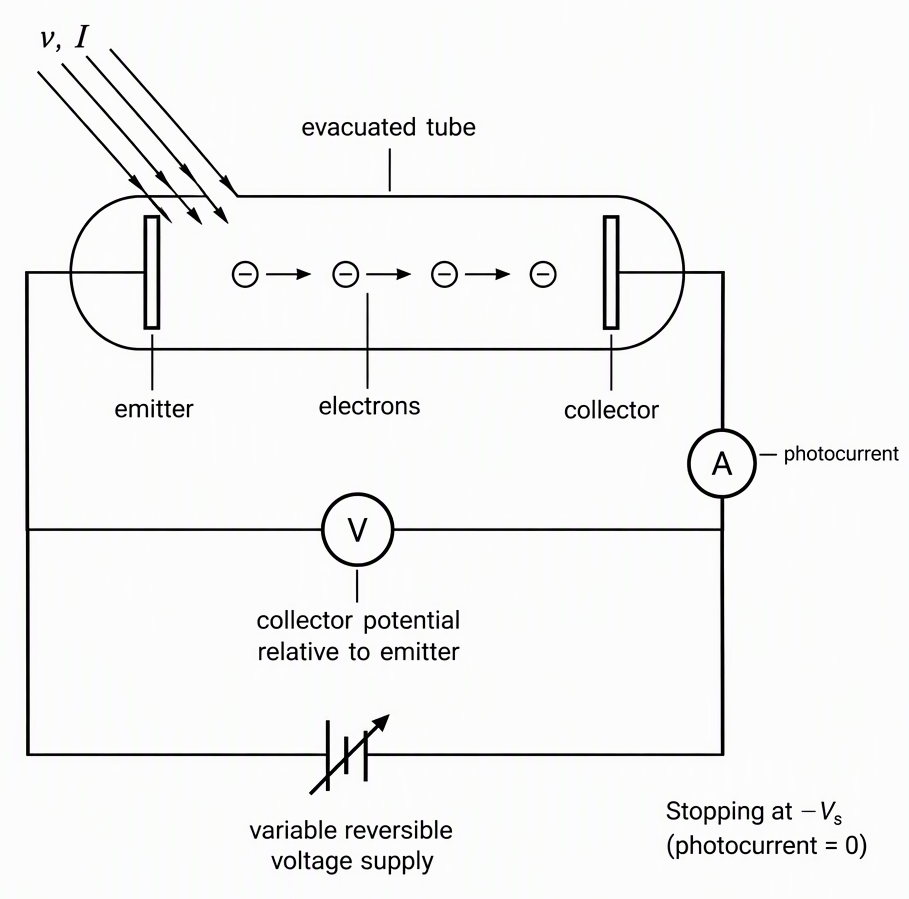
- Separate energy per photon from photon arrival rate.
- Photon energy: depends on frequency, not intensity.
- Photon arrival rate: depends on intensity at fixed frequency and illuminated area.
- Maximum photoelectron kinetic energy: depends on frequency and the metal’s work function, not intensity.
Before solving, circle the controlled variables: same metal, fixed frequency, same kinetic energy, same momentum or same accelerating potential. These conditions decide which formula or ratio applies.
- Write the threshold gate before arithmetic.
A photon must supply at least the work function. At the ideal threshold, the maximum kinetic energy is zero.
Increasing intensity cannot cause emission when the wavelength exceeds the threshold wavelength.
- Use one energy chain and one energy unit.
Calculate photon energy, subtract the work function, then obtain stopping-potential magnitude. Use this chain only after passing the threshold check.
Here, stopping potential means its positive magnitude. Below threshold, report no emission, not negative electron kinetic energy.
Keep photon energy, work function and kinetic energy in either electronvolts or joules throughout a subtraction. When substituting SI quantities, convert energies to joules, including before dividing by charge in coulombs to obtain volts.
- Read graph axes before recalling slopes.
The vertical axis determines the slope. These are different graphs, despite their similar appearance:
Both straight lines meet the frequency axis at the threshold frequency. Neither is a photocurrent graph.
- Start matter waves with momentum.
Start with the momentum relation. Use the kinetic-energy form only in the non-relativistic regime.
For a non-relativistic particle starting from rest through an accelerating potential:
Use the magnitude of charge and the accelerating potential difference. Check “starting from rest” before using the last formula.
Does doubling intensity make photoelectrons faster?
No: at fixed frequency, doubling intensity changes photon arrival rate, not energy per photon. Use Steps 2, 3 and 4 to separate the number of emitted electrons from their maximum kinetic energy.
Original practice example, not a NEET previous-year question: A metal receives monochromatic photons with energy three times its work function. Intensity doubles while frequency, illuminated area and collection conditions remain fixed.
Find the new maximum kinetic energy and stopping-potential magnitude. Choose one pair:
Step 3, threshold: Emission is allowed because:
Step 4, energy and stopping potential:
Option 1 is correct. Step 2 tells us that neither answer changes when intensity doubles.
For a numerical check, choose:
Under unchanged emission efficiency and complete collection, saturation photocurrent doubles. The tempting wrong answer is Option 2: doubling electron kinetic energy because the beam is brighter.
If photon energy falls below the work function, raising intensity cannot restore emission.
How do I solve stopping-potential graph questions without memorising the picture?
Derive the line from the photoelectric equation, then read its slope and intercept. For stopping-potential magnitude against frequency, changing the metal shifts the threshold but does not change the slope. Apply Step 5 after checking both axis labels.
Original practice example: Two metals have work functions satisfying:
Which description of their stopping-potential-versus-frequency plots is correct?
- Option 1: Parallel lines, with A having the lower threshold.
- Option 2: Parallel lines, with A having the higher threshold.
- Option 3: A has the steeper slope.
- Option 4: Both have the same threshold.
Rearrange the energy equation:
The slopes are identical, and A has the smaller work function. Option 1 is correct.
Above both thresholds, A has the larger stopping-potential magnitude.
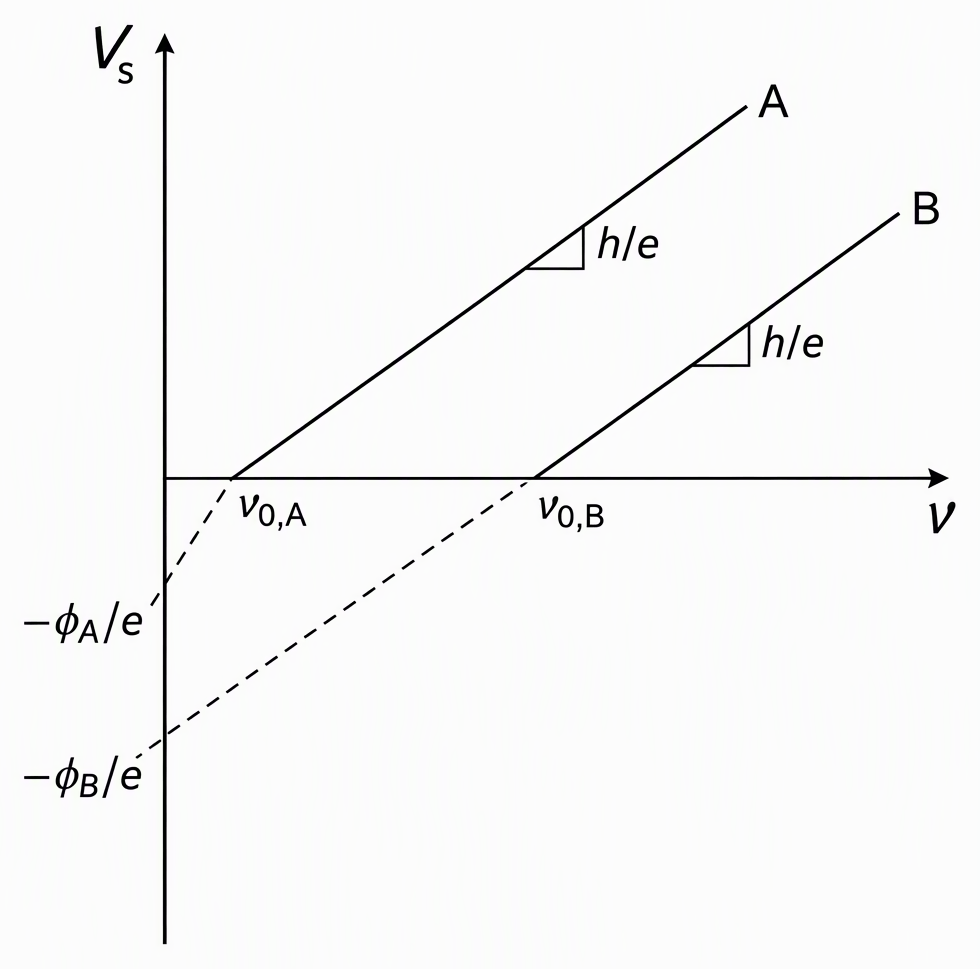
The negative vertical intercept is an extrapolation, not a measured negative stopping-potential magnitude. Each emission branch begins at its threshold.
For photocurrent versus collector potential, increasing intensity at fixed frequency above threshold raises saturation current without shifting stopping potential. Do not automatically assign higher saturation current to higher frequency: photon flux and emission efficiency also matter.
For targeted practice, NEET JEEnius AI’s practice mode provides topic sets that skip questions already seen, with 60 free sets a month.
How can wavelength ratios make de Broglie questions faster?
Take the ratio before substituting constants when the particles are identical. For non-relativistic electrons accelerated from rest, wavelength varies inversely with the square root of accelerating potential. Step 6 supplies the formula; the controlled variables tell you what cancels.
Original practice MCQ: One electron starts from rest and accelerates through a potential. A second starts from rest and accelerates through four times that potential. Both remain non-relativistic. Find the second wavelength divided by the first.
Write the complete chain:
Then divide:
Option 2 is correct. No numerical values of Planck’s constant, electron charge or electron mass are needed because the particles are identical and these constants cancel.
- Equal momentum: equal wavelength, regardless of mass.
- Equal kinetic energy, non-relativistic particles: wavelength varies inversely with the square root of mass.
- Equal accelerating potential, equal charge magnitude, starting from rest: the same inverse-square-root mass dependence applies in the non-relativistic regime.
The common error is using inverse potential instead of inverse square root:
Do not use the rest-start formula when initial kinetic energy is significant. Include it before calculating momentum:
What should I practise next to find and fix my mistakes?
Practise observations, thresholds, graphs and de Broglie ratios separately before attempting mixed MCQs. Keep this order for your next session so each wrong answer points to a specific rule.
- NCERT observations: classify the effects of intensity, frequency and collector potential.
- Threshold and work function: decide whether emission occurs before calculating energy.
- Graphs: identify axes, slopes, thresholds and saturation current.
- de Broglie ratios: separate equal momentum, equal energy and equal accelerating potential.
- Mixed MCQs: choose the equation without a topic label guiding you.
Before each solution, complete this line:
Changes: …; fixed: …; emission allowed: yes/no/not applicable; equation: ….
Label every wrong answer in your own error log and attach one corrected rule:
- Concept: record the corrected dependence, such as “Intensity changes photon rate at fixed frequency.”
- Threshold: write the emission condition you missed.
- Graph axes: name both axes and the correct slope.
- Units: record the conversion or unit mismatch.
Return to wrong questions after a gap. Explain why every rejected option is wrong, rather than recalling the correct letter.
Check readiness without notes: redraw the key graphs, explain why intensity cannot overcome threshold, and distinguish equal momentum from equal kinetic energy.
For a fresh follow-up set, NEET JEEnius AI’s daily practice problems provide a topic set every day, with 20 free attempts a month. Keep the error log and revisit schedule yourself; apply the classification line before answering each question.
Next step: daily practice problems on NEET JEEnius AI and get a fresh set on a topic every day (20 free attempts a month).
Related on NEET JEEnius AI: Aves (Birds) NEET 2026: Penguin vs Ostrich Forelimbs.
Frequently asked questions
How should I study Dual Nature for NEET?
Start with NCERT’s photoelectric experiment and observations, then separate photon energy from photon arrival rate. Check the emission threshold before using the photoelectric energy equation, and keep energy units consistent. Finish with graph axes and slopes, then study matter waves starting from wavelength equals Planck’s constant divided by momentum.
Does increasing intensity increase photoelectron kinetic energy?
No. At fixed frequency and for the same metal, increasing intensity changes photon arrival rate, not maximum photoelectron kinetic energy or stopping-potential magnitude. Under unchanged emission efficiency and complete collection, doubling intensity doubles saturation photocurrent. Below the threshold frequency, increasing intensity cannot cause photoelectric emission.
What is the slope of a stopping-potential versus frequency graph?
For stopping-potential magnitude plotted against frequency, the slope is h/e. Changing the metal changes the threshold frequency but not this slope. If the vertical axis is maximum kinetic energy instead, the slope is h, so read both axes before answering.
How does de Broglie wavelength change when accelerating voltage is quadrupled?
For identical particles starting from rest and remaining non-relativistic, de Broglie wavelength is inversely proportional to the square root of accelerating potential. Quadrupling the potential therefore halves the wavelength. If initial kinetic energy is significant, include it in the final kinetic energy before calculating momentum.