
How should I start studying Electromagnetic Waves for NEET?
- Build one recall sheet with three question types. Study Electromagnetic Waves for NEET under spectrum and properties, wave calculations, and displacement current. Use the current official syllabus, available through neet.nta.nic.in, as your scope checklist and the relevant NCERT text as your study source.
Give each question type its own space. Read the relevant NCERT passage, close it, and write what you remember. Keep facts that help select or reject an option, not copied paragraphs.
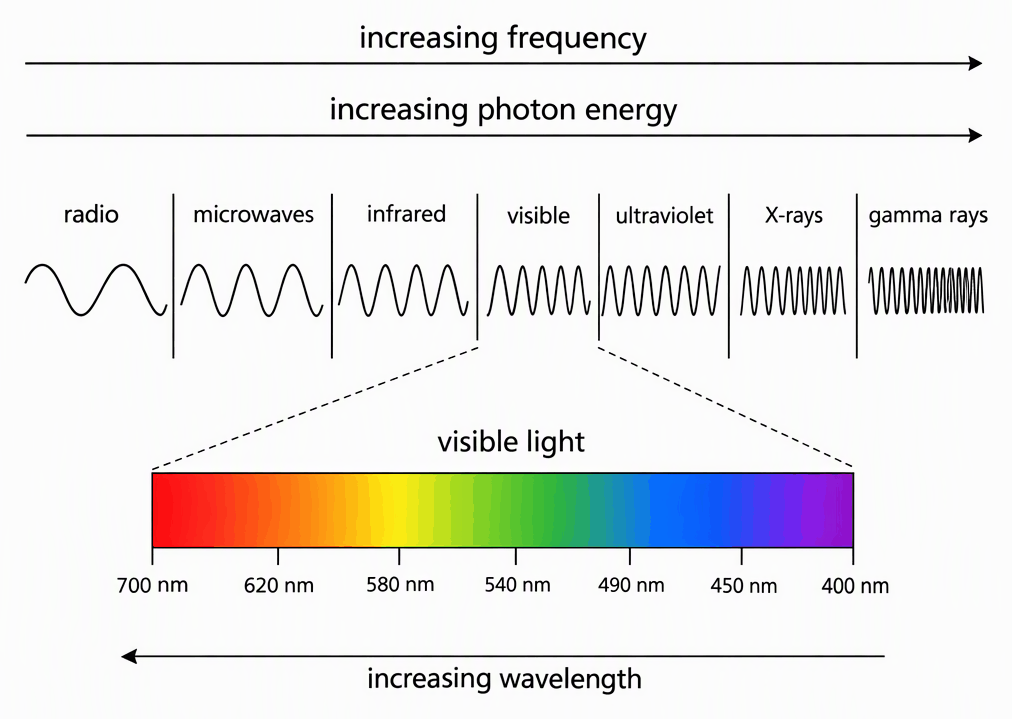
- Reconstruct the spectrum from memory. Write the bands in this order: radio, microwaves, infrared, visible, ultraviolet, X-rays, gamma rays. Moving in that direction, frequency and photon energy increase while wavelength decreases.
Within visible light, violet has higher frequency and shorter wavelength than red. Attach these directions to the spectrum rather than learning separate lists.
Make a compact application strip:
- Radio: broadcasting.
- Microwaves: radar.
- Infrared: thermal imaging.
- Ultraviolet: germicidal action.
- X-rays: diagnostic imaging.
- Gamma rays: cancer treatment.
These are representative uses, not exclusive definitions. A band can have several applications; an application alone does not establish a sharp spectrum boundary.
- Recall the properties before checking NCERT. Electromagnetic waves need no material medium. In vacuum they are transverse: the electric and magnetic fields are mutually perpendicular, perpendicular to propagation, and in phase.
Propagation follows the cross product:
An accelerating charge can radiate. A stationary charge produces an electric field but does not radiate; “every moving charge radiates” is incorrect.
Which equations and checks should I use for an MCQ?
- Write the vacuum formula box before solving. Choose the relation from the quantity asked, convert units, then substitute. Keep photon energy separate from electric-field strength.
Convert wavelength to metres before substitution:
For spectrum comparisons, use:
The calligraphic symbol denotes photon energy; the electric-field symbol in the amplitude ratio denotes field strength. Higher frequency means greater photon energy, not automatically a stronger electric field.
- Learn what changes inside a charging capacitor. No conduction current crosses an ideal dielectric. A changing electric flux supplies the displacement-current term.
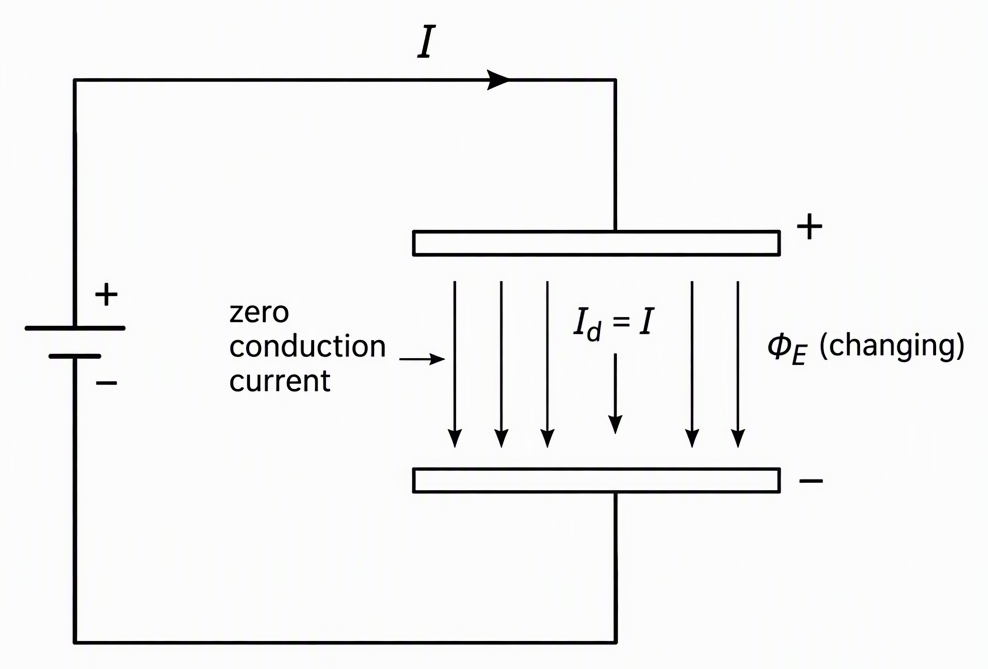
For the standard ideal charging-capacitor model:
This does not mean charges physically cross the gap. The changing flux provides the current term needed in the magnetic-field law.
- Classify, solve, then inspect the trap. Write the relevant fact or equation before looking for a matching option. Check spectrum direction for comparisons, units and the vacuum condition for calculations, and the physical mechanism for capacitor questions.
Finish by closing the book and rebuilding the spectrum, formula box and capacitor explanation. Reopen NCERT only to repair missing or incorrect items. Prioritise these relations and their physical meaning over extended Maxwell-equation derivations.
How do I solve a spectrum statement question without guessing?
Read the spectrum in the direction required by each option, then separate speed from frequency and wavelength. A remembered application anchors the band, but it cannot prove an unrelated statement.
Original practice question, not a PYQ: Choose the single correct statement.
- A. Microwaves have higher frequency than ultraviolet.
- B. Infrared has shorter wavelength than visible light.
- C. Ozone absorbs much of the Sun’s ultraviolet radiation.
- D. All electromagnetic waves have the same wavelength in vacuum.
C is correct. Recall ultraviolet’s germicidal use as a band association, but learn ozone absorption as a separate fact.
- A is false: moving from microwaves towards ultraviolet increases frequency. Ultraviolet has the higher frequency.
- B is false: moving from infrared towards visible decreases wavelength. Infrared has the longer wavelength.
- D is false: electromagnetic waves have equal speed in vacuum, not equal frequency or wavelength.
Before comparing bands, mark what the question asks about: speed, frequency, wavelength, energy or application. Then apply only the relevant comparison.
How do I calculate frequency and magnetic-field amplitude?
Convert wavelength first, then calculate frequency and magnetic amplitude separately. The amplitude ratio applies here because the wave is in vacuum, not because it holds unchanged in every medium. Pair electric-field amplitude with magnetic-field amplitude, not an RMS value.
Original practice question, not a PYQ: A vacuum electromagnetic wave has wavelength 600 nm and electric-field amplitude 120 V/m. Which pair gives its frequency and magnetic-field amplitude?
- A.
- B.
- C.
- D.
Convert, then substitute:
A is correct. Reject the others by identifying their errors:
- B: uses the micrometre conversion instead of the nanometre conversion.
- C: divides speed by electric-field amplitude, which does not even give tesla units.
- D: combines both errors.
For direction, suppose the electric field points along positive x and the magnetic field along positive y at the same instant. Propagation is along positive z:
Use the cross product to check the sign, not just the remaining axis.
What current flows through a charging capacitor’s gap?
The ideal gap has zero conduction current but a displacement current equal to the instantaneous wire current. The dielectric blocks charge transport across the gap; it does not prevent electric flux from changing.
Original practice question, not a PYQ: An ideal capacitor charges with an instantaneous wire current of 2 mA. What are the conduction and displacement currents, respectively, through a surface spanning the gap?
- A.
- B.
- C.
- D.
C is correct: no charge crosses the ideal dielectric, so conduction current is zero. Increasing plate charge changes the electric flux, giving:
Including this term makes the magnetic-field calculation consistent for different surfaces bounded by the same loop. One surface cuts the wire; another passes through the gap.
After charging finishes in ideal steady DC, electric flux is constant:
The electric field can remain nonzero. For this fixed ideal capacitor, displacement current requires a changing field and hence changing flux, not merely an existing field.
What should I practise next, and how should I repair errors?
Start with 12 questions and write a reason or equation for every answer. This is a teaching recommendation, not an exam-weightage claim. Count a correct guess as a concept needing repair: the selected option alone does not show understanding.
Split the starter set into:
- Four spectrum or application questions.
- Four vacuum-wave formula or direction questions.
- Four properties or displacement-current questions.
Tag every error and repair its cause:
- Recall: check the exact NCERT fact, close the book, and write it correctly.
- Spectrum reversal: rebuild the spectrum with separate frequency and wavelength arrows.
- Unit conversion: write the conversion before substitution, then redo the calculation.
- Field direction: write the electric-field cross magnetic-field order and check its sign.
- Capacitor concept: explain separately what happens in the wire and in the dielectric.
Practise the missed type, then mix question types without topic labels. Choosing the method is part of the practice, not something to postpone until full mocks.
Try closed-book recall the next day and again after a week. This proposed routine checks what you can retrieve after a gap; it is not a guarantee of retention.
Judge readiness by observable work: reconstruct the spectrum correctly, use the vacuum relations with units, and explain why the charging gap has displacement current but no conduction current. Before your next set, rewrite the reason behind today’s first error correctly, without the book.
Next step: practice mode on NEET JEEnius AI and practise a topic in sets that skip questions you have already seen (60 free sets a month).
Read next: Microbes in Human Welfare Practice Questions NEET: 8 MCQs.
Frequently asked questions
How do I start studying Electromagnetic Waves for NEET?
Make one recall sheet with three sections: spectrum and properties, wave calculations, and displacement current. Use the current official NEET syllabus to check scope and NCERT as your study source. Read each relevant passage, close the book and write the facts or equations you can recall.
What is the electromagnetic spectrum order for NEET?
The order is radio, microwaves, infrared, visible, ultraviolet, X-rays and gamma rays. In this direction, frequency and photon energy increase while wavelength decreases. Within visible light, violet has higher frequency and shorter wavelength than red.
Which Electromagnetic Waves formulas should I learn for NEET?
Learn the vacuum relations c = νλ, E₀/B₀ = c and c = 1/√(μ₀ε₀), with c approximately 3 × 10⁸ m/s. Use photon energy = hν for energy comparisons and I_d = ε₀ dΦ_E/dt for displacement current. Convert wavelengths to metres before substitution, and do not confuse photon energy with electric-field strength.
Why is there displacement current in a charging capacitor?
A charging capacitor has changing electric flux through its gap, which supplies the displacement-current term. In the standard ideal model, this displacement current equals the instantaneous wire current, while conduction current through the dielectric is zero. After charging finishes in ideal steady DC, the flux is constant and displacement current becomes zero even though an electric field can remain.
How should I practise Electromagnetic Waves MCQs for NEET?
Start with 12 questions: four on spectrum or applications, four on vacuum-wave formulas or direction, and four on properties or displacement current. Write a reason or equation for every answer, treating a correct guess as a concept needing repair. Tag errors by cause, practise the missed type and then mix question types without labels.