
Should I start with chapter MCQs, PYQs or full mocks?
Start with NCERT-aligned Microbes in Human Welfare practice questions for NEET, then verified PYQs; use full mocks for integration. Chapter MCQs find factual and process gaps, verified PYQs show how facts were examined, and full mocks test recall across subjects under time pressure.
Eight original, free single-correct MCQs with explained answers follow here. They are editorial practice, not official NTA questions or actual PYQs. A full mock is not an efficient substitute for repairing one weak chapter.
What is the difference between free chapter MCQs, verified PYQs and full mocks?
Chapter MCQs isolate weak concepts, verified PYQs show past exam treatment, and full mocks test whole-paper pacing. Choose the format that addresses your current mistakes, not the largest question bank.
- Best use
- Original NCERT-aligned chapter MCQs: Find organism–product and process gaps.
- Verified chapter PYQs: Study how chapter concepts have been examined.
- Full-length NEET mocks: Practise mixed-subject recall and pacing.
- Chapter focus
- Chapter MCQs: Every question targets this chapter.
- Verified PYQs: Chapter-filtered, but limited to previously examined concepts.
- Full mocks: Whole-paper coverage, with no guaranteed number from Microbes in Human Welfare.
- Answer verification
- Chapter MCQs: Match each explanation to the relevant NCERT concept.
- Verified PYQs: Check the claimed year and provenance against the official paper and final key.
- Full mocks: Check disputed answers against NCERT or the relevant subject reference.
- Timing relevance
- Chapter MCQs: Begin without time pressure to expose reasoning.
- Verified PYQs: Add timing after correcting knowledge gaps.
- Full mocks: Test pacing across a complete paper.
- Main limitation
- Chapter MCQs: Cannot measure full-paper readiness.
- Verified PYQs: Familiar options can conceal weak recall.
- Full mocks: A per-subject breakdown is not chapter-level diagnosis.
- What is actually free
- Chapter MCQs: Eight original questions with explanations below.
- Verified PYQs: No verified collection is supplied here. Check official NTA papers and final keys at neet.nta.nic.in to establish provenance; this article makes no free-access claim for third-party collections.
- Full mocks: For integration practice, NEET JEEnius AI offers 30 free a month: each has 180 questions, 720 marks and 180 minutes, with 45 Physics, 45 Chemistry and 90 Biology questions, plus a scored per-subject breakdown.
Which format should I choose for first reading, revision or repeated mistakes?
Use chapter practice for factual or process errors; choose full mocks when recall breaks down only in mixed tests. Your class label alone does not decide the format. A dropper may still need NCERT repair, while a student with secure chapter recall may need pacing practice.
- First-time learner: Complete the relevant NCERT material, then attempt chapter MCQs without notes. Revisit the exact concept behind each error instead of rereading everything.
- Class 11 student studying ahead: Use chapter practice after learning the material. A full-syllabus mock score is not a fair measure of preparation when much of that syllabus is unfinished.
- Class 12 student revising: Attempt this diagnostic cold. Repair wrong and guessed answers before moving to verified PYQs.
- Dropper who remembers PYQ answers: Recognising a familiar option does not prove you can retrieve the fact. Try fresh questions and explain why you rejected each alternative before trusting repeat-PYQ performance.
- Accurate in chapter practice, weak in mixed tests: Prioritise full mocks. Read the subject breakdown alongside your own question-level error notes to separate forgotten facts, misreads and pacing problems.
Record confidence before checking the key. Choose your next step from the error type, not an accuracy cutoff: a correct guess still needs review.
Which eight Microbes in Human Welfare practice questions should I try for NEET?
Attempt all eight without notes, keeping the answer section out of view. This original editorial diagnostic tests organism–product pairs and treatment processes; it is not an exhaustive chapter test or a prediction of chapter weightage. Choose one option per question and record a short reason so you can distinguish recall from guessing.
1. Milk kept with a suitable curd starter becomes sour and sets. Which explanation correctly links lactic acid bacteria to both changes?
- A. They release ethanol, which coagulates milk proteins.
- B. They produce lactic acid, which helps coagulate milk proteins.
- C. They release methane, which turns dissolved proteins into curd.
- D. They produce citric acid as the main agent of curd formation.
2. A producer wants to ferment a sugar-rich liquid to obtain ethanol. Which organism–product pairing best matches that purpose?
- A. Aspergillus niger–citric acid
- B. Acetobacter aceti–acetic acid
- C. Lactobacillus–lactic acid
- D. Saccharomyces cerevisiae–ethanol
3. A student must select the microbial product used as an immunosuppressive agent in organ-transplant patients. Which correctly matched entry should they select?
- A. Cyclosporin A–Trichoderma polysporum
- B. Statins–Monascus purpureus
- C. Streptokinase–Streptococcus
- D. Citric acid–Aspergillus niger
4. Sewage shows a lower BOD after effective aerobic biological treatment. Which explanation correctly connects the treatment to this fall?
- A. BOD is simply the dissolved oxygen concentration, which aeration lowers.
- B. Oxygen converts every dissolved salt into a substance microbes can digest.
- C. Microbes consume organic matter, leaving less biodegradable material to exert oxygen demand.
- D. Methane-producing microbes perform all treatment stages in oxygen-rich water.
5. After aeration, microbial flocs settle and form activated sludge. Which description correctly distinguishes the two main routes taken by this sludge?
- A. All sludge returns to the aeration tank; none undergoes digestion.
- B. A small portion returns as inoculum; the remainder enters anaerobic sludge digesters.
- C. A small portion enters the aeration tank as disinfectant; the rest becomes drinking water.
- D. All sludge enters anaerobic digesters before any portion can serve as inoculum.
6. A biogas digester receives cattle dung and operates without oxygen. Which statement correctly describes the contribution of methanogens such as Methanobacterium?
- A. They contribute to methane production under anaerobic conditions.
- B. They release oxygen that supports aerobic flocs throughout the digester.
- C. They convert dung into ethanol through the same role as brewer’s yeast.
- D. They produce methane only when oxygen is continuously supplied.
7. A farmer considers a preparation containing Bacillus thuringiensis for pest control. Which statement is biologically justified?
- A. It kills every insect species that touches a treated plant.
- B. It supplies nitrogen by fixing atmospheric nitrogen in root nodules.
- C. It improves phosphorus uptake by forming mycorrhiza with roots.
- D. It can control susceptible insect larvae through its insecticidal proteins.
8. A plant’s roots form a mycorrhizal association involving Glomus. Which benefit best matches the role described in this chapter?
- A. Fixation of atmospheric nitrogen inside legume root nodules
- B. Ethanol production that provides the plant with a growth regulator
- C. Improved absorption of phosphorus from the soil
- D. Conversion of root waste into methane in oxygen-rich soil
What are the correct answers, and why are the other options wrong?
The key is: 1 B, 2 D, 3 A, 4 C, 5 B, 6 A, 7 D, 8 C. Check your reason against each explanation, not just your letter.
- 1. B, acid production explains curd formation. Lactic acid bacteria multiply in milk and produce lactic acid, causing sourness and helping coagulate milk proteins. D substitutes citric acid for lactic acid. Naming the organism alone does not explain why the milk sets.
- 2. D, yeast produces ethanol by fermentation. Saccharomyces cerevisiae is used for alcoholic fermentation. B is a genuine organism–product pair, but acetic acid production does not answer an ethanol-production question. Recall check: Can you name the product without seeing the options?
- 3. A, cyclosporin A is the immunosuppressant. Its source is Trichoderma polysporum. B names a medically useful product, but statins from Monascus purpureus lower blood cholesterol rather than serving the immunosuppressive role asked here. All four pairings are genuine; the use decides the answer.
- 4. C, treatment reduces biodegradable organic load. BOD concerns the oxygen demand associated with microbial decomposition of organic matter, not simply the dissolved oxygen present, as A claims. Once microbes consume much of that organic material, the remaining demand falls. Recall check: Can you explain why BOD falls?
- 5. B, recycling and digestion have different purposes. Aerobic treatment supports microbial flocs; settling then produces activated sludge. A small portion returns as inoculum, while the remainder enters anaerobic sludge digesters. D wrongly makes digestion a prerequisite for recycling: the entire secondary-treatment process is not anaerobic.
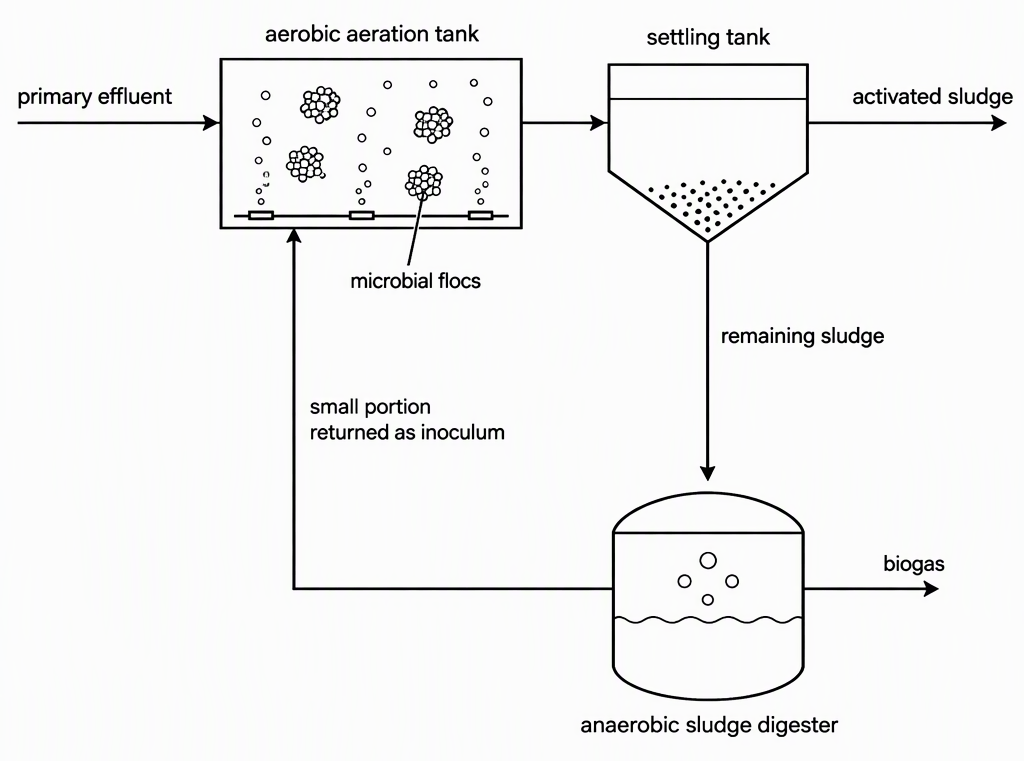
- 6. A, methanogens support anaerobic methane production. Methanobacterium is a chapter example associated with this role. D keeps the correct gas but reverses the oxygen requirement. Do not transfer the oxygen supply needed in an aeration tank to an anaerobic biogas digester.
- 7. D, susceptibility matters. Bt insecticidal proteins act against susceptible insect larvae, not every insect species as A claims. Applying a microbial preparation is distinct from inserting Bt genes into crops. For the latter, see Bt crops: gene matching explained.
- 8. C, mycorrhiza supports phosphorus uptake. The fungal partner absorbs phosphorus from soil and makes it available to the plant. A describes nitrogen fixation in legume root nodules, associated with Rhizobium, not Glomus. Nitrogen-fixing biofertilisers and mycorrhiza benefit plants through different nutrient roles.
How should I use my mistakes to choose the next free practice format?
Classify each response as confident-correct, guessed-correct, factual error, process error or misread. Repair the cause before choosing another resource. Guessed-correct answers still need review because the letter alone does not prove recall.
- Factual error: Rebuild a compact organism–product–use list from NCERT. Cover the products and retrieve them.
- Process error: Redraw the sewage-treatment sequence and explain each stage aloud, including where oxygen is supplied and where it is absent.
- Misread: Record the exact qualifier overlooked, such as “ethanol”, “small portion” or “susceptible”, rather than copying the explanation.
- Guessed-correct: Explain the answer and reject the nearest distractor without checking the key.
- Confident-correct: Check that your reason matches the explanation, then move on.
Can I convert this diagnostic result into a predicted NEET score?
No, eight selected chapter questions cannot predict a NEET score or rank. To score your attempt using NEET marking, apply:
Retry missed concepts without options, then progress to verified PYQs. For mixed-subject retrieval and exam pacing, use the integration-stage option of NEET JEEnius AI’s 30 free full-length mocks a month, keeping question-level error notes beside the subject breakdown.
Next step: full-length mock tests on NEET JEEnius AI and sit a full 180-question, 720-mark, 180-minute paper, 45 Physics, 45 Chemistry and 90 Biology, and get a scored per-subject breakdown (30 free a month).
Frequently asked questions
Should I start Microbes in Human Welfare with MCQs or PYQs?
Start with NCERT-aligned chapter MCQs to identify factual and process gaps, then attempt verified PYQs after repairing those gaps. Use full mocks for mixed-subject recall and pacing, not as a substitute for fixing a weak chapter.
Are these Microbes in Human Welfare questions official NEET PYQs?
No. These eight free single-correct MCQs are original editorial practice with explained answers, not official NTA questions or actual PYQs. Verify any claimed PYQ against the official paper and final answer key.
Should I review MCQs I guessed correctly?
Yes, a correct guess does not prove recall. Explain the answer and reject the nearest distractor without checking the key. If you cannot, revisit the relevant NCERT fact or process before moving on.
Can these eight chapter questions predict my NEET score?
No, eight selected chapter questions cannot predict your NEET score or rank. You can score this attempt using S = 4C - W, where C is the number correct and W is the number wrong; unattempted questions score zero. Use the result to identify concepts needing repair, not to estimate full-paper readiness.