
Should I study Environmental Issues for my target NEET year?
- An old Environmental Issues chapter does not establish inclusion in your target-year NEET syllabus. Match concepts to the official syllabus before studying them. An old NCERT book, coaching module or PYQ collection is not proof of current inclusion.
The supplied information does not establish Environmental Issues’ current syllabus status. A year-specific inclusion or deletion claim cannot be verified from it.
Go to neet.nta.nic.in and find the official syllabus for your target examination year. Check the year on the document itself, then search its Biology section for each concept and read the surrounding wording. Do not decide from a missing chapter title alone.
Check sewage treatment and BOD under Microbes in Human Welfare separately. A change involving Environmental Issues does not automatically remove overlapping concepts taught elsewhere.
- Make a checklist with three fields: concept, corresponding official syllabus wording, and action. Copy the official wording, not a coaching chapter label. Assign one action to each concept:
- Study now: it maps to the verified syllabus.
- Retain as supporting background: it explains an included concept but does not justify memorising the entire old section.
- Defer: you cannot establish its relevance to your target syllabus.
If you cannot verify the target-year document, keep the checklist provisional. Resolve that uncertainty before spending revision time on legacy details.
Keep NEET preparation and school-board preparation separate. Your school-board syllabus may require material that your NEET checklist does not retain.
How do I turn retained topics into notes that help solve MCQs?
Build a causal chain, reconstruct it without looking, then use it to reject wrong options. Learn what causes the change, not just which terms appear together.
- Write source or cause → process → consequence → control for each retained topic. Leave a field unused when it does not fit. Do not invent a control measure to complete the template.
For syllabus-matched sewage treatment, connect biodegradable organic matter with microbial oxygen demand. During effective biological treatment, microbes consume much of that material, leaving less residual biodegradable matter and therefore a lower BOD.
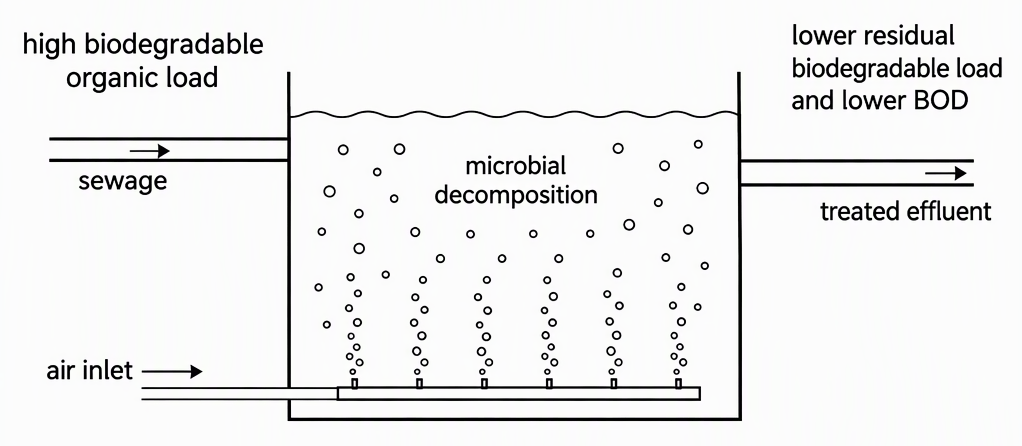
Use the applicable NCERT text for terminology and examples after filtering by syllabus. Shorten its explanation without changing the cause-and-effect relationship.
Make contrast notes for easily confused terms:
- BOD versus dissolved oxygen: BOD measures oxygen demand associated with microbial breakdown under specified conditions; dissolved oxygen is oxygen already present in water.
- Bioaccumulation versus biomagnification: bioaccumulation is buildup within one organism over time; biomagnification is increasing concentration across trophic levels.
- Ozone depletion versus the greenhouse effect: ozone depletion reduces stratospheric ultraviolet protection; the greenhouse effect involves absorption and re-emission of outgoing infrared radiation.
Retain the latter two comparisons only if they fit your checked syllabus or another examination you are preparing for. Do not memorise legacy details merely because they share a chapter.
- Close the source and reconstruct the chain from memory. Write the cause, process and consequence. Reopen the text only to correct omissions, incorrect terms or reversed relationships.
Recall must include direction. Remembering “microbes, organic matter, BOD” is not enough unless you can explain why effective treatment lowers BOD.
- Identify what the MCQ tests before evaluating its options: cause, mechanism, effect, control or an incorrect statement. Reject options that reverse the chain or describe a different process.
Record each error as a precise correction, not a copied question. For example: “BOD is oxygen demand, not the amount of oxygen already dissolved in water.”
How do I solve a BOD question using the treatment mechanism?
Effective biological treatment reduces the remaining biodegradable load, so BOD falls. Microbes consume oxygen while breaking down waste, but that does not mean the treated effluent has a higher oxygen demand.
This is an author-created practice question, not a NEET PYQ. Check the concept under sewage treatment rather than rejecting it because of an old Environmental Issues chapter label.
After effective biological treatment of sewage, which change is expected?
- A. BOD rises because organic load rises.
- B. BOD falls as biodegradable organic matter is consumed.
- C. BOD is unchanged because microbes do not affect organic matter.
- D. BOD becomes a measure of dissolved oxygen concentration.
Correct answer: B. The expected fall follows from the treatment mechanism:
- Sewage contains biodegradable organic matter.
- Microbes decompose this matter during biological treatment.
- Effective treatment leaves less residual biodegradable material.
- The remaining microbial oxygen demand is lower, so BOD falls.
Reject the distractors by locating their errors:
- A reverses the expected change: effective treatment reduces the biodegradable load.
- C denies the treatment mechanism: microbes do act on organic matter.
- D confuses demand with concentration: BOD measures oxygen required, not oxygen already present.
What does a high BOD indicate about biodegradable organic pollution?
How can I distinguish biomagnification from bioaccumulation?
Check the scale: buildup within one organism over time is bioaccumulation; increasing concentration across successive trophic levels is biomagnification. Pollutant presence alone does not distinguish them.
This is an author-created legacy Environmental Issues practice example. Prioritise it only if it maps to your verified syllabus or another examination you are preparing for.
A persistent, poorly metabolised pollutant occurs at progressively higher concentrations at successive trophic levels. This pattern is called:
- A. Bioaccumulation.
- B. Biomagnification.
- C. Eutrophication.
- D. Biodegradation.
Correct answer: B. The decisive wording is “successive trophic levels.” The question compares positions in a food chain, not one organism at different times.
Persistence, poor metabolism and poor elimination help explain why certain pollutants remain in organisms and become more concentrated through feeding relationships. Not every pollutant biomagnifies.
Reject the alternatives by definition:
- Bioaccumulation: buildup within an organism over time, not the stated cross-trophic pattern.
- Eutrophication: nutrient enrichment of a water body, not increasing pollutant concentration across trophic levels.
- Biodegradation: biological breakdown, not the concentration pattern described.
Keep the scale distinction in your recall note. “Pollutant buildup” is too vague to separate the closest options.
How do I separate ozone depletion from greenhouse warming in a statement question?
Match each mechanism to its radiation: stratospheric ozone absorbs harmful ultraviolet radiation; greenhouse gases absorb and re-emit outgoing infrared radiation. Reject statements that swap those roles.
This is an author-created, syllabus-conditional legacy-topic example. It is not a NEET PYQ or evidence of current weightage.
Which statement is correct?
- A. Stratospheric ozone shields Earth from harmful ultraviolet radiation.
- B. The greenhouse effect is caused by the ozone hole admitting more infrared radiation.
- C. Ozone depletion and global warming are the same mechanism.
- D. Carbon dioxide protects Earth mainly by absorbing ultraviolet radiation.
Correct answer: A. It links stratospheric ozone with ultraviolet absorption.
- B confuses the mechanisms: the greenhouse effect involves outgoing infrared radiation, not an ozone hole admitting more infrared radiation.
- C treats different mechanisms as identical: loss of ozone protection and greenhouse warming are not interchangeable explanations.
- D assigns carbon dioxide the wrong principal role: its role here is greenhouse absorption of infrared radiation, not stratospheric ultraviolet shielding.
Do not replace one misconception with another: substances affecting ozone can also contribute to warming. Different mechanisms do not require completely separate sets of chemicals.
Close the source: which radiation is involved in ozone protection, and which in the greenhouse effect?
What should I practise next without wasting time on excluded material?
Practise retained concepts in this order: direct mechanism questions, confusing-term comparisons, then mixed statement questions. Choose topics from your verified syllabus and your errors, not an old chapter boundary. Use older PYQs only after checking their concepts against the target-year syllabus; historical appearance does not prove present inclusion.
For sewage-treatment revision, start with Microbes in Human Welfare practice questions. Apply the causal-chain method before reading each explanation.
Classify every wrong answer and assign a specific repair:
- Syllabus-selection failure: return to the official wording and reclassify the concept.
- Factual-recall failure: check the applicable NCERT passage, then retrieve the fact with the book closed.
- Reversed cause and effect: rewrite the chain and explain each link.
- Misread stem: identify words such as “incorrect,” “after treatment” or “successive trophic levels” before evaluating options.
Worked numerical: score the three practice answers. Suppose you answer the BOD and biomagnification examples correctly but miss the ozone statement. Under the NEET marking rule:
Changing the wrong answer to a correct answer produces:
This is scoring arithmetic, not a promised score gain. Repair the ozone-versus-greenhouse contrast rather than rereading every environmental topic.
You are ready when you can reconstruct a process, distinguish its nearest confusing term and justify rejecting the distractors. Repeated reading does not establish those abilities.
For available, syllabus-matched topics, NEET JEEnius AI practice mode offers sets that skip questions already seen, with 60 free sets a month. Choose your next set from the concept behind your last error, then check whether the precise correction holds on a new question.
Next step: daily practice problems on NEET JEEnius AI and get a fresh set on a topic every day (20 free attempts a month).
Frequently asked questions
Is Environmental Issues included in my NEET syllabus?
Check the official syllabus for your target examination year at neet.nta.nic.in; an old NCERT chapter or PYQ collection does not establish inclusion. Search the Biology section for individual concepts and read the surrounding wording, rather than relying on the chapter title. Check sewage treatment and BOD under Microbes in Human Welfare separately.
How should I make Environmental Issues notes for NEET?
First retain only concepts that map to your verified target-year syllabus. For each retained topic, write source or cause → process → consequence → control, leaving out any field that does not fit. Close the source, reconstruct the chain from memory and correct missing terms or reversed relationships.
Why does BOD decrease after biological sewage treatment?
During effective biological treatment, microbes break down biodegradable organic matter. This leaves less residual biodegradable material, so the remaining microbial oxygen demand—and therefore BOD—is lower. BOD measures oxygen demand, not the oxygen already dissolved in water.
Should I solve old Environmental Issues NEET PYQs?
Use older PYQs only after checking their concepts against your target-year official syllabus. Historical appearance does not prove current inclusion. For retained concepts, practise direct mechanism questions first, then confusing-term comparisons and mixed statement questions.