
How can I study Human Reproduction for NEET in six steps?
Study Human Reproduction for NEET by checking site, stage, trigger and outcome before trusting a familiar-looking option. Turn NCERT into linked event maps, then reproduce them without looking. Choose this over repeated rereading because it exposes where your sequence or explanation breaks.
- Divide the current NCERT chapter into six blocks. Use reproductive anatomy, gametogenesis, menstrual cycle, fertilisation and implantation, pregnancy and embryonic development, and parturition and lactation. Treat these as a coverage checklist, not a predicted weightage ranking. Against each block, record whether you can recall its structures, events and controlling signals. Stay within Human Reproduction; contraception, STIs and infertility treatments belong to Reproductive Health.
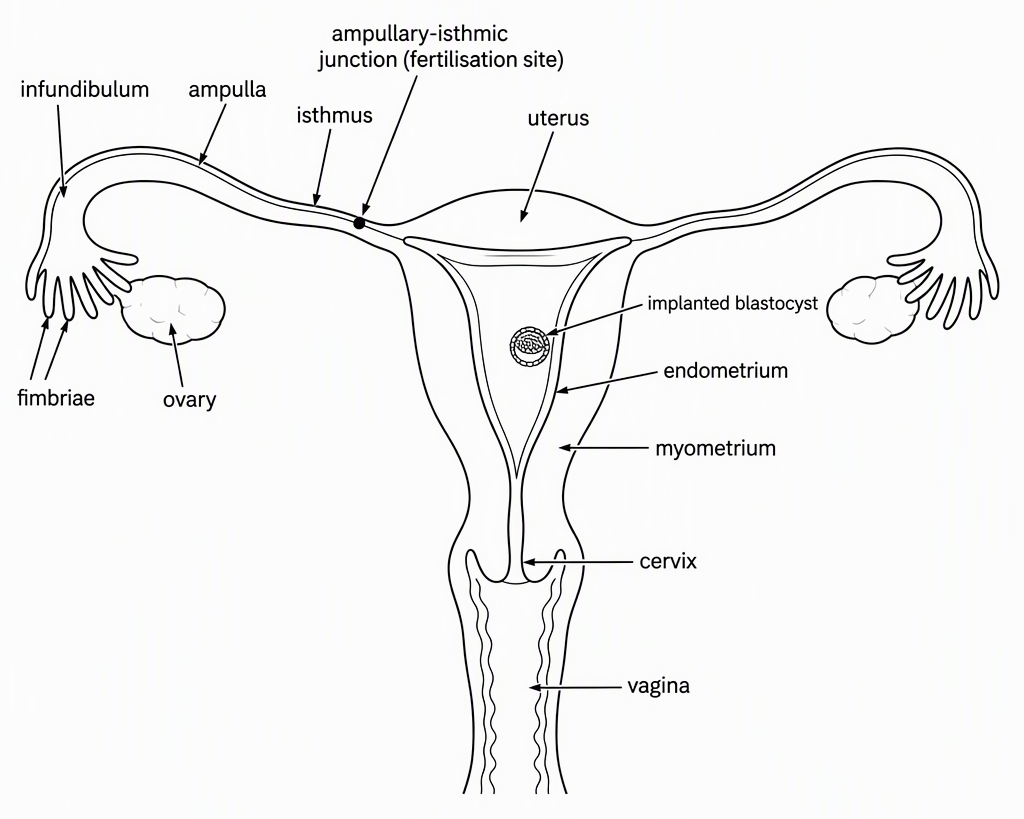
- Trace structures before memorising labels. Follow sperm from seminiferous tubules through rete testis, vasa efferentia, epididymis, vas deferens, ejaculatory duct and urethra. On the female-system diagram, distinguish the funnel-shaped infundibulum, wider ampulla and narrow isthmus joining the uterus. Cover the NCERT labels and retrieve them without looking. Check connections as well as names: recognising “oviduct” is not enough to locate fertilisation.
- Build separate sperm and oocyte sequences. Label the cell immediately before and after each division. One primary spermatocyte produces two secondary spermatocytes through meiosis I, then four spermatids through meiosis II. Spermiogenesis changes spermatids into spermatozoa; spermiation releases spermatozoa from Sertoli cells into the tubule lumen.
In oogenesis, the primary oocyte completes meiosis I to form a secondary oocyte and first polar body. The ovulated cell is a secondary oocyte, not an ovum that has already completed meiosis II.
Worked numerical: Suppose five primary spermatocytes all complete both meiotic divisions. Each produces four spermatids, so the total is:
Spermiogenesis changes their form, not their number. Assuming all differentiate successfully, twenty spermatozoa result. Do not apply this four-functional-gamete output to oogenesis.
- Build a three-column menstrual-cycle table in your notebook. Use ovarian event, uterine change and controlling hormone as the columns. Fill it with these linked rows rather than isolated hormone names:
- Menstrual phase: corpus luteum regression from the preceding cycle; endometrial shedding; falling progesterone and oestrogen.
- Follicular phase: follicular growth; endometrial rebuilding; FSH supports follicles, which secrete oestrogens.
- Ovulation: release of the secondary oocyte; the lining does not shed; the LH surge triggers release.
- Luteal phase: corpus luteum formation; endometrial maintenance and secretory changes; progesterone from the corpus luteum provides support.
- Extend the map from fertilisation to birth. Order fertilisation, cleavage, morula, blastocyst and implantation, attaching a site to each. Add NCERT recall prompts for placental exchange and secretions, embryonic milestones and their time points, the foetal-ejection reflex, uterine contractions and colostrum. Separate prolactin-supported milk production from oxytocin-mediated milk ejection.
- Close NCERT and reproduce the outputs. Your final sheets should contain labelled anatomy sketches, paired gametogenesis sequences, a cycle table and a fertilisation-to-birth event map. These replace copied paragraphs, not NCERT itself.
Solve MCQs using site, stage, trigger and outcome wherever applicable. Underline incorrect, before and after, then verify the complete option. Reopen NCERT to repair the specific broken link, rather than rereading every page.
For a fresh application of a repaired concept, NEET JEEnius AI’s optional daily practice problems provide a fresh set on a topic every day, with 20 free attempts a month.
How do I separate the sites of fertilisation and implantation?
Fertilisation usually occurs at the ampullary-isthmic junction; implantation involves the uterine endometrium. Reconstruct the route before selecting an answer, then test both halves of the pair.
Original practice question, not a previous-year NEET question: Which pair correctly gives the usual site of fertilisation and the site of implantation, respectively?
- A. Ampullary-isthmic junction and uterine endometrium.
- B. Uterine cavity and uterine endometrium.
- C. Ampullary-isthmic junction and myometrium.
- D. Cervix and uterine endometrium.
After fertilisation in the oviduct, cleavage proceeds during transport towards the uterus. The morula enters the uterus, develops further into a blastocyst and subsequently implants. Correct answer: A.
Apply the site check twice:
- A: Both locations are correct.
- B: The implantation site is correct, but fertilisation is misplaced.
- C: The fertilisation site is correct, but the myometrium is muscular uterine tissue, not the lining involved in implantation.
- D: The implantation site is correct, but the cervix is not the usual fertilisation site.
Closed-book task: Mark both sites on an unlabelled female reproductive-system diagram. State which stage enters the uterus and which stage implants.
How do I solve a menstrual-cycle hormone sequence question?
Menstruation follows corpus luteum degeneration and declining progesterone support, not the earlier LH surge. Trace the post-ovulatory stage, loss of hormone support and resulting uterine change.
Original practice question: In a cycle without fertilisation, which sequence explains the onset of menstruation?
- A. Corpus luteum degeneration, reduced progesterone support, endometrial breakdown.
- B. Corpus luteum degeneration, increased progesterone, endometrial maintenance.
- C. LH surge, implantation, endometrial breakdown.
- D. Sustained corpus luteum activity, sustained progesterone, endometrial breakdown.
Correct answer: A. The stage is post-ovulatory. Corpus luteum degeneration reduces progesterone support, leading to endometrial breakdown.
- B: Progesterone falls after degeneration; it does not increase.
- C: The LH surge triggers ovulation, not the later hormone withdrawal. Implantation does not belong in this unfertilised cycle.
- D: The first two events fit together, making this tempting. Its outcome does not: sustained progesterone supports the endometrium rather than explaining its breakdown.
Use NCERT’s typical cycle as a teaching model, not a claim that every person ovulates on an identical calendar day. Check the causal sequence, not just a remembered day number.
Which oocyte stage is released at ovulation?
Ovulation releases a secondary oocyte arrested at metaphase II. Sperm entry induces completion of its second meiotic division. Ovarian release does not itself complete meiosis II, even when everyday language loosely calls the released cell an “ovum”.
Original practice question: Which statement correctly describes the cell released at ovulation and its subsequent meiotic progression?
- A. A primary oocyte completes meiosis I only after implantation.
- B. A secondary oocyte arrested at metaphase II completes meiosis II following sperm entry.
- C. An ovum that has already completed meiosis II is released at ovulation.
- D. An oogonium begins meiosis after entering the oviduct.
Correct answer: B. Reconstruct the sequence: primary oocyte, completion of meiosis I, secondary oocyte, ovulation, sperm entry, completion of meiosis II.
- A: Places meiosis I far too late.
- C: Uses a familiar everyday term but assigns completed meiosis II to the wrong stage.
- D: Substitutes an earlier germ-cell stage and misplaces the start of meiosis.
For comparison, use Spermatogenesis: divisions and spermiogenesis to separate meiotic divisions from sperm differentiation. A division changes cell number; differentiation changes cell form.
What should I practise after making the chapter maps?
Start with a closed-book diagnostic: label a reproductive-system diagram, reconstruct both gametogenesis sequences, explain the menstrual cycle through hormone changes, and order fertilisation through implantation. If you cannot explain a connection without notes, repair that connection before attempting another mixed set.
Match the practice to the failure:
- Site errors: use diagram labelling and structure-function matching.
- Stage errors: use sequence questions and identify the cell before and after each division.
- Hormone errors: use cause-and-effect statements, checking whether the stated outcome follows from the signal.
Keep an error log with the mistaken claim, corrected NCERT fact and reason for the error. Distinguish missing knowledge from misreading a qualifier: repair the fact for the former; underline the qualifier and recheck the complete option for the latter.
After targeted repair, attempt a mixed Human Reproduction set covering pregnancy, placental functions, embryonic development, parturition and lactation too. The three worked examples demonstrate the method; they are not the entire chapter syllabus.
Re-test after a gap without notes. Judge readiness by explaining the correct option and why each distractor fails, not by remembering an answer letter.
NEET JEEnius AI’s optional practice mode offers topic sets that skip questions already seen, with 60 free sets a month. Unseen questions test transfer, but they do not replace revision. Separately revisit your recorded mistakes and reconstruct the reasoning before checking the answer.
Next step: practice mode on NEET JEEnius AI and practise a topic in sets that skip questions you have already seen (60 free sets a month).
Frequently asked questions
How should I study Human Reproduction for NEET?
Divide NCERT into six blocks: anatomy, gametogenesis, menstrual cycle, fertilisation and implantation, pregnancy and embryonic development, and parturition and lactation. Build labelled diagrams, paired gametogenesis sequences, a cycle table and a fertilisation-to-birth map. Reproduce these without notes, then solve MCQs by checking site, stage, trigger and outcome.
Where do fertilisation and implantation occur?
Fertilisation usually occurs at the ampullary-isthmic junction of the oviduct. Implantation involves the uterine endometrium, not the muscular myometrium. The morula enters the uterus, develops into a blastocyst and subsequently implants.
Which oocyte stage is released during ovulation?
Ovulation releases a secondary oocyte arrested at metaphase II. Sperm entry induces completion of meiosis II. Do not select an option claiming that the released cell has already completed its second meiotic division.
Which hormone changes cause menstruation?
In a cycle without fertilisation, corpus luteum degeneration leads to falling progesterone and oestrogen levels. Loss of hormonal support causes endometrial breakdown and shedding. The earlier LH surge triggers ovulation, not menstruation.
How do I fix mistakes in Human Reproduction MCQs?
Record the mistaken claim, corrected NCERT fact and reason for the error. Repair site errors with diagram labelling, stage errors with sequences, and hormone errors with cause-and-effect checks. For misread qualifiers, underline words such as incorrect, before and after, then recheck the complete option. Re-test after a gap and explain why each distractor fails.