
How should I study Molecular Basis of Inheritance for NEET in six steps?
Study Molecular Basis of Inheritance for NEET by predicting answers before reading the options. Organise your work around three tasks: tracking a sequence, predicting an experimental result and tracing gene regulation. Use NCERT for the rules and compact recall sheets to practise applying them. These six steps are faculty recommendations, not official requirements or a guarantee of marks.
- Map the chapter before taking notes. List genetic material and its evidence; DNA structure and packaging; replication; transcription and RNA processing; genetic code and translation; gene regulation; Human Genome Project; and DNA fingerprinting. Keep Human Genome Project and DNA fingerprinting on a separate coverage checklist because a DNA-to-protein flowchart does not cover them.
- Read one NCERT block and produce one small output from memory. Choose a labelled diagram, a process arrow chain or a comparison table in your notebook. For packaging, reconstruct the hierarchy; for RNA processing, list what each modification changes. Reopen NCERT, correct omissions and close it again. Do not rewrite whole paragraphs: copying does not test recall.
- Build a process table with fixed fields. Use starting material, product, enzyme or machinery, direction and context. Keep separate entries rather than creating one blended “DNA process” rule:
- Replication: DNA produces DNA; DNA polymerase extends a primer; new DNA is synthesised five-prime to three-prime.
- Transcription: a DNA template produces RNA; RNA polymerase synthesises RNA five-prime to three-prime while reading the template in the opposite direction.
- Translation: mRNA directs polypeptide formation; ribosomes, tRNAs and associated machinery act together; mRNA is read five-prime to three-prime.
Distinguish template from coding strand. Record the cellular context separately: transcription and translation can be coupled in bacteria, while eukaryotic primary mRNA transcripts require processing before translation. Do not transfer a prokaryotic rule into a eukaryotic question.
- Convert each genetic-material experiment into four prompts. Record what was changed or labelled, what was observed, what was concluded and what a competing explanation would predict. Griffith demonstrated transformation; he did not identify DNA as the transforming substance. Avery, MacLeod and McCarty identified the transforming principle as DNA. For their enzyme treatments, explain why destroying DNA, rather than protein or RNA, abolished transformation.
- Use one MCQ routine every time. Classify the task, write the governing rule, mark the relevant direction or experimental condition, predict the answer, then inspect the options. For statement questions, judge each statement independently. One familiar phrase does not make an entire option correct.
- Reconstruct before practising. Close the book and rebuild your outputs. Label errors as missing fact, confused comparison, direction mistake or failed inference; repair that output rather than restarting the chapter. Your coverage check must explicitly include packaging, RNA processing, genetic-code features, translation, Human Genome Project and DNA fingerprinting. The three examples below demonstrate a method, not the entire chapter.
After repairing one output, NEET JEEnius AI daily practice problems offer a fresh topic set every day, with 20 free attempts a month.
How do I get the mRNA sequence right without reversing the strand?
Keep the template’s end labels visible and build a complementary, antiparallel RNA strand. Do not start by replacing thymine with uracil: that shortcut applies to a coding strand written in the same direction as the required RNA, not to the template. Identify the supplied strand before changing any base.
Original practice example, not a NEET previous-year question
A DNA template strand is:
Which option gives the corresponding mRNA written five-prime to three-prime?
- A
- B
- C
- D
Method: identify the template, retain its direction labels, apply complementary RNA bases, then label the product antiparallel to it.
Correct answer: A. Each distractor exposes a different error:
- B: copies the template, substituting U for T.
- C: reverses the correct RNA sequence while retaining the wrong end labels.
- D: uses DNA bases, including T.
mRNA is complementary to the template. It matches the coding strand, when both are written in the same direction, except that U replaces T.
Closed-book check: explain which rule changes when the supplied strand is coding rather than template.
How do I predict Meselson–Stahl bands instead of memorising them?
Track the old strands through each replication round. Under semiconservative replication, each daughter molecule retains one parental strand and receives one newly synthesised strand. The medium determines the label in the new strands; moving bacteria into light medium does not remove the heavy label already present in parental DNA.
Original practice example
Bacteria with nitrogen-15-labelled DNA are transferred to nitrogen-14 medium. After two rounds of DNA replication, which DNA bands are expected in a density gradient?
- A: heavy only.
- B: intermediate only.
- C: intermediate and light.
- D: heavy and light.
Correct answer: C. Begin with one fully heavy DNA molecule. The first round produces two hybrid molecules, each containing one heavy strand and one light strand. In the next round, each hybrid produces one hybrid molecule and one fully light molecule.
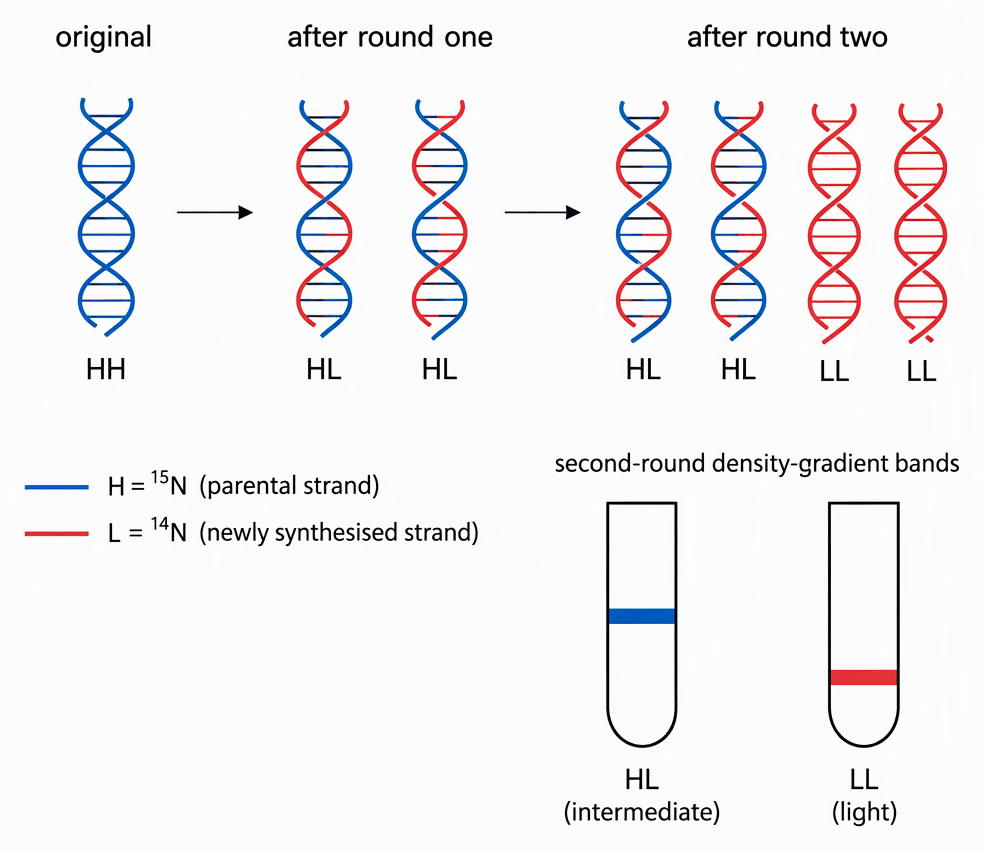
The resulting molecule fractions are:
A hybrid molecule is not a mixture of separate fully heavy and fully light molecules. It contains one heavy and one light strand.
Use the competing-model check: conservative replication predicts separate heavy and light DNA after the first round, unlike the observed intermediate band.
How do I solve a lac-operon question by tracing the switch?
Follow what binds to what, then decide whether repression remains. In the NCERT model, an available inducer interacts with the repressor and prevents it from binding the operator. This relieves repression and permits transcription. Keep the DNA binding sites separate from the molecules that bind them.
Original practice example using the NCERT-level lac-operon model
Which change permits transcription of the lac structural genes when the inducer is available?
- A: the repressor binds the operator.
- B: the inducer binds the repressor and prevents its binding to the operator.
- C: the operator produces the inducer.
- D: the structural genes stop transcription of the i gene.
Correct answer: B. Trace the causal chain:
Without inducer, the active repressor binds the operator and blocks transcription. A therefore describes repression, not its removal.
Keep these identities separate:
- i gene: encodes the repressor.
- Operator: a DNA site, not a protein or an inducer-producing structure.
- Promoter: the RNA-polymerase binding site.
C assigns production to a DNA binding site. D invents a feedback step in which structural genes switch off the i gene.
Do not conclude that lactose switches off the i gene. Relief of repression permits transcription; it does not guarantee maximal transcription regardless of other conditions.
What should I practise next after making a mistake?
Start with the task that failed: coding-versus-template questions in different written orientations, experiment questions that change a label or replication stage, or lac-operon questions that change inducer availability. Repair that task before mixing question types. Rereading the whole chapter is a poor response to a specific direction or inference error.
Then mix in NCERT statement, diagram and comparison questions on DNA packaging, replication enzymes, RNA processing, genetic-code properties, translation, Human Genome Project and DNA fingerprinting. Include these even when your three worked-example skills feel secure.
Use this error-to-repair list beside your practice sheet:
- Missing fact: retrieve the relevant NCERT line from memory, then verify it.
- Confused comparison: rebuild a side-by-side table in your notebook.
- Direction error: label both ends of both strands before converting bases.
- Inference error: draw the causal chain or track the labelled material through each stage.
Revisit errors in a later sitting before solving unseen variants. Recognising an already-solved option is weaker evidence of learning than solving a fresh question and explaining why its distractors fail.
Keep chapter practice separate from full-paper simulation. An examination with 180 questions in 180 minutes does not require a fixed one-minute limit for every Biology question. During repair, prioritise correct reasoning; during full-paper practice, assess pacing across the paper.
For unseen variants, NEET JEEnius AI practice mode provides topic practice in sets that skip questions already seen, with 60 free sets a month, not 60 free questions.
Readiness test: reconstruct the chapter map, explain why the wrong options fail and complete mixed practice without notes. If one test fails, repair that specific output before attempting another set.
Next step: daily practice problems on NEET JEEnius AI and get a fresh set on a topic every day (20 free attempts a month).
For a worked example of the same idea, see Free NEET PYQs: Verify Papers, Keys and Chapterwise Sets.
Frequently asked questions
How should I study Molecular Basis of Inheritance for NEET?
Map the chapter, then read one NCERT block at a time and reconstruct a diagram, process chain or comparison table from memory. Build separate process tables for replication, transcription and translation, and record each experiment’s setup, observation and conclusion. Predict MCQ answers before reading options, then repair specific errors before mixed practice. Keep Human Genome Project and DNA fingerprinting on your coverage checklist.
How do I write mRNA from a DNA template strand?
Label the template’s ends and build a complementary, antiparallel RNA strand using U instead of T. RNA is synthesised five-prime to three-prime, so a template written three-prime to five-prime can be converted directly into the complementary mRNA sequence. Simply replacing T with U works for the coding strand written in the same direction as the required RNA, not for the template.
What bands appear after two rounds in the Meselson–Stahl experiment?
After nitrogen-15-labelled bacteria undergo two replication rounds in nitrogen-14 medium, intermediate and light DNA bands appear. Semiconservative replication produces hybrid DNA after the first round; each hybrid then produces one hybrid and one fully light molecule. After two rounds, half the DNA molecules are hybrid and half are fully light.
How does the inducer allow transcription in the lac operon?
In the NCERT-level model, the inducer interacts with the repressor and prevents it from binding the operator. This relieves repression and permits transcription of the structural genes. The inducer does not switch off the i gene, and relief of repression does not guarantee maximal transcription under every condition.