
How can I study Plant Physiology for NEET in five steps?
Study Plant Physiology for NEET by reconstructing processes, not repeatedly rereading chapters. For each process, retrieve its site, starting material, output and conditions. Use those same checks to reject MCQ options and identify the fact to repair after a mistake.
How do I turn an NCERT passage into a recall sheet?
Use one process per sheet, not an entire chapter. Read the passage with its diagram, close the book, and rebuild the process before attempting questions. Follow these five steps.
- Fix the scope. Check the official syllabus for your target exam year at neet.nta.nic.in against the NCERT edition you use. Organise your study around Photosynthesis in Higher Plants, Respiration in Plants, and Plant Growth and Development where prescribed.
Do not automatically add Transport in Plants or Mineral Nutrition because an old playlist includes them. Verify whether their topics appear in the applicable official syllabus. Study photosynthesis first, respiration next, and growth and development last: this is a conceptual order, not a chapter-weightage ranking. Photosynthesis and respiration share energy-carrier concepts; growth and development shifts the focus to regulation.
- Read one process-sized passage with its diagram. Record five fields: process, site, starting material or trigger, output or response, and relevant condition or exception. Add energy carriers, such as ATP and NADPH, where relevant to biochemical pathways.
For hormones, use trigger–regulator–response rather than forcing every effect into a chemical input–output template. A useful entry is: water stress → ABA → stomatal closure → reduced water loss. Keep the qualifying condition attached to the response.
- Close NCERT and reconstruct. Rebuild the diagram or comparison from memory. Reopen the book and correct missing labels, reversed arrows and qualifying words. Recognition while reading is not the same as recall without the page.
For a C3–C4 comparison sheet, make adjacent C3 and C4 columns with these separate rows:
- Primary carbon dioxide acceptor: C3, RuBP; C4, PEP.
- First stable fixation product: C3, 3-PGA; C4, oxaloacetic acid.
- Initial fixation location: C3, mesophyll chloroplast stroma; C4, mesophyll cytoplasm.
- Calvin cycle location: C3, mesophyll chloroplast stroma; C4, bundle-sheath chloroplast stroma.
Initial fixation and the Calvin cycle are different stages. C4 plants still use RuBP in their Calvin cycle. Record the stage, not just “C4 acceptor”.
- Solve with the same checklist. Identify the process, check its site, check the starting material and output, then test conditions or exceptions. Mark words such as directly, only and incorrect before comparing options.
- Diagnose the error. Label each wrong answer as a site error, sequence error, product or energy error, or qualifier error. Repair the relevant NCERT fact, then retrieve it again without looking.
The compact sheet supplements NCERT. It does not replace the book’s examples, diagrams or exceptions.
How do I separate cyclic from non-cyclic photophosphorylation?
Track the electron’s destination and the products formed. In cyclic flow, the excited electron returns through the electron transport pathway to PSI. ATP is formed, but there is no net NADPH formation or oxygen evolution.
Original NEET-style practice MCQ, not a previous-year question
Which statement correctly describes cyclic photophosphorylation?
- A. It involves both PSII and PSI.
- B. It produces ATP without net NADPH formation or oxygen evolution.
- C. Its electrons are replaced by splitting water.
- D. NADP⁺ is the terminal electron acceptor.
Correct answer: B. Identify cyclic electron flow involving PSI, operating through the thylakoid membrane system. Follow the returning electron, then check the output: ATP, rather than ATP plus NADPH and oxygen.
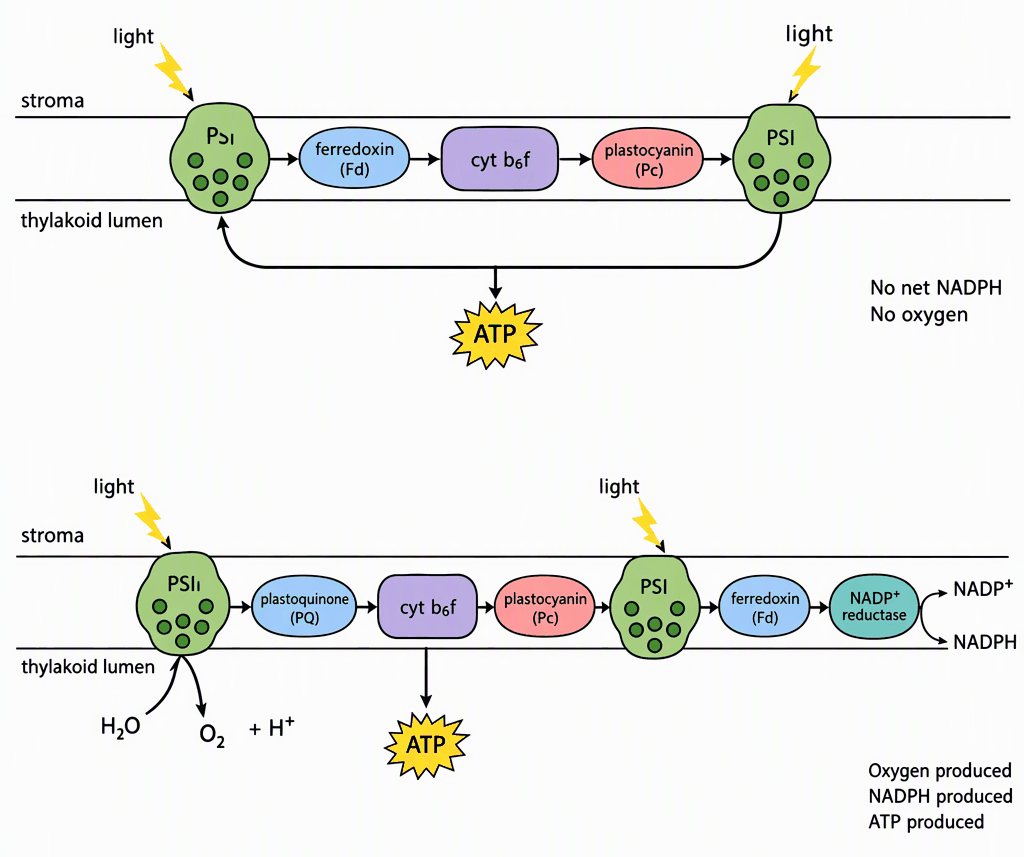
Reject each distractor for a specific reason:
- A: Both photosystems participate in non-cyclic flow.
- C: Water splitting replaces electrons lost from PSII in non-cyclic flow.
- D: Terminal reduction of NADP⁺ belongs to non-cyclic flow.
If you chose A, repair a comparison sheet with adjacent cyclic and non-cyclic columns. Use rows for photosystems involved, electron destination, ATP, NADPH and oxygen. Close the book and answer: What happens to the excited electron in cyclic flow?
How do I avoid confusing glycolysis with mitochondrial respiration?
Check location before making any claim about oxygen. Glycolysis occurs in the cytoplasm and produces pyruvate. It does not directly require molecular oxygen, but that does not mean it occurs only without oxygen. The pathway operates in both aerobic and anaerobic contexts.
Original NEET-style practice MCQ
Which statement about glycolysis is correct?
- A. It occurs in the mitochondrial matrix.
- B. It directly consumes molecular oxygen.
- C. It converts glucose into pyruvate in the cytoplasm.
- D. It completely oxidises glucose to carbon dioxide.
Correct answer: C. Apply the checklist in order: the process is glycolysis; its site is the cytoplasm; glucose is the starting material; the carbon-containing end product is pyruvate; molecular oxygen is not directly required.
- A is a site swap: The mitochondrial matrix is associated with the TCA cycle, not glycolysis.
- B confuses a pathway with the overall process: Aerobic respiration uses oxygen, but glycolysis does not directly consume it.
- D confuses partial breakdown with complete oxidation: Glycolysis produces pyruvate, not carbon dioxide.
For correction, redraw glycolysis leading to pyruvate, then branch into subsequent pathways under the relevant conditions.
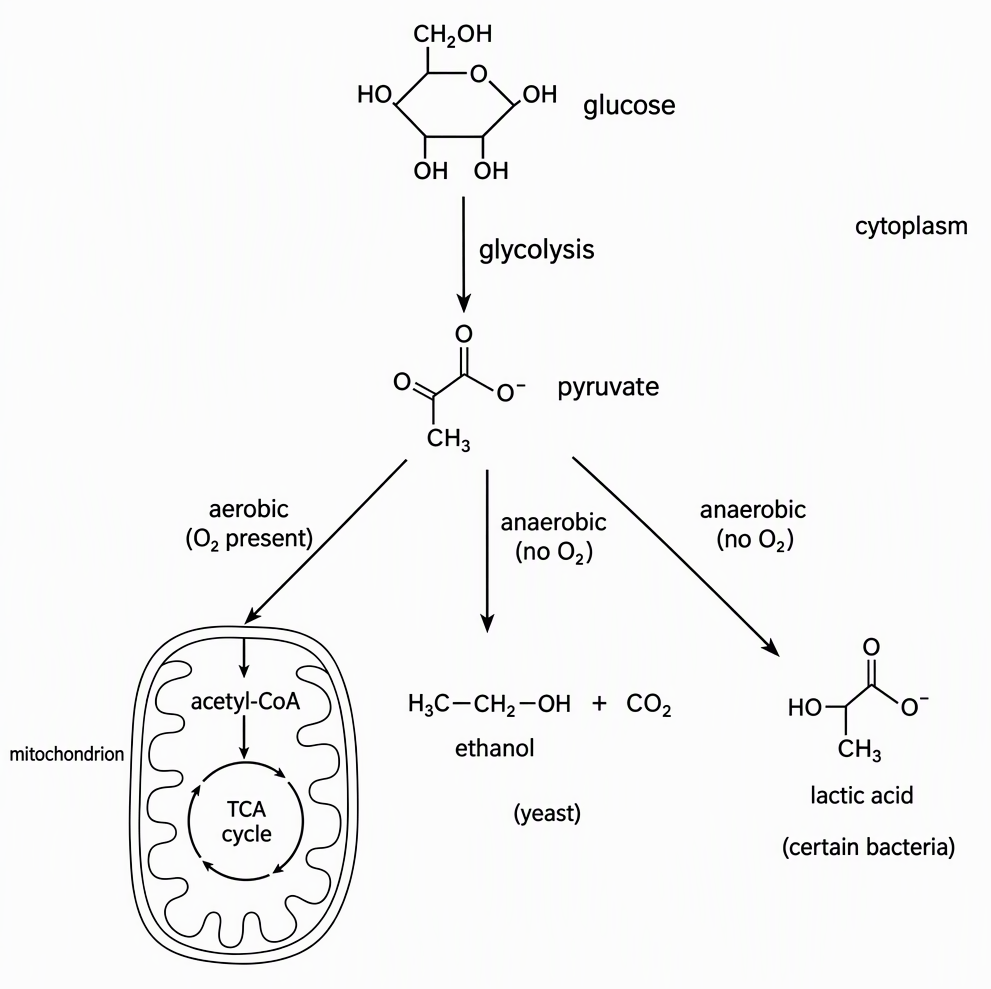
Retrieve the location and branch conditions again. Do not make mitochondrial ATP-yield totals the centre of this repair.
How do I identify a plant hormone from its response?
Match the trigger and response before considering broad hormone labels. Water stress followed by stomatal closure points to abscisic acid, or ABA. Closure reduces water loss through transpiration. That specific association is more useful than remembering ABA only as a “growth inhibitor”.
Original NEET-style practice MCQ
During water stress, which plant growth regulator promotes stomatal closure?
- A. Auxin
- B. Gibberellin
- C. Cytokinin
- D. Abscisic acid
Correct answer: D. Apply the adapted checklist: the trigger is water stress; the response is stomatal closure; the associated regulator is ABA. The relevant site is the stomatal apparatus, where guard cells control the opening.
Compare the alternatives using specific NCERT associations:
- Auxin: Associated with apical dominance.
- Gibberellins: Promote stem elongation.
- Cytokinins: Promote cell division.
- ABA: Promotes stomatal closure during water stress.
These associations reject the distractors here; they are not complete definitions. Hormones have multiple, context-dependent effects, so “growth promoter” and “growth inhibitor” cannot answer every question.
Repair an error by making a sheet with regulator, response and example columns. One entry could connect auxin, apical dominance and suppression of lateral-bud growth by the growing apex. Test the sheet backwards: cover the regulator and recall it from the response.
What should I practise after making the recall sheets?
Start with topic-wise questions immediately after reconstructing the corresponding NCERT diagram or comparison. Then mix photosynthesis, respiration and hormone questions so you must identify the process without a chapter cue. Add statement-based and incorrect-statement questions only when you can retrieve the underlying process.
- Separate the closest processes. Practise C3 versus C4 initial fixation, then cyclic versus non-cyclic photophosphorylation.
- Separate respiratory stages. Compare glycolysis, the TCA cycle and the electron transport system by site, starting material, products, energy carriers and oxygen’s role.
- Compare overlapping regulator effects. Keep the tissue, condition and specific response attached to each hormone.
- Use syllabus-aligned NEET previous-year questions. Explain why every distractor fails, not just why the correct option works.
Suppose you attempt the three MCQs above, answering two correctly and one incorrectly. Using four marks for a correct answer and a deduction of one mark for an incorrect answer:
If that wrong answer were correct, the same marking scheme would give:
Keep an error log containing the mistaken claim, the corrected NCERT statement and a retrieval prompt. Revisit it in the next study session and again after studying another topic.
Class 11 students should build process maps during first learning. Class 12 students and droppers should begin with a mixed diagnostic set and rebuild only the maps their errors expose.
If your confusion is between plant groups rather than plant processes, use How to Study Plant Kingdom NEET: NCERT Recall and MCQs. Classification and physiology need different recall sheets.
For fresh topic practice, NEET JEEnius AI’s practice mode offers sets that skip questions you have already seen, with 60 free sets a month. After each set, turn every wrong answer into one closed-book retrieval prompt.
Frequently asked questions
How should I study Plant Physiology from NCERT for NEET?
Read one process-sized passage with its diagram, then close NCERT and reconstruct it from memory. Record the process, site, starting material or trigger, output or response, and relevant conditions. Check your reconstruction against NCERT, solve topic-wise MCQs and repair each mistake with another closed-book recall attempt.
Which Plant Physiology chapters should I study first for NEET?
Check the official syllabus for your target exam year against your NCERT edition before choosing chapters. Where prescribed, study Photosynthesis in Higher Plants first, Respiration in Plants next, and Plant Growth and Development last. This order builds conceptual connections; it is not a chapter-weightage ranking.
Should I study Transport in Plants and Mineral Nutrition for NEET?
Verify whether their topics appear in the official syllabus for your target exam year at neet.nta.nic.in. Do not add these chapters automatically because an older playlist includes them.
How do I stop making mistakes in Plant Physiology MCQs?
Check the process, site, starting material, output and conditions before comparing options, and mark words such as directly, only and incorrect. Classify wrong answers as site, sequence, product or energy, or qualifier errors. Log the mistaken claim, the corrected NCERT statement and a retrieval prompt, then revisit the prompt in the next study session and after another topic.