
How should I organise Properties of Matter before learning formulas?
To study Properties of Matter for NEET, choose the physical model before inserting numbers. Learn each formula with its question trigger, condition of use and nearest confusing alternative, rather than memorising an undivided formula list.
- Step 1: Map your material. Properties of Matter is a coaching umbrella, not necessarily one textbook chapter. Separate your material into mechanical properties of solids, mechanical properties of fluids and thermal properties. Check the official syllabus for your exam year at neet.nta.nic.in. Kinetic theory and thermodynamics remain outside this article’s worked scope.
- Step 2: Follow a learning sequence. Study elasticity, fluids at rest, fluids in motion and viscosity, surface tension, then thermal properties. This builds related ideas in order; it is not an exam-weightage ranking. Before each block, read the relevant NCERT definitions, diagrams and worked examples. Close the book and explain what the physical quantities mean.
- Step 3: Make a four-field formula map. Record the question trigger, governing relation, condition of use and likely confusion for each entry.
- Trigger: wire extension. Relation:
Condition: linear elastic range. Confusion: extension versus strain; cross-sectional area versus radius.
- Trigger: pressure difference with depth. Relation:
Condition: fluid at rest with constant density. Confusion: pressure increase versus absolute pressure.
- Trigger: capillary rise. Relation:
Condition: equilibrium in a narrow circular tube. Confusion: radius versus diameter; changed contact angle.
- Trigger: temperature change without phase change. Relation:
Condition: no phase change and approximately constant specific heat capacity. Confusion: sensible heat versus latent heat.
Do not confuse surface tension with temperature change. The symbols here mean:
How do I select the right formula in a numerical MCQ?
Use classify–check–solve, then test the result before choosing an option. Classification selects the question family; checking decides whether its formula applies. Do this before substitution, not after an answer fails to match the options.
- Step 4: Identify the model and prepare the data. Underline what changes, what stays fixed and the requested quantity. Sketch the system when useful, and convert substitution data to SI units. Resolve these traps first:
- Radius versus diameter: halve the diameter before calculating circular area.
- Area versus length: radius enters cross-sectional area through its square.
- Gauge versus absolute pressure: add the reference atmospheric pressure to gauge pressure when absolute pressure is requested.
- Temperature change versus phase change: warming needs specific heat; melting needs latent heat.
Standard Bernoulli assumes steady, incompressible, non-viscous flow along a streamline. Stokes’ law requires low-Reynolds-number flow. An insulated calorimetry balance must include any phase change.
- Step 5: Write the relation symbolically. Use ratios when dimensions or material properties change. For fixed tensile force and material:
With surface tension, density, contact angle and gravity unchanged:
- Step 6: Test dimensions, sign and direction. A wider wire of the same length stretches less under the same load within the linear elastic range. A wider wetting capillary shows less rise under the conditions above. Check any result with the wrong units or direction before selecting an option.
After an error, label it model selection, applicability condition, units, algebra or reading error. Write the missed decision rule, such as “diameter must be halved before calculating area”, rather than copying the solution.
How does wire extension change when length and radius both double?
The extension becomes half the original value when material and tensile force are unchanged. Doubling length increases extension, but doubling radius quadruples cross-sectional area. The area effect wins, provided both wires remain within the linear elastic range.
Constructed teaching example, not a NEET past-year question: Two wires of the same material carry the same tensile force. Wire B has twice the length and twice the radius of wire A. Find the extension of wire B divided by that of wire A, assuming linear elasticity.
Classify: elasticity. Check: tensile force and Young’s modulus are fixed. Solve: use circular area and form the ratio before calculating.
Option B is correct. The tempting answer of one treats doubled radius as doubled area.
Extension and strain are not interchangeable. Strain divides extension by the original length, which also changes here:
What happens to capillary rise when the tube radius doubles?
The rise halves if the liquid, temperature and contact angle stay unchanged. This is inverse-radius scaling, not inverse-area scaling. Check the contact angle before using the shortcut because it controls both the size and direction of the level change.
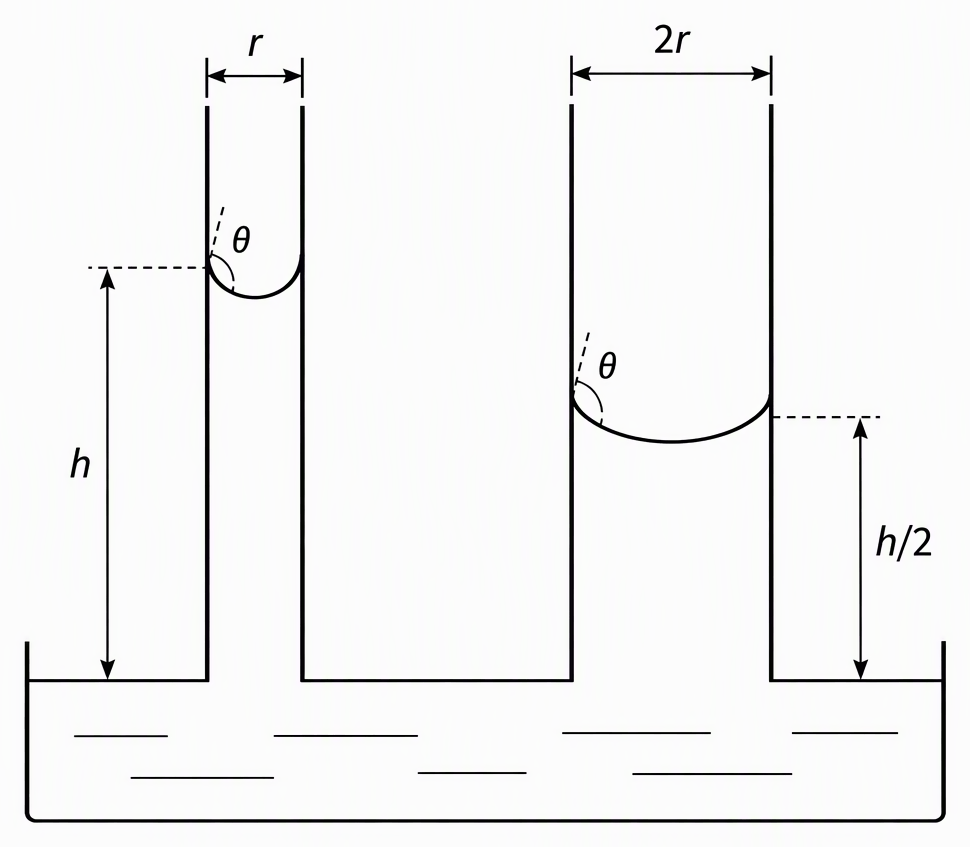
Constructed teaching example: A liquid rises 4 cm in a narrow capillary. Find the rise in another capillary of twice the internal radius, with the same liquid, temperature, tube material and contact angle.
Classify: capillarity. Check: equilibrium in narrow circular tubes; the numerator and liquid density are unchanged. Solve:
Option B is correct. Centimetres work in this dimensionless ratio because matching units cancel; direct substitution still requires consistent units.
If the liquid or contact angle changes, do not automatically halve the height. Use the full ratio:
For optional follow-up, NEET JEEnius AI’s daily practice problems provide a fresh set on a topic every day, with 20 free attempts a month.
How do I solve calorimetry questions when some ice remains?
Compare the heat available with the heat needed to melt all the ice before solving for final temperature. If the water cannot supply enough heat, ice remains. At ordinary atmospheric pressure, the equilibrium water–ice mixture is at 0°C.
Constructed teaching problem: All values below are supplied teaching data, not exam statistics or a quoted PYQ. Mix 0.10 kg of water at 20°C with 0.050 kg of ice at 0°C in an insulated vessel of negligible heat capacity. Find the final temperature and ice remaining.
- A: 0°C and 0.025 kg of ice.
- B: 0°C and no ice.
- C: 10°C and 0.025 kg of ice.
- D: 0°C and 0.050 kg of ice.
Classify: calorimetry with possible phase change. Check: do not assume all the ice melts. Solve: calculate the heat released as water cools to 0°C.
Compare this with the heat needed to melt all the ice. The ice starts at its melting point, so it needs no warming first.
Available heat is insufficient. Both water and ice remain at 0°C.
Option A is correct. Applying only the temperature-change relation to both substances ignores latent heat and can produce a physically invalid final state. Insulation means energy stays within the system, not that phase changes can be ignored.
What should I practise after these three examples?
Begin with topic-wise NCERT examples and exercises, then attempt questions clearly identified as NEET PYQs by a reliable source. The three problems above are constructed examples, not PYQs. Build accuracy within each family before mixing families where the question does not name the formula.
- Elasticity: direct extension, dimension-change ratios and stress–strain graph interpretation.
- Fluids: hydrostatic pressure and buoyancy, continuity versus Bernoulli selection, terminal-speed scaling, capillary rise and excess pressure.
- Thermal properties: expansion, calorimetry with and without phase change, plus conduction and radiation covered by your current syllabus.
For excess pressure, count interfaces before choosing the relation. A liquid drop has one interface; a thin soap bubble has two:
State the governing law and its condition before doing arithmetic. Once you can do that within one family, switch to mixed questions.
Reattempt wrong questions without viewing the solution, then solve an unseen question using the same principle. Choose the next family from your error log, not from whichever topic feels easiest.
As an optional tool, NEET JEEnius AI’s practice mode offers topic sets that skip questions already seen, with 60 free sets a month. Use your most frequent error category to choose the next topic set.
Next step: daily practice problems on NEET JEEnius AI and get a fresh set on a topic every day (20 free attempts a month).
For a worked example of the same idea, see Photosynthesis Practice Questions NEET: 6 Explained MCQs.
Frequently asked questions
In what order should I study Properties of Matter for NEET?
Study elasticity, fluids at rest, fluids in motion and viscosity, surface tension, then thermal properties. Read the relevant NCERT definitions, diagrams and worked examples before each block. This sequence builds related ideas; it is not an exam-weightage ranking.
How do I choose the right formula in Properties of Matter numericals?
Use classify–check–solve: identify the physical model, check the formula's conditions and then calculate. Write the relation symbolically and use ratios when dimensions or material properties change. Before selecting an option, check units, sign and whether the result changes in the expected direction.
What happens to wire extension if length and radius both double?
The extension becomes half the original value if the material and tensile force remain unchanged and both wires stay within the linear elastic range. Extension is proportional to length divided by radius squared, so the ratio is 2/4 = 1/2. Strain becomes one-quarter of the original value because the original length also doubles.
How do I solve calorimetry questions when some ice remains?
For ice initially at 0°C, compare the heat available from water cooling to 0°C with the heat required to melt all the ice. If the available heat is insufficient, the equilibrium water–ice mixture remains at 0°C at ordinary atmospheric pressure. Divide the heat available for melting by the latent heat of fusion to find the melted mass, then subtract it from the initial ice mass.