
Which free photosynthesis questions should I start with for NEET?
Start with original NCERT-aligned chapter MCQs, use verified PYQs for exam wording, and use full-paper mocks for execution. For photosynthesis practice questions for NEET, that order separates three jobs: finding misconceptions, interpreting actual exam questions, and recalling Biology while managing the complete paper.
A full-paper mock is not an efficient substitute for fixing confusion between cyclic and non-cyclic electron flow. Use focused questions and return to the relevant NCERT explanation.
Six free original questions and explained answers appear below. Attempt them before reading the key, then choose your next format from your mistakes.
How do chapter MCQs, verified PYQs and full-length mocks compare?
Chapter questions diagnose understanding; verified PYQs test interpretation of exam wording; full mocks test whole-paper execution. Choose according to the problem you need to fix, not a website ranking.
- Best use
- On-page original set: Find confusion between related photosynthesis concepts.
- Verified NEET PYQs: Study actual exam wording and distractors.
- NEET JEEnius AI full-length mocks: Practise completing a whole paper under a time limit.
- Chapter focus
- On-page set: Six photosynthesis questions only.
- Verified PYQs: Focused if you select authenticated photosynthesis questions.
- Full-length mocks: Whole-paper practice, with no guarantee of a photosynthesis question.
- What the result reveals
- On-page set: Which tested distinction needs repair.
- Verified PYQs: Whether you can interpret past exam questions, provided you have not simply memorised their keys.
- Full-length mocks: Overall and per-subject performance, not chapter-level diagnosis.
- Explanations or feedback
- On-page set: Correct options, reasoning and targeted repair actions.
- Verified PYQs: The final official key establishes the answer; explanations depend on the source.
- Full-length mocks: A scored per-subject breakdown.
- Free-access scope
- On-page set: All six questions and explanations below, without a registration step.
- Verified PYQs: Access conditions depend on the source.
- Full-length mocks: 30 free a month, each with 180 questions, 720 marks and 180 minutes: 45 Physics, 45 Chemistry and 90 Biology questions.
- Main limitation
- On-page set: Original practice, not actual NEET PYQs or a comprehensive chapter bank.
- Verified PYQs: Authenticity requires a traceable paper and final official answer key.
- Full-length mocks: Not a substitute for targeted chapter repair; the documented offer does not establish chapter filters.
Which format fits my preparation stage right now?
Choose from your preparation behaviour, not your class label alone. A Class 11 student with sound understanding can move to verified PYQs, while a dropper with weak concepts still needs chapter repair. Identify what causes your errors: missing knowledge, misread wording or difficulty managing a complete test.
- Class 11, just finished the chapter: Begin with the on-page set. After each conceptual error, return to the relevant NCERT passage or diagram before attempting another question.
- Class 12, revising plant physiology: Use chapter questions to check recall first. Then use verified PYQs to test your interpretation of exam wording.
- Dropper, recognising repeated PYQ answers: Try unfamiliar original questions. Recognising an option is not evidence that you can explain the pathway.
- Comfortable with chapter questions, struggling in complete tests: Choose full-length mocks to practise switching between subjects and allocating time.
If you remember the answer letter before reading the stem, explain why the other options are wrong. Then test the same concept with an unfamiliar question.
Can I try free photosynthesis practice questions for NEET now?
These six questions are original NCERT-aligned practice, not previous-year questions. Each has four options and one correct answer. They test selected distinctions, not the entire chapter. Record your choice and mark any guess before scrolling to the explanations.
1. During photosynthesis in a green plant, the oxygen released into the atmosphere comes directly from:
- A. Carbon dioxide reduced during carbohydrate formation
- B. Water split during the light reactions
- C. Glucose broken down during respiration
- D. RuBP used during carbon fixation
2. Which combination correctly describes cyclic photophosphorylation?
- A. ATP and NADPH formation, with oxygen evolution
- B. NADPH formation only, without oxygen evolution
- C. ATP formation and oxygen evolution, without NADPH formation
- D. ATP formation, without NADPH formation or oxygen evolution
3. In a chloroplast, the Calvin cycle takes place in the:
- A. Stroma
- B. Thylakoid lumen
- C. Thylakoid membrane
- D. Space between the outer and inner envelope membranes
4. Which pairing correctly describes initial carbon fixation in a C4 plant?
- A. Bundle sheath cells, PEP carboxylase
- B. Mesophyll cells, RuBisCO
- C. Mesophyll cells, PEP carboxylase
- D. Bundle sheath cells, RuBisCO
5. Which event initiates the photorespiratory pathway?
- A. PEP carboxylase fixing carbon in a mesophyll cell
- B. RuBisCO acting as an oxygenase on RuBP
- C. ATP synthase forming ATP across the thylakoid membrane
- D. Pyruvate entering ordinary mitochondrial respiration
6. A leaf receives sufficient light, but carbon dioxide availability remains limiting. Temperature and other conditions remain suitable and unchanged. Increasing light intensity further produces no rise in photosynthetic rate. What best explains this?
- A. Light cannot influence photosynthesis under any conditions.
- B. Extra light necessarily stops water splitting.
- C. The Calvin cycle can now continue without carbon dioxide.
- D. Carbon dioxide remains limiting, so extra light alone cannot raise the rate.
Attempt the whole set before checking individual answers. Looking up one pathway halfway through can supply clues to later questions and hide what you originally knew.
Why is each answer correct, and what should I revise?
The key is 1-B, 2-D, 3-A, 4-C, 5-B and 6-D. Check each explanation against your reasoning, not just your answer letter. Complete the repair action wherever the distinction was unclear.
Why does photosynthetic oxygen come from water?
1. B is correct: water splitting during the light reactions supplies the oxygen released. Carbon dioxide supplies the carbon incorporated into carbohydrates, not the evolved oxygen. Option A is tempting because carbon dioxide contains oxygen atoms, but that does not establish the source of oxygen gas.
Repair: Revisit NCERT’s account of water splitting. Write separate statements identifying the source of evolved oxygen and the source of carbohydrate carbon.
What does cyclic photophosphorylation produce?
2. D is correct: cyclic photophosphorylation produces ATP without NADPH formation or oxygen evolution. Electrons associated with photosystem I return through the electron-transfer pathway. Option C incorrectly imports oxygen evolution from the water-splitting process associated with non-cyclic flow.
Repair: Compare NCERT’s electron-flow pathways. For each, identify the photosystems involved, whether electrons return, and whether ATP, NADPH and oxygen are produced.
Where does the Calvin cycle happen?
3. A is correct: the Calvin cycle occurs in the chloroplast stroma. The light reactions involve the thylakoid membranes, while the lumen is the internal thylakoid space. Option C confuses the location of energy capture with the location of carbon assimilation.
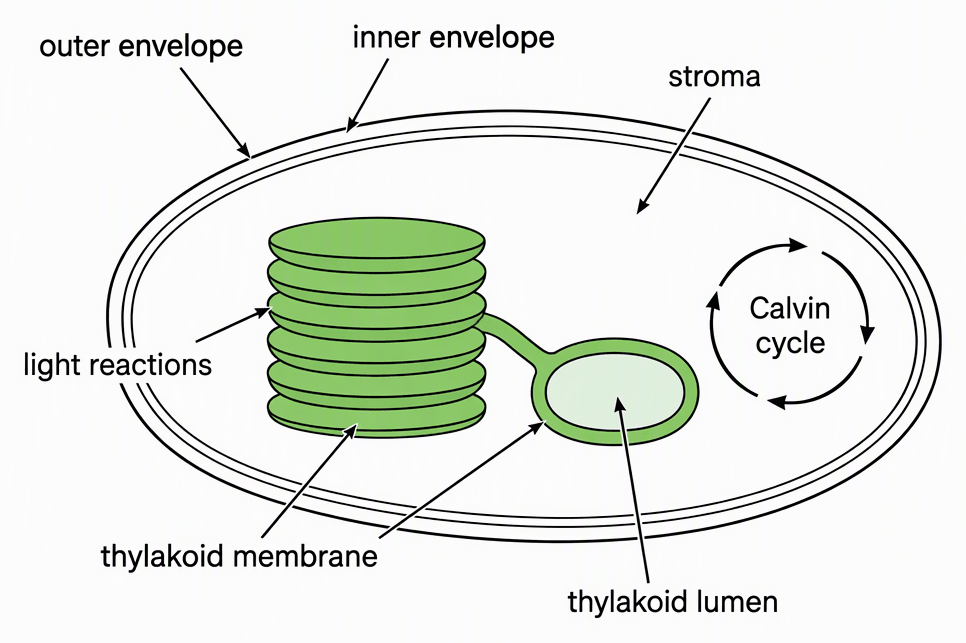
Repair: Redraw and label these compartments from memory. Check your labels against NCERT.
Which enzyme fixes carbon first in C4 plants?
4. C is correct: initial fixation occurs in mesophyll cells through PEP carboxylase, with PEP as the primary carbon dioxide acceptor. Option D names the bundle sheath location and enzyme associated with the Calvin cycle, not initial fixation. C4 plants also use the Calvin cycle; initial fixation does not replace it.
Repair: Trace initial fixation in mesophyll cells and transfer of four-carbon acids. Then trace carbon dioxide release and Calvin-cycle fixation in bundle sheath cells.
How does RuBisCO initiate photorespiration?
5. B is correct: RuBisCO’s oxygenase activity on RuBP initiates the photorespiratory pathway. Option D describes a connection to ordinary mitochondrial respiration, not the initiating event. Photorespiration involves chloroplasts, peroxisomes and mitochondria, but it is not another name for mitochondrial respiration.
Repair: Compare RuBisCO’s carboxylase and oxygenase activities. Identify the gas involved and the pathway that follows each activity.
Why does extra light sometimes fail to increase photosynthesis?
6. D is correct: carbon dioxide remains limiting, so increasing an already sufficient factor cannot remove that constraint. Option A turns a conditional result into a false universal claim. Light can affect photosynthesis when light itself is limiting.
Repair: Revisit NCERT’s limiting-factor explanation. Identify the limiting factor before judging the effect of changing another.
How should my mistakes decide what I practise next?
Conceptual errors need NCERT review followed by an unfamiliar question testing the same distinction. Wording errors need a reading correction. If your reasoning is secure across this set, choose verified PYQs next; reserve full-length mocks for broader exam execution.
- Location confusion: Rebuild the stroma, membrane and lumen labels.
- Pathway confusion: Compare cyclic and non-cyclic flow, or initial C4 fixation and the Calvin cycle.
- Enzyme or substrate confusion: Separate PEP carboxylase from RuBisCO, and water’s role from carbon dioxide’s role.
- Repeated qualifier errors: Mark words such as only, initial and not before selecting an answer.
If you guessed correctly, explain why every alternative is wrong before treating the concept as secure. A correct guess does not show that you understood the distinction.
NEET’s official marking rule is:
You can apply that rule here, but this small diagnostic cannot predict a NEET score or rank. For a repeatable revision routine, use How to Study Plant Physiology NEET: NCERT Recall and MCQs.
How can I check another free question set before using it?
Check the question’s source, explanation quality and free-access scope before using it. “NEET-level” describes a claimed difficulty or style, not proof that a question appeared in NEET.
- For claimed PYQs: Look for an identifiable paper, the exact question and the final official answer key. Match the paper code or question numbering where needed.
- For explanations: Prefer reasoning that resolves a specific NCERT distinction over an answer-letter-only list.
- For free access: Check that questions, the key and explanations are all included.
- For full-paper simulations: The current pattern has 180 compulsory questions and no optional Section B. Check official pattern information at neet.nta.nic.in.
An older chapter question can still teach a valid concept. An older optional-section paper should not be treated unchanged as a current-pattern full mock.
Are these six questions enough to finish the chapter?
No, they diagnose selected confusions, not complete coverage. Use your mistakes to guide revision, then practise other NCERT concepts with unfamiliar questions.
Are original questions better than PYQs?
For checking whether you rely on memorised keys, unfamiliar original questions are the better choice. Verified PYQs are better for studying actual exam wording. Neither replaces the other for every student.
How many photosynthesis questions will NEET ask?
There is no guaranteed chapter quota to plan around. This diagnostic provides no basis for predicting a future chapter count.
Before opening another set, write one sentence explaining your weakest distinction. If you cannot write it accurately, return to NCERT first, then test it with a question whose answer you do not already know.
Next step: full-length mock tests on NEET JEEnius AI and sit a full 180-question, 720-mark, 180-minute paper, 45 Physics, 45 Chemistry and 90 Biology, and get a scored per-subject breakdown (30 free a month).
Frequently asked questions
Where can I practise free photosynthesis questions for NEET?
This article provides six free original NCERT-aligned photosynthesis MCQs with answers and explanations, without registration. Attempt the complete set before checking the key, and mark any guesses. These are diagnostic practice questions, not actual NEET PYQs.
What does cyclic photophosphorylation produce?
Cyclic photophosphorylation produces ATP without NADPH formation or oxygen evolution. Electrons associated with photosystem I return through the electron-transfer pathway. Compare it with non-cyclic flow to avoid confusing their products.
Are six photosynthesis MCQs enough to finish the chapter?
No. These six questions diagnose selected confusions rather than cover the entire chapter. Revise the relevant NCERT passages after mistakes, then attempt unfamiliar questions on other chapter concepts.
Should I practise original photosynthesis MCQs or NEET PYQs?
Use unfamiliar original MCQs to check understanding, especially if you recognise answers from repeated PYQ practice. Use verified PYQs to study actual exam wording and distractors. Authenticate claimed PYQs against an identifiable paper and the final official answer key.