
How should I study Ray Optics for NEET without mixing up signs?
Study Ray Optics for NEET by turning each diagram into a signed equation before calculating. Identify the model, mark directions, audit signs and check the physical answer. Use the six steps below to connect each formula to its diagram and conditions.
This is a transferable solving method, not a replacement for every derivation or every question type in the chapter. Apply it to NCERT examples before moving to unfamiliar diagrams.
- Study in dependency order. Start with reflection and spherical mirrors, then refraction at plane and spherical surfaces, thin lenses, total internal reflection and prisms, and finally optical instruments. Revise similar triangles when magnification needs them and basic trigonometry when angles enter.
- Retrieve the diagram after each NCERT subtopic. Close the book, redraw its essential ray diagram and explain what changes when the object moves. Check the image’s side, orientation and size against NCERT. Attempt related questions immediately rather than waiting until every lecture is finished.
- Classify before choosing a formula. Identify the question family:
- Image formation.
- A sequence of optical elements.
- An interface or TIR decision.
- Prism deviation.
- Instrument magnification.
The presence of a lens does not automatically make a question a single-lens calculation.
- Sketch and assign signs. Mark the principal axis or interface normal and the incident-light direction. For Cartesian image-formation formulas, measure from the relevant mirror pole, surface pole or lens optical centre, with the positive direction along incident light. Do not apply signed object-distance rules to incidence angles, which are measured from the normal.
- Write the governing equation before substituting. Keep each formula beside its diagram and conditions. Spherical-mirror and thin-lens formulas here use the paraxial approximation; the lens examples use thin lenses in air.
For spherical mirrors:
For thin lenses:
For refraction at an interface:
- Audit the result. Check image side, real or virtual nature, erect or inverted orientation, expected size and consistent units. For multiple elements, restart distance measurement at each element. A correct calculation measured from the wrong origin is still a wrong answer.
Use the same compact template throughout: identify the family → draw and sign → calculate → check → name the likely mistake. Record the mistake beside the solution, not just the correct option.
How do I solve a concave-mirror question without guessing signs?
A negative image distance can describe a real image in a mirror problem. With incident light travelling left to right, a concave mirror’s real image forms to its left, so its image distance is negative. This example and both examples below are illustrative practice problems, not NEET previous-year questions.
Identify the family: single-mirror image formation. An object is 30 cm in front of a concave mirror of focal length 20 cm.
Draw and sign: place the pole at the origin and take rightward distances as positive.
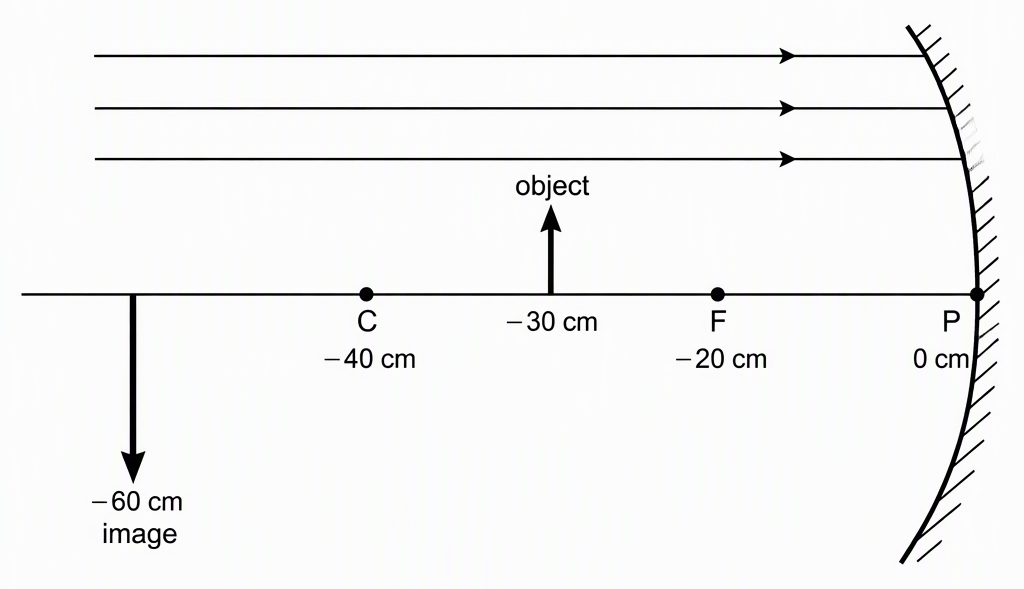
Calculate: rearrange the mirror equation before inserting values.
Check: the image is real, inverted and twice the object’s height. The object lies between F and C, so an enlarged image beyond C on the object side is expected.
Likely mistake: treating every negative image distance as virtual. Interpret the sign using the optical element and the image’s physical location.
How do I find the final image formed by two separated lenses?
Solve one lens at a time and measure the second object distance from the second lens. Do not carry the first image distance directly into the next equation. The intermediate image’s position relative to the next lens determines the new object distance.
Identify the family: sequential image formation with two thin lenses in air. A convex first lens, L1, has focal length 10 cm, with an object 30 cm to its left. A concave second lens, L2, of focal length minus 20 cm, sits 25 cm to its right.
Draw and sign: keep rightward positive and locate the intermediate image before tackling the second lens.
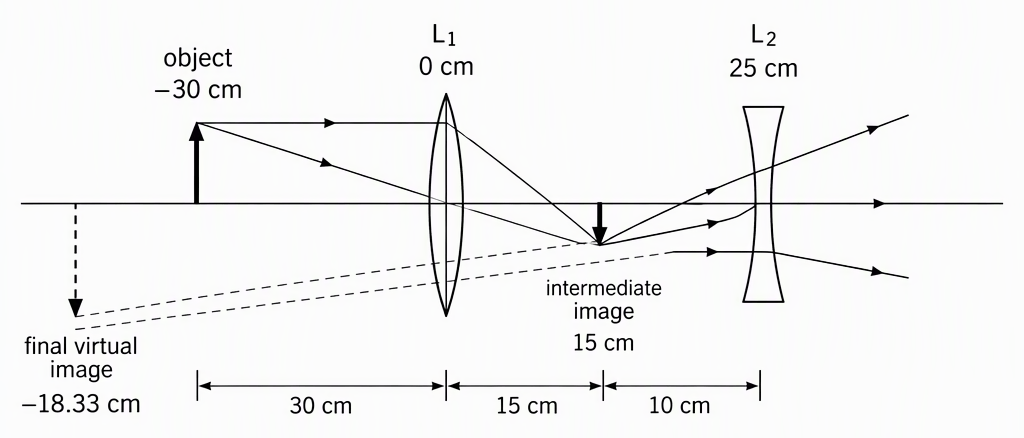
Calculate for L1:
The intermediate image is 10 cm left of L2. It acts as a real object for that lens.
Check: the final image is 6.67 cm left of L2, or 18.33 cm right of L1. It is virtual for the emerging rays.
The final image is inverted relative to the original object and reduced.
Likely mistakes: carrying the first image distance into the second object distance, omitting the reference lens, or using the lenses-in-contact power formula for separated lenses.
For ongoing topic practice, NEET JEEnius AI daily practice problems provide a fresh set each day, with 20 free attempts a month.
How do I decide whether refraction or total internal reflection occurs?
Check the direction of travel and the critical angle before calculating a refracted angle. Total internal reflection is possible only when light travels from an optically denser medium towards an optically rarer one. The incidence angle must also exceed the critical angle.
Identify the family: interface/TIR decision. The ray travels into air, with incidence measured from the normal.
Draw and sign: mark the interface normal and the incident angle from it. No signed object distance belongs in this calculation.
Calculate: the direction permits TIR, so find the critical angle.
Check: total internal reflection occurs. There is no propagating refracted ray, and the reflection angle equals the incidence angle:
At the boundary, the refracted ray grazes the interface:
TIR requires incidence strictly greater than the critical angle, not equal to it.
Likely mistakes: measuring from the surface, applying the critical-angle condition in the reverse direction, or forcing a real refraction angle when Snell’s law gives:
What should I practise next, and how do I know I am ready?
Begin with 12 diagnostic questions, then let the error type choose your next set. Use NCERT diagrams and examples first. This allocation is a suggested practice plan, not a claim about NEET weightage.
- 4 single-mirror or single-lens questions: test signs and image interpretation.
- 4 interface/TIR questions: test normals, direction and boundary conditions.
- 4 sequential-image questions: test changing origins.
Tag every error and respond specifically:
- Diagram: redraw the rays and explain where they meet, or where their backward extensions meet.
- Sign: write the signed object distance, image distance and focal length before substitution.
- Formula condition: state assumptions such as thin lenses, paraxial rays or minimum deviation.
- Algebra: recalculate line by line, keeping units.
- Physical interpretation: explain image side, orientation and size without repeating the numerical answer.
Redo missed questions without looking at the solution before attempting fresh variants. Choose those variants from the family where the error occurred, rather than restarting the whole chapter.
Extend coverage next to:
- Apparent depth and spherical-surface refraction.
- Prism deviation and minimum deviation.
- Lens power and combinations.
- Microscope/telescope diagrams and magnification under the conditions in the current syllabus.
Check the official NTA site, neet.nta.nic.in, for syllabus scope. After NCERT, use chapter-wise NEET previous-year questions with the year and source checked; keep illustrative practice separate from verified PYQs.
Move to mixed questions when you can choose the model, assign signs and explain the answer without solution prompts. Start untimed; record time only after the method is stable.
For fresh variants after correcting your errors, NEET JEEnius AI practice mode offers topic sets that skip questions already seen, with 60 free sets a month.
Next step: practice mode on NEET JEEnius AI and practise a topic in sets that skip questions you have already seen (60 free sets a month).
For a worked example of the same idea, see Plant Kingdom Practice Questions NEET: 6 Explained MCQs.
Frequently asked questions
In what order should I study Ray Optics for NEET?
Start with reflection and spherical mirrors, followed by refraction at plane and spherical surfaces, thin lenses, total internal reflection and prisms, then optical instruments. After each NCERT subtopic, close the book, redraw the essential ray diagram and attempt related questions immediately.
Does a negative image distance always mean a virtual image?
No. With incident light travelling left to right, a concave mirror forms its real image to the left of the pole, giving a negative image distance under the Cartesian convention. Interpret the sign using the optical element and the image's physical location.
How do I solve questions with two separated lenses?
Solve the first lens and locate its image before applying the second lens equation. Measure the new object distance from the second lens, assigning its sign from the intermediate image's position and the incident-light direction. Do not carry the first image distance directly into the second equation or use the lenses-in-contact power formula.
Does total internal reflection occur at the critical angle?
No; total internal reflection requires light to travel from an optically denser medium towards an optically rarer medium, with incidence strictly greater than the critical angle. At the critical angle, the refracted ray grazes the interface, making a refraction angle of 90 degrees. Measure incidence and refraction angles from the normal, not the surface.