
How should I study Reproductive Health from NCERT for NEET?
For Reproductive Health NEET preparation, learn the nearest wrong alternative alongside every NCERT fact. Use three contrasts: method versus mechanism, gamete versus embryo, and rule versus exception. Recognising a term is not enough when every option contains familiar words.
- Map the chapter before making notes. Match your current NCERT edition against the applicable NEET syllabus, using the official NTA site, neet.nta.nic.in, for syllabus verification. Check reproductive-health programmes, population and birth control, contraception, MTP, STIs, infertility and assisted reproduction. This is a coverage checklist, not a predicted question distribution.
- Build a contraception recall table on paper. Use four columns: method, example, mechanism and nearest confusing alternative. Keep these categories separate:
- Natural methods: Periodic abstinence; avoids intercourse during the fertile period; does not chemically inhibit ovulation.
- Barriers: Condom; blocks sperm entry into the female reproductive tract; does not act like a hormonal pill.
- Copper-releasing IUDs: CuT; copper ions suppress sperm motility and fertilising capacity; distinguish this from hormone release.
- Hormone-releasing IUDs: LNG-20; makes the uterus unsuitable for implantation and the cervix hostile to sperms; not copper’s action.
- Hormonal methods: Oral pills; inhibit ovulation and implantation and alter cervical mucus; not physical barriers.
- Surgical methods: Vasectomy interrupts the vasa deferentia; tubectomy interrupts the fallopian tubes; neither removes the gonads.
Keep another contrast beside these entries: contraception prevents conception, whereas MTP terminates an established pregnancy.
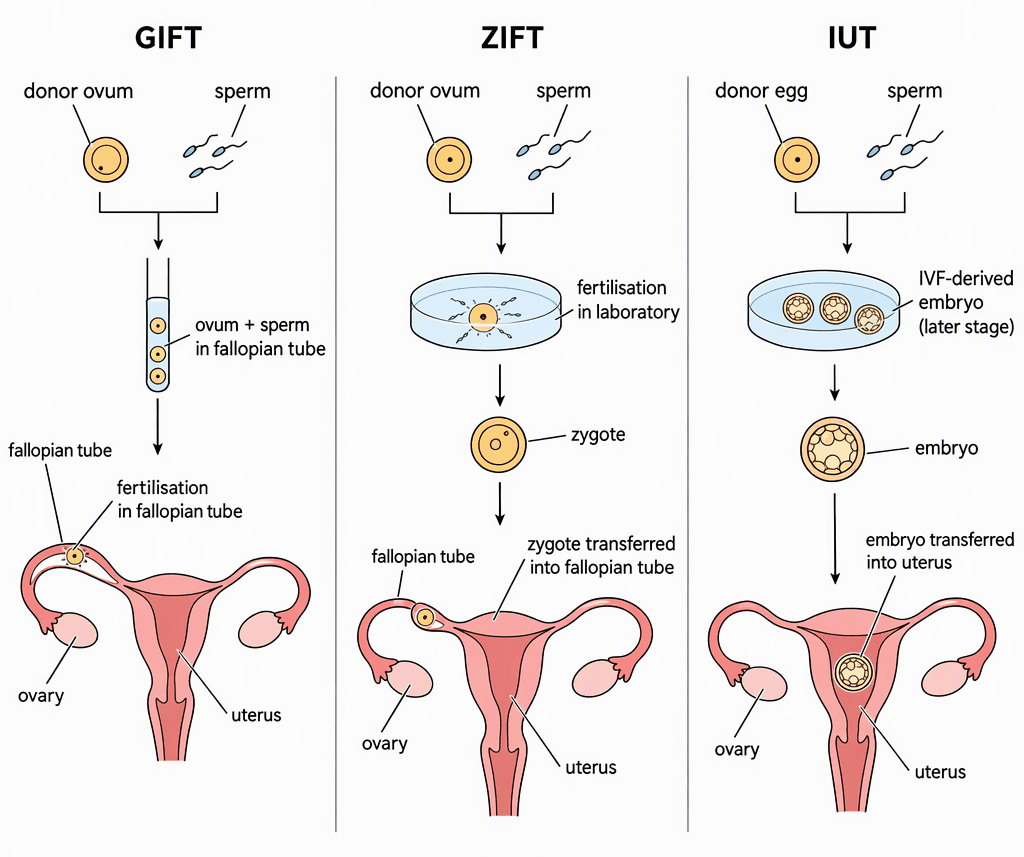
- Build an assisted reproductive technology, or ART, table. Use columns for what is handled, where fertilisation occurs and where transfer occurs. Expand each name:
- IVF, in vitro fertilisation: Gametes fertilise outside the body; the name alone does not specify the later transfer site.
- ZIFT, zygote intrafallopian transfer: An externally formed zygote or early embryo is transferred into a fallopian tube.
- GIFT, gamete intrafallopian transfer: An ovum from a donor is transferred into a fallopian tube; fertilisation occurs inside the body.
- IUT, intrauterine transfer: An embryo is transferred into the uterus; in NCERT’s IVF discussion, fertilisation occurs outside the body.
- ICSI, intracytoplasmic sperm injection: A sperm is injected directly into an ovum in the laboratory; the name does not specify the later transfer site.
- Record qualifiers and exceptions. Link every NCERT exception to its parent statement. In practice stems, mark except, incorrect, only and all before judging options.
- Close the book and reconstruct both tables. Reopen NCERT only to repair missing or incorrect entries. Familiarity with the page is not proof of recall.
- Solve through explicit elimination. Identify the requested relationship, mark any negative instruction, recall the contrast and reject each distractor with one factual reason.
Label errors fact not recalled, concepts confused or qualifier missed. Repair them with targeted retrieval, a paired contrast or a rewritten instruction respectively, rather than rereading everything. The examples below are original single-correct teaching questions, not claimed previous-year NEET questions.
How do I match a contraceptive with its mechanism?
Match the named method to its biological action, not to any reproductive effect that sounds plausible. Classify the method first: a barrier does not act like a hormone, and surgery that interrupts a duct does not stop gamete production.
Which contraceptive–mechanism pair is correctly matched?
- A. Copper-releasing IUD: suppresses sperm motility and fertilising capacity.
- B. Vasectomy: stops sperm formation in the testes.
- C. Condom: inhibits ovulation.
- D. Tubectomy: prevents implantation by changing the endometrium.
Correct answer: A. NCERT states that IUDs increase phagocytosis of sperms within the uterus; copper ions also suppress sperm motility and fertilising capacity.
Give each rejected option its own factual reason:
- B is wrong: Vasectomy interrupts sperm transport through the vasa deferentia, not spermatogenesis in the testes.
- C is wrong: Condoms act as barriers. They do not inhibit ovulation.
- D is wrong: Tubectomy interrupts passage through the fallopian tubes. Changing the endometrium is not its mechanism.
Attach each action to its contraceptive category. Do not transfer the action of a hormonal method to a barrier or surgical method simply because all prevent pregnancy.
Close the book and answer: What changes between copper-releasing and hormone-releasing IUDs?
How do I identify an ART procedure from what is transferred?
Use three clues: the material handled, the fertilisation site and the transfer destination. These distinguish procedures that initials alone can leave confused.
A zygote produced by fertilisation outside the body is transferred into a fallopian tube. Which procedure is described?
- A. GIFT
- B. ZIFT
- C. IUT
- D. ICSI
Extract zygote, fertilisation outside the body and fallopian-tube transfer before examining the options. The correct answer is B: zygote intrafallopian transfer. “Zygote” identifies the material; “intrafallopian” identifies the destination; “transfer” identifies the action.
- Reject GIFT: It transfers a gamete, not an already formed zygote.
- Reject IUT: Its transfer destination is the uterus.
- Reject ICSI: It describes direct sperm injection into an ovum, not the transfer described.
IVF describes fertilisation outside the body; transfer terminology adds information. IVF and ZIFT are not interchangeable labels.
For more retrieval practice, NEET JEEnius AI’s daily practice problems provide a fresh set on a topic every day, with 20 free attempts a month.
Without looking back: Which clue would change if gametes, rather than a zygote, were transferred?
How do I answer an STI exception question without reversing it?
Mark exception before evaluating any disease name. You need the infection outside the textbook’s early-detection-and-proper-treatment rule, not simply a recognised STI.
According to NCERT, which infection is an exception to the statement that STIs are completely curable if detected early and treated properly?
- A. Gonorrhoea
- B. Syphilis
- C. Chlamydiasis
- D. Genital herpes
Correct answer: D. Retrieve NCERT’s exception group together: hepatitis B, genital herpes and HIV infection. Keep that group attached to the complete parent statement, including early detection and proper treatment.
Gonorrhoea, syphilis and chlamydiasis fit the textbook’s curability statement rather than its exception group. Reject them for that reason, not because one disease name seems more serious than another.
“Not completely curable” does not mean “cannot be treated or managed”. This question tests interpretation of an NCERT statement. It is not personal medical advice or a complete guide to clinical treatment.
If you selected a familiar bacterial STI despite knowing the exception group, log qualifier missed. Rewrite the task as “select the exception”, then retrieve the group again. Rereading every disease description would target the wrong error.
What should I practise after these Reproductive Health examples?
Begin with separate topic sets on contraception mechanisms, ART identification and STI statements. Correct errors before moving to mixed Reproductive Health questions.
- Repair each wrong answer: Write the corrected fact and its nearest false alternative.
- Retrieve before continuing: Explain the distinction without looking, then attempt an unseen question testing it.
- Restore full coverage: Include reproductive-health programmes, population-related statements, MTP and amniocentesis in mixed practice.
- Separate types of claims: For MTP and amniocentesis, distinguish biological purpose, ethical concerns and textbook legal statements. NCERT is not a complete account of current law; do not add unverified contemporary legal limits.
Suppose you answered two of these three teaching questions correctly and one incorrectly. Using the standard NEET marking scheme for this illustration:
If all three were correct:
This is an illustration, not a promised improvement. Check readiness by reconstructing the core tables and explaining why the rejected options are wrong, without consulting NCERT. Recognising the correct answer alone does not pass that check.
For an optional next step, NEET JEEnius AI’s practice mode provides topic sets that skip questions already seen, with 60 free sets a month. Choose the topic matching your latest error-log entry.
Next step: daily practice problems on NEET JEEnius AI and get a fresh set on a topic every day (20 free attempts a month).
For a worked example of the same idea, see Plant Physiology Practice Questions NEET: 6 Explained MCQs.
Frequently asked questions
How should I study Reproductive Health from NCERT for NEET?
Match your current NCERT edition against the applicable NEET syllabus before making notes. Build separate contraception and ART tables, and record qualifiers and exceptions beside their parent statements. Reconstruct the tables without looking, then practise MCQs by giving a factual reason for rejecting each distractor.
How do I remember contraceptive methods and their mechanisms?
Make a four-column table covering method, example, mechanism and nearest confusing alternative. Contrast copper-releasing IUDs with hormone-releasing IUDs, and separate barriers from hormonal methods. Remember that vasectomy and tubectomy interrupt ducts; they do not remove the gonads.
What is the difference between GIFT, ZIFT and IUT?
GIFT transfers a donor ovum into a fallopian tube, with fertilisation occurring inside the body. ZIFT transfers an externally formed zygote or early embryo into a fallopian tube. IUT transfers an embryo into the uterus; in NCERT's IVF discussion, fertilisation occurs outside the body.
Which STIs are exceptions to NCERT's complete curability statement?
NCERT lists hepatitis B, genital herpes and HIV infection as exceptions to the statement that STIs are completely curable if detected early and treated properly. Learn this exception group with the full parent statement. Not completely curable does not mean that an infection cannot be treated or managed.