
Which free metallurgy questions should I start with for NEET?
Start with worked, concept-labelled metallurgy practice questions for NEET, not a giant chapter bank, and check syllabus relevance first. A small explained set helps expose confused reasoning. A question carrying a NEET label is not proof that its topic belongs in the syllabus for your attempt.
Choose the format by the problem you need to solve:
- Worked MCQs: Diagnose concept confusion.
- Authenticated older NEET/AIPMT questions: Study historical exam wording, subject to syllabus alignment.
- Full-length mocks: Practise pacing across the whole paper.
Free original questions and worked explanations appear below. They are classic metallurgy concept practice, not official PYQs. This comparison assesses practice formats, not untested website rankings.
How do worked MCQs, older PYQs and free mocks compare?
Pick worked MCQs for a specific confusion, older questions for wording practice, and full mocks for paper completion. Compare explanations, syllabus-check burden and coverage before choosing. For older collections, verify answer quality, provenance and access conditions at the actual source; not every collection is free or reliable.
Main purpose
- Worked MCQs here: Identify the principle you misunderstand.
- Older NEET/AIPMT collections: Examine historical wording and distractors.
- Free full-length mocks: Practise paper completion and subject balance.
Explanation availability
- Worked MCQs here: Original questions with explanations of the answer and a tempting distractor.
- Older collections: Check answer quality and explanation depth at the source.
- Full-length mocks: The verified product output is a scored per-subject breakdown. Detailed solution availability is not established.
Syllabus-check burden
- Worked MCQs here: Check each concept against your attempt’s official syllabus.
- Older collections: Check historical authenticity and present relevance separately.
- Full-length mocks: A mock’s contents are not the authority on official syllabus coverage.
Targeted metallurgy coverage
- Worked MCQs here: Process selection, separation, reduction and refining.
- Older collections: Inspect the actual questions before choosing.
- Full-length mocks: Metallurgy-specific coverage is unverified. A whole-paper mock is not a promised metallurgy bank.
Whole-paper pacing
- Worked MCQs here: Too narrow to test it.
- Older collections: Chapter collections cannot reproduce a complete paper’s demands.
- NEET JEEnius AI full-length mocks: 30 free a month, with 180 questions, 720 marks, 180 minutes and a scored per-subject breakdown.
Which option should Class 11, Class 12 students and droppers choose?
Choose by your current difficulty, not your class alone. Confusing roasting with calcination calls for worked concept questions before a timed paper. Knowing the concepts but leaving a paper unfinished calls for whole-paper practice. School or coaching assignments are a separate reason to practise metallurgy, not evidence of NEET relevance.
- Class 11 student with a school assignment: Use the on-page set for the assigned concepts. Check its NEET relevance separately.
- Class 12 student confusing roasting and calcination: Start with worked concept questions before taking a timed paper.
- Dropper repeating an older module: Check syllabus alignment before repeating extraction and refining questions simply because the module contains them.
- Student who understands concepts but misreads statements: Use authenticated older questions to examine wording, provided the required knowledge aligns with the syllabus.
- Student struggling with completion or subject balance: Choose a full mock instead of another narrow chapter set.
How do I check whether a metallurgy question belongs in my NEET syllabus?
Use the official syllabus for your attempt, accessed through neet.nta.nic.in. An old NCERT chapter or coaching PDF is not enough. The information supplied here does not establish the current official status of individual metallurgy topics, so it cannot support a definitive included-versus-deleted list.
Check the knowledge needed to solve an item, not just its chapter heading:
- Find the official syllabus document for your attempt.
- Identify the question’s topic, such as electrolytic refining.
- List the knowledge it requires, such as electrode roles and electrolyte choice.
- Match both against explicit syllabus wording.
Identifying oxidation and reduction is a broader chemistry skill. Recognising reduction in a metal-oxide reaction does not prove that an entire industrial extraction process is examinable.
All metallurgy-specific questions below are supplementary classic concept practice, not predictions for the next NEET paper. Where alignment remains uncertain, keep the item supplementary rather than letting it displace clearly listed syllabus content.
Can I practise free metallurgy MCQs before seeing the answers?
Attempt these original single-correct questions before scrolling to the explanations. Record your option and your reason for choosing it. The concept tags are learning labels, not verified syllabus labels. The supplementary-practice caveat applies even if you recognise a question type from an older module.
Question 1: Original practice. Concept tag: process selection
A zinc sulphide concentrate is heated strongly in excess air to convert the sulphide mainly into zinc oxide. Which description is correct?
- A. Calcination, because every strong-heating process is calcination.
- B. Roasting, because the sulphide is oxidised using air.
- C. Calcination, because sulphide conversion requires oxygen to be excluded.
- D. Roasting, because the process removes gangue by washing.
Question 2: Original practice. Concept tag: separation principle
An ore sample contains magnetic magnetite particles and non-magnetic quartz gangue. Both are sufficiently liberated from each other after crushing. Which method most directly exploits the stated difference?
- A. Hydraulic washing, using magnetic response.
- B. Froth flotation, using magnetic response.
- C. Magnetic separation, using different responses to a magnetic field.
- D. Leaching, using an assumed equal solubility in water.
Question 3: Original practice. Concept tag: reducing-agent choice
Why is carbon not a suitable universal reducing agent, with aluminium oxide as an example?
- A. Every metal oxide is more stable than carbon oxides under all conditions.
- B. Carbon cannot accept oxygen from any metal oxide.
- C. Heating makes every metal-oxide reduction spontaneous.
- D. Oxide stability and reaction conditions matter; aluminium oxide resists practical reduction by carbon, and carbide formation can complicate the process.
Question 4: Original practice. Concept tag: electrode roles
Which arrangement is suitable for electrolytic refining of copper?
- A. Impure copper anode, pure copper cathode, acidified copper sulphate solution.
- B. Pure copper anode, impure copper cathode, acidified copper sulphate solution.
- C. Impure copper anode, pure copper cathode, sugar solution.
- D. Two inert electrodes and distilled water, with no copper-ion source.
Question 5: Original practice. Concept tag: process conditions
Zinc carbonate is heated to form zinc oxide and carbon dioxide, with air absent or limited. Which statement best explains the process?
- A. It is roasting because carbon dioxide is released.
- B. It is calcination because the carbonate decomposes without requiring oxidation by excess air.
- C. It is concentration because the metal oxide has been reduced to metal.
- D. It is electrolytic refining because the product is purer than the starting material.
Why are these answers correct, and why do the tempting options fail?
The correct choices are 1 B, 2 C, 3 D, 4 A and 5 B. Check whether your reasoning used the stated ore properties and process conditions. A correct option chosen for the wrong reason still needs revision; explain the principle and reject the tempting alternative before moving on.
1. B: Roasting depends on the ore and the role of air.
The sulphide is heated in excess air, and oxygen converts it mainly to oxide. This is roasting. Option A is tempting if you remember only “heating”, but calcination is not a name for every high-temperature treatment.
Calcination commonly decomposes carbonate or hydrated ores with air absent or limited. Strong heating alone does not distinguish the processes.
2. C: Use the property the question supplies.
Magnetite responds to a magnetic field; quartz does not respond comparably. Once crushing frees the particles from each other, magnetic separation can exploit that contrast.
Froth flotation is tempting because it is familiar from concentration questions. Its principle is selective wetting and attachment to bubbles, not magnetic response. No suitable flotation conditions are supplied here; an ore’s name alone is not enough to select a method.
3. D: A reducing agent must work under the chosen conditions.
Carbon can reduce some metal oxides, but aluminium oxide is too stable for ordinary practical carbon reduction to provide clean aluminium extraction. At high temperatures, carbide formation can also complicate the chemistry. Aluminium is therefore obtained industrially by an electrolytic route rather than by simply heating its oxide with coke.
Option C mistakes heat for a guarantee that a reaction can occur. Temperature affects whether reduction is favourable; it does not make every proposed reduction possible or useful.
4. A: The impure metal supplies ions; the cathode receives metal.
Copper from the impure anode dissolves into the electrolyte, while copper ions are deposited on the pure copper cathode. Acidified copper sulphate provides a conducting solution containing copper ions.
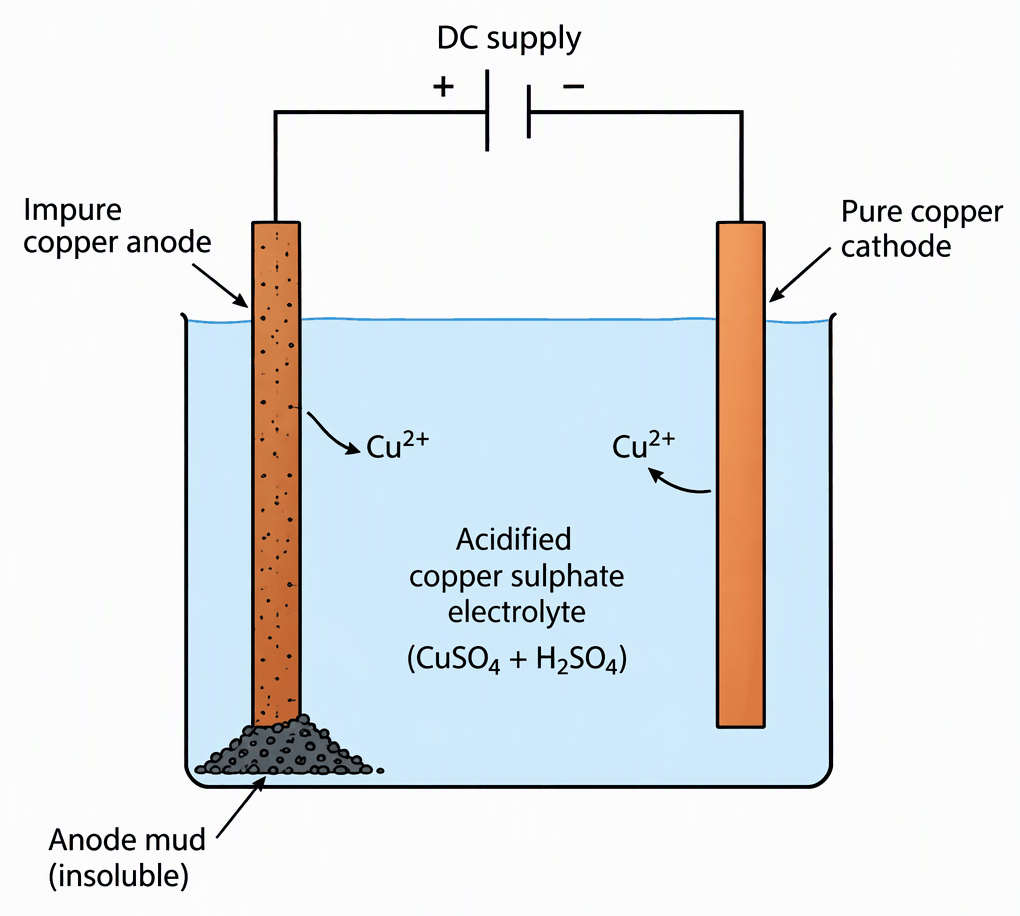
Option B reverses the electrode roles. The impure metal does not become pure by receiving a deposit; refining transfers copper from the impure anode to the cathode.
5. B: Gas release does not automatically mean roasting.
Zinc carbonate decomposes on heating to zinc oxide and carbon dioxide. Oxygen from excess air is not required, making calcination the correct description.
Option A focuses on the gas rather than the chemistry. Compare Question 1: carbonate decomposition and sulphide oxidation are different processes even though both involve heating.
What should I do with mistakes before moving to a mock?
Repair the reason for an error before adding questions. A missing fact, a confused condition and a misread option need different responses. Before retrying, explain why your wrong option fails. If you cannot, recognising the correct letter has not become understanding.
Use this error-log template:
- Question concept: Roasting versus calcination.
- Chosen reasoning: “Strong heating means calcination.”
- Correct principle: Ore type and the role of air distinguish the processes.
- Next action: Explain Questions 1 and 5 side by side without viewing the key.
Match the repair to the error:
- Missing fact: Revisit the textbook passage, close it, then recall the fact.
- Confused process condition: Contrast the starting material, air supply and product.
- Option-reading error: Mark words such as “excess”, “magnetic” and “universal”, then justify each rejected option.
Move to a full mock when the main difficulty is completion or subject balance. The official full paper has 180 compulsory questions in 180 minutes, with no optional Section B. A short metallurgy set cannot test that demand, and its score cannot establish your likely rank or full-paper score.
What should I verify before using old PYQs or free practice?
Check authenticity, syllabus relevance and access separately. A genuine historical question may still be supplementary for your attempt, and a “free” collection may have access limits. For learning, judge whether you can explain the principle and reject distractors, not whether you have completed a large question count.
Is metallurgy included in my NEET syllabus?
Check the official syllabus for your attempt at neet.nta.nic.in against the individual topic and required knowledge. An older textbook’s chapter list does not establish a target-year ruling.
Are old NEET and AIPMT metallurgy questions still useful?
They can help you examine historical wording once their provenance is authenticated. Present syllabus relevance requires a separate check; an exam year printed beside a question proves neither.
How many metallurgy questions are enough?
Judge understanding, not question count. You should be able to explain the principle, reject the plausible distractor and solve a changed version without recalling an answer letter.
Are the questions here free, and what should I practise next?
The original questions and explanations on this page are free to use directly. Free access elsewhere depends on each source’s conditions.
For broader practice, NEET JEEnius AI offers 30 free full-length mocks a month, each with 45 Physics, 45 Chemistry and 90 Biology questions, plus scored per-subject breakdowns. Choose one when your next task is balancing subjects across a complete paper, rather than repairing a metallurgy concept.
Next step: full-length mock tests on NEET JEEnius AI and sit a full 180-question, 720-mark, 180-minute paper, 45 Physics, 45 Chemistry and 90 Biology, and get a scored per-subject breakdown (30 free a month).
Related on NEET JEEnius AI: Cell Membrane NEET 2026: Answer, Bilayer and Glycocalyx.
Frequently asked questions
Is metallurgy included in the NEET syllabus?
Check the official syllabus for your attempt through neet.nta.nic.in, matching each topic and the knowledge needed to solve it against explicit syllabus wording. An old NCERT chapter or coaching module does not establish current inclusion. Keep questions supplementary where alignment remains uncertain.
Are these metallurgy questions official NEET PYQs?
No. These five free MCQs are original classic metallurgy concept questions with worked explanations, not official PYQs. For older NEET or AIPMT questions, verify historical authenticity and present syllabus relevance separately.
How many metallurgy questions should I practise?
There is no fixed question count that proves understanding. You should be able to explain the principle, reject the plausible distractor and solve a changed version without recalling the answer letter. Repair the reasoning behind mistakes before adding more questions.
When should I move from chapter questions to a full NEET mock?
Move to a full mock when your main difficulty is paper completion or subject balance rather than concept confusion. A short metallurgy set cannot test whole-paper pacing or predict your rank. NEET JEEnius AI offers 30 free full-length mocks a month with scored per-subject breakdowns.