
Should I start Nuclei practice with chapter questions or a full mock?
Start with Nuclei practice questions for NEET, not a full mock, if you cannot explain why an answer is correct. Original chapter drills expose conceptual gaps. Verified chapterwise PYQs test those concepts against actual examination questions. Full-length mocks test execution across the paper.
If your concepts are sound, begin with verified PYQs rather than repeating basic drills. Below are six original, free, single-correct Nuclei MCQs with worked explanations. Attempt them before reading the key, and write a reason for each choice.
How do chapter drills, verified PYQs and full mocks compare?
Chapter drills isolate misconceptions, verified PYQs test application to past examination tasks, and mocks test question selection, pacing and subject switching. Pick the format that exposes your current problem.
- Diagnostic purpose: Original chapter drills reveal specific misconceptions. Verified chapterwise NEET PYQs test application to actual past tasks. Full-length mocks reveal whole-paper execution problems.
- Chapter focus: Drills provide targeted repetition of one distinction, such as total binding energy versus binding energy per nucleon. Chapterwise PYQs stay within Nuclei but follow past questions. Full mocks spread attention across subjects.
- Answer provenance: Original drills need checkable reasoning, as provided below; they are not evidence of what appeared in NEET. PYQs require a verified paper and corresponding answer key. A mock score alone does not verify its answer key.
- After memorising a solution: Change a drill’s conditions and explain the result. For PYQs, a remembered option is weak evidence of independent mastery. Repeating a familiar mock weakens its value as a pacing test.
- Main limitation: Drills may become predictable. PYQs can become recognition exercises. Full mocks are inefficient for isolating one Nuclei misconception.
For whole-paper practice, NEET JEEnius AI offers 30 free full-length mocks a month: each has 180 questions, 720 marks and 180 minutes, with 45 Physics, 45 Chemistry and 90 Biology questions, plus a scored per-subject breakdown.
Which practice route should Class 11, Class 12 and dropper students choose?
Choose by the observed problem, not your class or attempt number. A dropper can need basic mass bookkeeping, while a Class 12 student may be ready for unfamiliar PYQs. Use your explanation of an answer, not familiarity with its formula, to decide.
- Class 11, studying ahead: Learn the relevant concepts first, then attempt the diagnostic. Questions check understanding; they cannot replace learning nuclear radius, mass defect and binding energy.
- Class 12, mixing up binding quantities: Choose targeted drills with explanations if you confuse mass defect, total binding energy and binding energy per nucleon. Identify what each quantity measures before calculating.
- Formulas understood, changed wording difficult: Choose unseen, verified chapterwise PYQs. Translate the wording into the physical comparison before looking at the options.
- Dropper, every PYQ answer familiar: Use fresh original questions. Require a written reason before counting a correct response as mastery.
- Chapter work comfortable, mixed papers weak: Move to full-length mocks. Review time spent, questions skipped and whether subject switching disrupted your approach.
Can I try six free Nuclei MCQs before seeing the answers?
These six questions are original practice, not NEET PYQs, and each has exactly one correct option. Attempt them before reading the explanations. Record a short reason beside each answer and mark any guess, even if it turns out to be correct.
1. How does the radius change?
Two nuclei follow the same standard radius model:
The second nucleus has eight times the mass number of the first. Its radius is:
- A. Eight times the first radius
- B. Twice the first radius
- C. Four times the first radius
- D. The same as the first radius
2. Why is nuclear density approximately constant?
Assume spherical nuclei, the standard radius model and approximately equal nucleon masses. Which statement explains why density is approximately independent of mass number?
- A. Nuclear mass increases, but nuclear volume stays constant.
- B. Nuclear volume grows in proportion to nuclear radius.
- C. Nuclear mass and nuclear volume both grow in proportion to mass number.
- D. Every nucleus has the same mass and radius.
3. What does positive mass defect mean?
Compare a bound nucleus in its ground state with its constituent protons and neutrons separated and at rest. Which statement is correct?
- A. The bound nucleus has less rest mass; energy must be supplied to separate it completely.
- B. The bound nucleus has more rest mass because binding adds mass.
- C. Their rest masses are equal because the nucleon count is unchanged.
- D. The bound nucleus has less rest mass, so complete separation releases energy.
4. Which nucleus has greater binding energy per nucleon?
Nucleus Y has twice as many nucleons as nucleus X, but only one-and-a-half times its total binding energy. Which statement follows?
- A. X has greater binding energy per nucleon.
- B. Y has greater binding energy per nucleon.
- C. Both have equal binding energy per nucleon.
- D. Their binding energies per nucleon cannot be compared.
5. When does a nuclear reaction release rest-mass energy?
Count all reactants and products consistently. The reaction has positive energy release when:
- A. Total product rest mass exceeds total reactant rest mass.
- B. Total reactant rest mass exceeds total product rest mass.
- C. Total rest masses are equal.
- D. The reaction is called fusion, regardless of the mass comparison.
6. Which statement correctly separates nuclear and electric forces?
- A. Nuclear force is the electrostatic repulsion between protons.
- B. Nuclear attraction remains strong at ordinary atomic separations.
- C. Nuclear attraction acts over short nuclear distances and is distinct from proton-proton electrostatic repulsion.
- D. Neutrons cannot experience nuclear force because they have no electric charge.
What are the answers, and why do the wrong options fail?
The key is 1-B, 2-C, 3-A, 4-A, 5-B, 6-C. Compare your written reason with each explanation. A correct option reached through faulty reasoning still needs correction.
1. B: Radius increases by a factor of two.
The radius model gives a cube-root relationship with mass number. Taking the ratio cancels the common radius constant:
Option A treats radius as directly proportional to mass number. That would give eight times the radius, contradicting the model.
2. C: Mass and volume scale together.
For a spherical nucleus, cubing the radius makes volume proportional to mass number. Nuclear mass is also approximately proportional to mass number, so their ratio stays approximately constant.
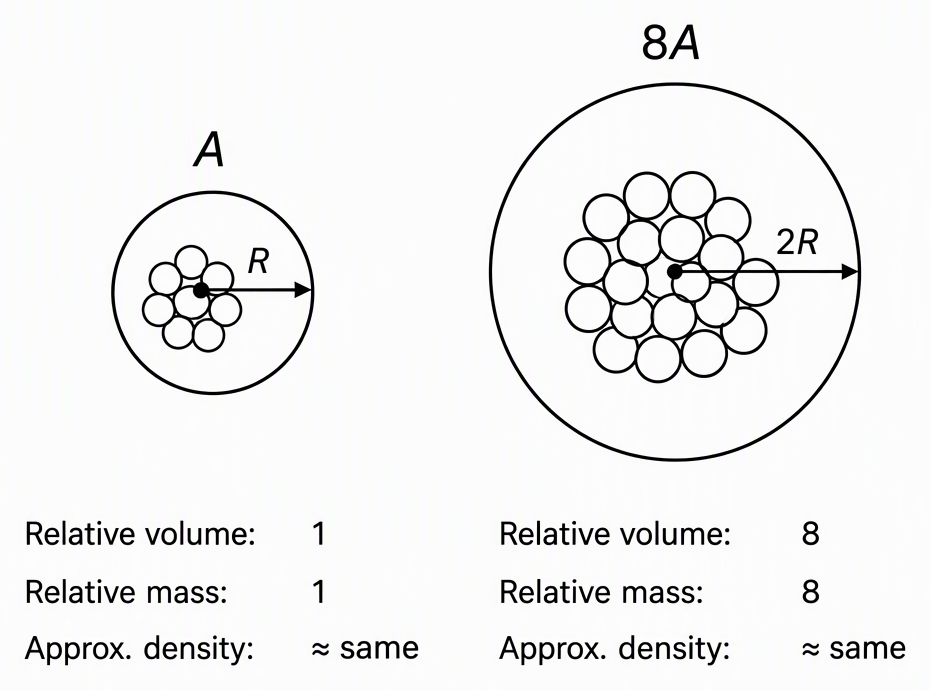
Option B is the trap: volume scales with the cube of radius, not radius itself. Equal approximate density does not mean identical dimensions.
3. A: Binding lowers the system’s rest mass.
Mass defect subtracts the bound nucleus’s mass from the sum of the separated nucleon masses. The corresponding binding energy is the energy needed for complete separation:
The subtracted mass is nuclear mass, not neutral atomic mass. Atomic masses include electrons and require consistent bookkeeping.
Option D gets the mass comparison right but reverses the energy direction. Complete separation requires energy input; forming the bound state releases binding energy.
4. A: Compare binding energy per nucleon, not the total.
Divide total binding energy by nucleon count. Y’s larger total is spread across twice as many nucleons:
Option B confuses a larger total with a larger amount per nucleon. Binding energy per nucleon measures average binding; it is not a complete test of every possible decay channel.
5. B: Lower product rest mass gives positive reaction energy.
Subtract total product rest mass from total reactant rest mass. A positive difference makes energy available to the products:
Option D fails because “fusion” alone does not establish the mass balance. Do not assume every fusion or fission reaction releases energy.
6. C: Nuclear attraction is short-range and is not Coulomb repulsion.
Nucleons experience nuclear interactions, including neutrons despite their zero electric charge. Proton-proton electrostatic repulsion is a separate interaction and extends beyond nuclear distances.
Option A wrongly identifies two different forces as one. Nuclear attraction can bind nucleons over nuclear distances, but it does not remain strong at ordinary atomic separations.
How should I use these mistakes to choose my next free session?
Choose the next exercise from your mistaken idea, not your total score. Log the question, your mistaken idea, the corrected reasoning and whether you solved or guessed. Check guessed correct answers too: they do not establish that you understood the concept.
- Radius or density error: Practise proportional reasoning, including what happens when a length is cubed.
- Mass-defect error: Practise mass bookkeeping. Write the separated constituents first, then subtract the bound nuclear mass.
- Binding-energy or reaction-energy error: Use conceptual comparisons before numerical calculations.
- Nuclear-force error: Separate nuclear interactions from electric charge and Coulomb repulsion.
Once your reasoning is secure, move to unfamiliar, verified PYQs instead of repeatedly answering these six. A “chapterwise PYQ” label is not enough: check the paper identity, exact wording and corresponding answer key using Free NEET PYQs: Verify Papers, Keys and Chapterwise Sets.
If recording marks, apply the official rule below. Do not turn this six-question diagnostic into a predicted NEET score.
The current paper has 180 compulsory questions in 180 minutes, with no optional Section B. The overall average of one minute per question is not a mandatory limit for every Physics question.
What else should I know about free Nuclei practice for NEET?
Check where the questions came from and whether you can defend the answers. For original questions, inspect the worked reasoning. For claimed PYQs, verify the paper and key rather than trusting the label.
Where can I get free Nuclei questions with answers?
The six questions above are free original drills with worked explanations. For verified past-paper practice, use the linked verification guide to check paper sources and keys. Do not treat original questions as evidence of past NEET tasks.
Are NEET PYQs enough for Nuclei?
Use PYQs to practise actual past examination tasks, but do not rely on memorised options. Add fresh original questions when recognition starts replacing independent reasoning.
How many Nuclei questions should I solve before moving on?
There is no defensible universal count. Progress when you can solve independently, explain why competing options fail and correct recurring errors on fresh questions.
Can full mocks replace chapter practice?
No. They diagnose whole-paper execution but cannot by themselves explain every chapter-level weakness. After a mixed paper, identify the mistaken idea in a missed Nuclei question and solve a fresh question targeting it.
If mixed-paper execution is your weakness, the free mock allowance above is an optional next step, not a replacement for targeted chapter work.
Next step: full-length mock tests on NEET JEEnius AI and sit a full 180-question, 720-mark, 180-minute paper, 45 Physics, 45 Chemistry and 90 Biology, and get a scored per-subject breakdown (30 free a month).
Frequently asked questions
Where can I get free Nuclei questions with answers for NEET?
This article provides six free, original, single-correct Nuclei MCQs with worked explanations. They cover radius, density, mass defect, binding energy, reaction energy and nuclear force. These are diagnostic drills, not NEET PYQs.
Are NEET PYQs enough for Nuclei?
Verified PYQs test your application of concepts to actual past examination questions. If you remember the options rather than solve independently, add fresh original questions and write a reason for each answer. Familiarity with an answer is not evidence of mastery.
How many Nuclei questions should I solve before moving on?
There is no universal question count that establishes mastery. Move on when you can solve fresh questions independently, explain why competing options fail and correct recurring errors. Check guessed correct answers as carefully as wrong ones.
Should I practise Nuclei chapter questions or take full mocks?
Start with targeted chapter drills if you cannot explain why an answer is correct. If your concepts are secure, attempt unfamiliar, verified chapterwise PYQs. Use full mocks when your main weakness is whole-paper pacing, question selection or subject switching.