
Should I start with chapter MCQs, PYQs or a full mock?
Start with explained chapter MCQs if your reasoning is shaky, not a full mock. The periodic table practice questions NEET students can attempt here are six original, single-correct NEET-style questions with answers and explanations, not actual PYQs.
If you can already explain trends and exceptions, go directly to authenticated chapter PYQs to check exam-style application. Use mixed mocks to test recall under broader exam pressure.
How do explained MCQs, PYQs and mixed mocks compare?
Explained MCQs target misconceptions, authenticated PYQs show past exam framing, and mixed mocks test recall while switching topics. Choose the format that exposes your mistake. For each criterion below, the options appear in this order: original explained chapter MCQs / authenticated chapter PYQs / mixed or full-length mocks.
- Best use: Repair a specific misconception / Check application in actual past questions / Test recall amid competing topics.
- Chapter focus: Can stay entirely within periodicity / Chapter-filtered past questions / Periodicity coverage varies.
- Explanation requirements: Explain the rule and tempting wrong options / Connect the checked answer key to sound reasoning / Review relevant mistakes separately.
- Ability to expose weak reasoning: Useful when distractors target misconceptions / Useful unless answers are merely recognised / Can expose retrieval problems, but diagnosis needs follow-up.
- Exam-context value: NEET-style practice, not evidence of past appearance / Actual past framing when provenance is checked / Switching, pacing and sustained attention.
- Main limitation: Cannot establish how often a concept appears in NEET / Familiar answers can hide weak understanding / May contain too few Periodic Table questions for diagnosis.
How do I check whether a question is an authentic PYQ?
Check its exam source and answer against the corresponding official key before treating it as an authenticated PYQ. No particular free collection is being certified here.
Is a free answer-key PDF enough?
Not if you cannot explain your mistakes. An answer-key-only PDF may cost nothing while leaving faulty reasoning untouched; useful practice explains why the distractors fail, not just which letter is correct.
Which practice format should Class 11, Class 12 students and droppers choose?
Choose by the reasoning you can demonstrate, not by your class or attempt number. Your readiness check is simple: explain the correct option and reject the distractors without relying on the key.
- Class 11, first encounter with periodicity: Read the relevant NCERT material alongside explained chapter MCQs. Move to PYQs once you can connect an answer to electron arrangement or nuclear attraction.
- Class 12, trends remembered but exceptions confused: Practise the weak subtopic, such as first ionisation enthalpy, rather than restarting elementary classification questions. Then check authenticated PYQs.
- Dropper, old answers instantly recognised: State the governing rule before revealing the options or key. Use unfamiliar original questions to check whether you can apply that rule to a new question.
- Chapter questions correct, mixed Chemistry questions missed: Choose mixed testing. Inspect whether you retrieved the wrong rule, overlooked an ionic charge or rushed after spending too long elsewhere.
Parents should inspect the explanation behind an error before paying for a larger collection. More questions do not automatically correct confusion between “more negative electron gain enthalpy” and “harder to remove an electron”.
A correct answer supported only by “I have seen this before” shows recall, not understanding. Ask for the rule and the reason each alternative fails.
Can I try six free Periodic Table questions before choosing my next set?
Attempt these six questions before reading the answer key. They cover classification, radii, energy trends and oxide character. This is original practice, not PYQs, and is not a validated predictor of NEET performance.
Mark every response reasoned, recalled or guessed. Write one sentence explaining your choice, especially when two options seem close.
1. What are the period, group and block of the element with this ground-state configuration?
- A: Period 3, group 14, p-block
- B: Period 3, group 16, p-block
- C: Period 2, group 16, p-block
- D: Period 3, group 16, s-block
2. Which sequence gives the decreasing atomic radii of these Period 3 elements?
3. Which sequence gives decreasing ionic radius for these isoelectronic species?
4. Which option correctly compares first ionisation enthalpy in both pairs?
5. Which statement correctly compares first electron gain enthalpy?
- A: Fluorine’s is more negative because fluorine is smaller.
- B: Chlorine’s is more negative because the incoming electron experiences less repulsion in its larger 3p region.
- C: Both are equal because both belong to group 17.
- D: Both are positive because halogens resist gaining electrons.
6. Which sequence correctly classifies these oxides, in the order shown?
- A: Basic, basic, basic, acidic
- B: Basic, amphoteric, acidic, acidic
- C: Acidic, basic, amphoteric, basic
- D: Basic, basic, amphoteric, acidic
Keep your initial reasoning even if you change an answer later. Use it to identify the rule you applied incorrectly, not just the option you selected.
What are the answers, and which rule does each question test?
The answer key is 1-B, 2-D, 3-A, 4-C, 5-B, 6-D. Compare your explanation with the reasoning below before counting an item as understood. A correct guess still needs an explanation; a recalled answer needs an independent justification.
1. B: Use the outermost occupied shell and valence arrangement. The highest principal quantum number is three, so the element belongs to period 3. Its six valence electrons place this main-group element in group 16, and the differentiating electron enters a p subshell, making it a p-block element.
Option A counts only the four p electrons and misses the two s electrons. Option C mistakes the neon core for the element’s outermost occupied shell.
2. D: Nuclear attraction increases across the period. From sodium to silicon, nuclear charge increases while added electrons enter the same principal shell. Shielding does not fully cancel the stronger attraction, so effective nuclear charge rises and atomic radius decreases.
Option A reverses the trend. Having more electrons does not automatically make a neutral atom larger when the nucleus also gains protons.
3. A: Hold electron count constant, then compare nuclear charge. All four ions have ten electrons. Oxygen, fluorine, sodium and magnesium have progressively greater nuclear charge, so an electron cloud containing the same number of electrons is pulled inward more strongly along this sequence.
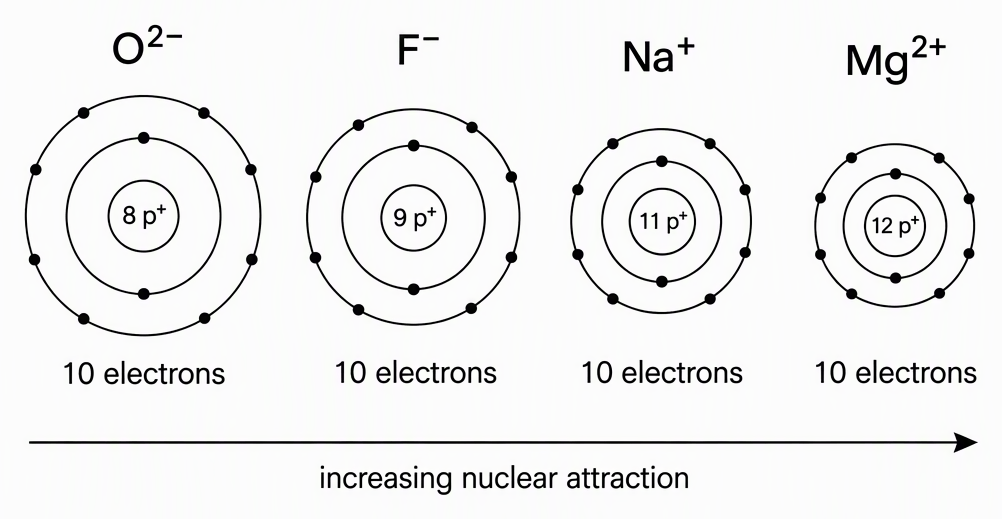
Option B reverses this attraction-based order. Option D overlooks magnesium’s stronger nuclear pull compared with sodium.
4. C: Identify which electron is removed. Beryllium loses a 2s electron, while boron loses its higher-energy, less penetrating 2p electron. That makes boron’s first electron easier to remove despite its greater nuclear charge.
Nitrogen has three singly occupied 2p orbitals; oxygen has one paired orbital. Repulsion within that pair makes removal from oxygen easier, and the resulting ion has three singly occupied 2p orbitals. Option A wrongly applies a smooth across-period increase to both exceptions.
5. B: Smaller size can increase electron–electron repulsion. The incoming electron enters fluorine’s compact 2p region, where crowding produces greater repulsion. Chlorine’s larger 3p region accommodates it with less repulsion, making chlorine’s first electron gain enthalpy more negative.
Option A considers nuclear attraction but ignores crowding. Electron gain enthalpy describes adding an electron, not removing one.
6. D: Aluminium oxide is the amphoteric case. Sodium oxide and magnesium oxide are basic, aluminium oxide is amphoteric, and silicon dioxide is acidic. Amphoteric aluminium oxide reacts with both acids and bases.
Option A assumes every metal oxide must be purely basic. Option B shifts the amphoteric character incorrectly to magnesium oxide.
What should I practise next based on my mistakes?
Use the missed rule to choose your next set, not an arbitrary score band. Test your corrected explanation with fresh wording rather than repeat questions whose answers you remember.
- Configuration error: Revise highest occupied shell, valence configuration and differentiating subshell. Then attempt focused period, group and block classification MCQs.
- Atomic or ionic radius error: Identify neutral atoms versus ions. Check electron count and nuclear charge before applying a trend.
- Ionisation or electron gain enthalpy error: Write the relevant electronic configurations. Identify electron removal versus addition, then use exception-focused practice with precise “more negative” wording.
- Oxide-character error: Revise the basic-to-acidic trend and aluminium oxide’s amphoteric character. Continue with P Block Practice Questions NEET: 5 MCQs and PYQ Guide for fresh related practice.
Keep each error-log entry in this format:
- Subtopic: Isoelectronic ionic radii.
- Mistaken reasoning: More protons must mean a larger ion.
- Corrected rule: At equal electron count, greater nuclear charge contracts the ion.
- Later fresh attempt: Record the chosen answer and whether you justified it without the key.
If reasoning is secure but every question looks familiar, check authenticated PYQs, then move to unfamiliar mixed practice. Recognition alone is not a reason to repeat the same collection.
When should I use a free full-length mock instead of more chapter questions?
Use a full-length mock to test recall and pacing across subjects, not to repair one periodicity misconception. A mixed paper can expose difficulty recalling a rule under pressure. It does not guarantee enough Periodic Table questions to diagnose the chapter.
For this step, NEET JEEnius AI provides 30 free full-length mock tests a month, each with 180 questions, 720 marks and 180 minutes, plus a scored per-subject breakdown. The split is 45 Physics, 45 Chemistry and 90 Biology questions.
The verified feature here is full-length mocks. A per-subject Chemistry score is not a Periodic Table diagnosis: inspect the relevant mistakes separately for missing knowledge, misreading or delayed recall.
Stop collecting elementary questions when you can explain fresh answers and reject their distractors without the key. If that reasoning fails, return to the specific rule rather than opening another full paper.
Repair the reasoning, attempt fresh chapter questions, check authenticated PYQs, then test retrieval in a mixed paper.
Next step: full-length mock tests on NEET JEEnius AI and sit a full 180-question, 720-mark, 180-minute paper, 45 Physics, 45 Chemistry and 90 Biology, and get a scored per-subject breakdown (30 free a month).
Frequently asked questions
Should I start Periodic Table practice with MCQs or PYQs?
Start with explained chapter MCQs if you cannot justify trends and exceptions. Move to authenticated chapter PYQs once you can explain the correct option and reject the distractors without the key.
Are these Periodic Table questions actual NEET PYQs?
No. These are six original, single-correct NEET-style questions with answers and explanations, not actual PYQs. They cover classification, atomic and ionic radii, ionisation enthalpy, electron gain enthalpy and oxide character.
How do I check whether a NEET question is an authentic PYQ?
Check the question's exam source and compare its answer with the corresponding official answer key. Do not treat a collection's PYQ label alone as proof of authenticity.
When should I move from Periodic Table MCQs to full mocks?
Use full-length mocks when your chapter reasoning is secure and you need to test recall and pacing across subjects. If you still misunderstand a periodicity rule, repair it with focused chapter practice first. A full mock may contain too few Periodic Table questions to diagnose the chapter.