
How should I turn NCERT Respiration in Plants into a pathway map?
Study Respiration in Plants for NEET with a closed-book pathway map and a unit-labelled output ledger, not repeated rereading. Use NCERT as your base text: retrieve the connections yourself, then reopen it to correct them. Your first reading should produce a map you can rebuild, not pages of notes.
Work through one pathway at a time:
- Read the pathway and its explanation.
- Close the book and draw the sequence from memory.
- Add its location, inputs and outputs.
- Reopen NCERT only to correct omissions or errors.
Connect glucose to pyruvate, then acetyl-CoA, then the Krebs cycle. Show NADH and FADH₂ feeding electrons into ETS. Fermentation branches from pyruvate, rather than following the Krebs cycle.
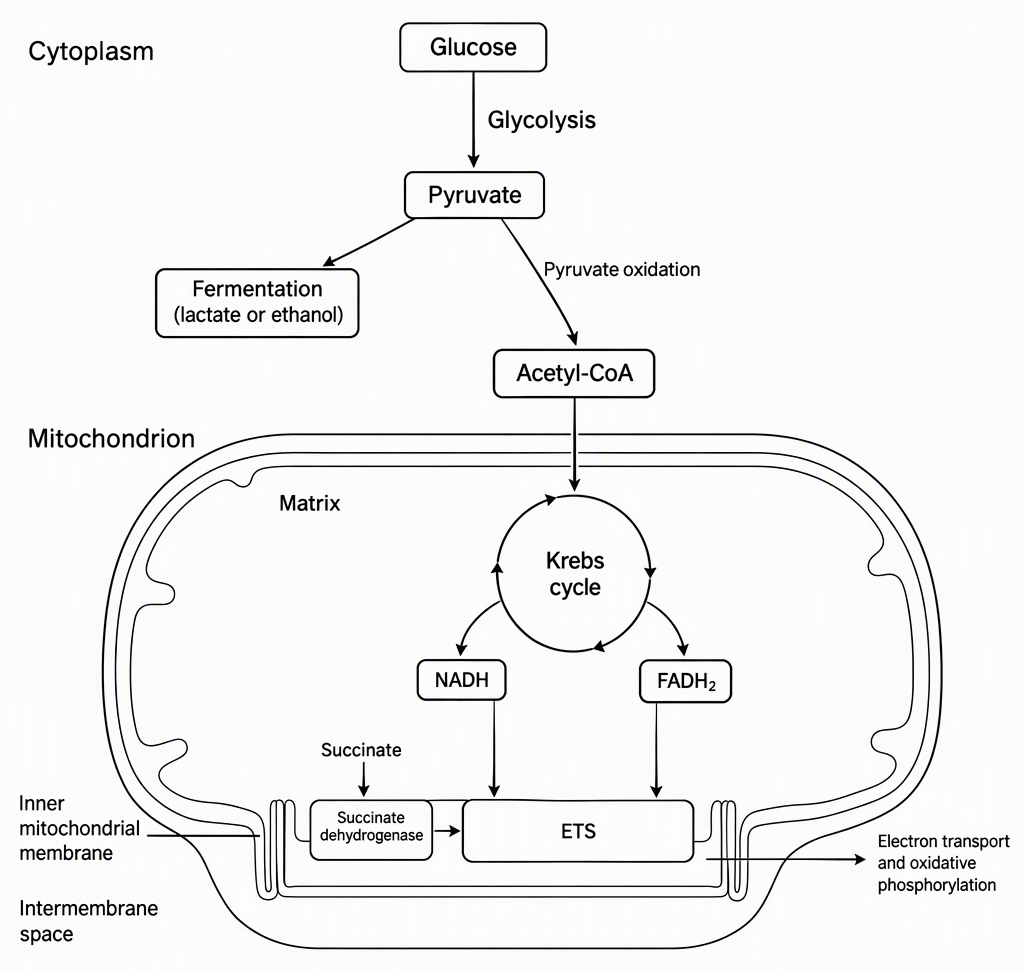
Label glycolysis in the cytoplasm, pyruvate oxidation and the Krebs cycle in the mitochondrial matrix, and ETS on the inner mitochondrial membrane. Mark the exception: succinate dehydrogenase participates in the Krebs cycle but is embedded in the inner mitochondrial membrane.
Below your map, add an NCERT statement strip:
- Plants respire during both day and night.
- Respiratory gases move largely by diffusion.
- Photosynthesis does not replace respiration.
Test your map with Match respiration processes to their sites. Correct any misplaced process before adding more detail.
How do I record pathway outputs without mixing counting units?
Write the counting unit before writing any yield. A correct Krebs-cycle output becomes a wrong answer when you silently switch from one acetyl-CoA to one glucose. Keep direct ATP production separate from reduced coenzymes: NADH carries reducing power, but it is not itself an ATP molecule.
Build a ledger using the same fields for every entry: stage; counting unit; carbon dioxide; NADH; FADH₂; direct ATP or GTP. Direct production means substrate-level phosphorylation.
- Glycolysis, per glucose: no carbon dioxide; two NADH; no FADH₂; four ATP formed but two invested, leaving two ATP net. The carbon products are two pyruvate molecules.
- Pyruvate oxidation, per glucose: two carbon dioxide; two NADH; no FADH₂; no direct ATP. The products entering the Krebs cycle are two acetyl-CoA molecules.
- Krebs cycle, per acetyl-CoA: two carbon dioxide; three NADH; one FADH₂; one ATP or GTP equivalent.
- Krebs cycle, per glucose: four carbon dioxide; six NADH; two FADH₂; two ATP or GTP equivalents, because two acetyl-CoA molecules enter.
Do not treat a theoretical ATP balance as an unconditional yield in a living cell. NCERT’s balance assumes an orderly pathway sequence, transfer of glycolytic reducing equivalents into mitochondria, no diversion of intermediates and no alternative substrates entering. Check those assumptions and any ATP-conversion convention supplied in the question.
Keep fermentation on a separate line. It regenerates oxidised NAD, allowing glycolysis to continue. Alcoholic fermentation produces ethanol and carbon dioxide; lactic acid fermentation produces lactate without releasing carbon dioxide. Neither adds ATP beyond glycolysis.
What should I check before calculating a respiration MCQ?
Identify the question family, counting unit and qualifier before calculating. A site question needs a location; a direct-ATP question needs substrate-level entries, not a complete energy balance.
Use this routine:
- Identify the family: process–site, pathway output, ATP accounting, oxygen or fermentation statements, or respiratory quotient.
- Underline the counting unit and qualifier. Circle words such as per glucose, per pyruvate, per acetyl-CoA, gross, net, directly and incorrect.
- Retrieve the relevant entry. Use the map for location and mechanism, and the ledger for quantities.
- Eliminate options against that entry, then check that your choice answers the wording.
For oxygen statements, distinguish no direct oxygen consumption in glycolysis from oxygen’s role as the terminal electron acceptor in aerobic ETS. Absence of direct oxygen use does not mean glycolysis is absent from aerobic respiration.
For RQ, compare gas quantities under comparable conditions. Use coefficients from the balanced equation when supplied:
Recall why respiration is amphibolic: intermediates can leave for biosynthesis, while fats and proteins can enter at different points. The next three questions are original teaching examples, not claimed PYQs.
Which statement correctly connects oxygen, glycolysis and ATP synthase?
Option C is correct: oxygen is the terminal electron acceptor in ETS. Classify this as a site-and-mechanism question, then test each statement against the pathway map. No ATP-yield calculation is needed.
Question: Which statement about aerobic respiration is correct?
- A. Glycolysis occurs in the mitochondrial matrix.
- B. Molecular oxygen is directly consumed during glycolysis.
- C. Oxygen is the terminal electron acceptor in ETS.
- D. ATP synthase pumps protons from the matrix into the intermembrane space during ATP synthesis.
Reject A because glycolysis occurs in the cytoplasm. Reject B because glycolysis does not directly consume molecular oxygen, even during aerobic respiration.
Accept C because oxygen accepts electrons and, with protons, forms water. Reject D because, during ATP synthesis, protons flow from the intermembrane space into the matrix through ATP synthase. Proton-pumping respiratory complexes establish that gradient.
Error label to record: mechanism, confusing the proton-pumping respiratory complexes with ATP synthase.
How much net ATP comes from substrate-level phosphorylation of one glucose?
The net gain is four ATP equivalents, option B. Count net glycolytic ATP and the direct output of two Krebs-cycle turns. Exclude oxidative phosphorylation because the question asks for substrate-level phosphorylation alone.
Question: During complete aerobic respiration of one glucose molecule, what is the net ATP-equivalent gain from substrate-level phosphorylation alone?
- A. Two.
- B. Four.
- C. Six.
- D. Eight.
On paper, underline one glucose, net and substrate-level phosphorylation before calculating. Glycolysis forms four ATP but invests two:
One glucose supplies two acetyl-CoA molecules. Two Krebs-cycle turns therefore contribute two ATP or GTP equivalents, while pyruvate oxidation contributes none directly:
Answer: B. Option A omits the Krebs-cycle contribution. Option C adds gross glycolytic ATP to Krebs-cycle output without subtracting the investment.
No NADH-to-ATP conversion is needed: oxidative phosphorylation has been excluded. Converting reduced coenzymes would count ATP outside the question’s scope.
How do I calculate RQ from a balanced equation?
Divide the carbon dioxide coefficient by the oxygen coefficient, giving four-thirds here, option C. Classify this as an RQ question and use the supplied equation before applying a remembered substrate label.
Question: Malic acid undergoes complete oxidation as shown. What is its RQ?
- A. Three-fourths.
- B. One.
- C. Four-thirds.
- D. Zero.
The equation gives four units of carbon dioxide evolved for three units of oxygen consumed. Keep carbon dioxide in the numerator:
Answer: C. Option A inverts the ratio. Option B wrongly assumes every respiratory substrate has an RQ of one.
Carbohydrate RQ is one, while fat RQ is generally below one. Use these as checks for the relevant substrates, not substitutes for the supplied equation.
Zero carbon dioxide release with positive oxygen consumption gives zero RQ. Zero oxygen consumption prevents the ordinary finite-ratio calculation because the denominator is zero.
What should I practise after these three examples?
Repair the category you missed before attempting mixed chapter questions. Before each practice session, rebuild the map and ledger without looking. Use omissions to choose your first question category.
Work through this sequence:
- Process–site matches.
- Glycolysis and fermentation.
- Pyruvate oxidation and Krebs-cycle accounting.
- ETS and chemiosmosis.
- RQ and amphibolic statements.
- Mixed chapter MCQs.
Keep an error log with four labels: location, counting unit, mechanism and NCERT statement. Beside each wrong answer, write the corrected rule, not just the correct option.
Reattempt errors after a gap. Explain why every distractor is wrong, rather than recognising the answer letter from memory.
Your completion check is specific: reconstruct the map and ledger unaided, distinguish gross from net ATP, and explain all three worked examples without notes. If one part fails, return to that category before using Plant Physiology Practice Questions: 6 Explained MCQs for broader practice.
For fresh topic practice, NEET JEEnius AI practice mode is an optional next step: practise in sets that skip questions already seen, with 60 free sets a month. Start with the topic containing your latest unresolved error.
Frequently asked questions
How should I study Respiration in Plants for NEET using NCERT?
Read one pathway, close NCERT, and draw its sequence with locations, inputs and outputs. Reopen the book to correct errors, then connect glycolysis, pyruvate oxidation, the Krebs cycle and ETS, with fermentation branching from pyruvate. Build a separate output ledger that states the counting unit before every yield.
How much net ATP comes from substrate-level phosphorylation per glucose?
Complete aerobic respiration of one glucose gives four net ATP equivalents through substrate-level phosphorylation. Glycolysis contributes two net ATP, and two Krebs-cycle turns contribute two ATP or GTP equivalents. Exclude NADH and FADH₂ conversion because that belongs to oxidative phosphorylation.
Does fermentation produce ATP beyond glycolysis?
Fermentation adds no ATP beyond glycolysis; it regenerates oxidised NAD so glycolysis can continue. Alcoholic fermentation produces ethanol and carbon dioxide, while lactic acid fermentation produces lactate without releasing carbon dioxide.
How do I calculate respiratory quotient from a balanced equation?
Divide the carbon dioxide coefficient by the oxygen coefficient in the balanced oxidation equation. For malic acid producing four units of carbon dioxide while consuming three units of oxygen, RQ is 4/3, approximately 1.33. If oxygen consumption is zero, the ordinary finite-ratio calculation is not possible.